The blunt answer
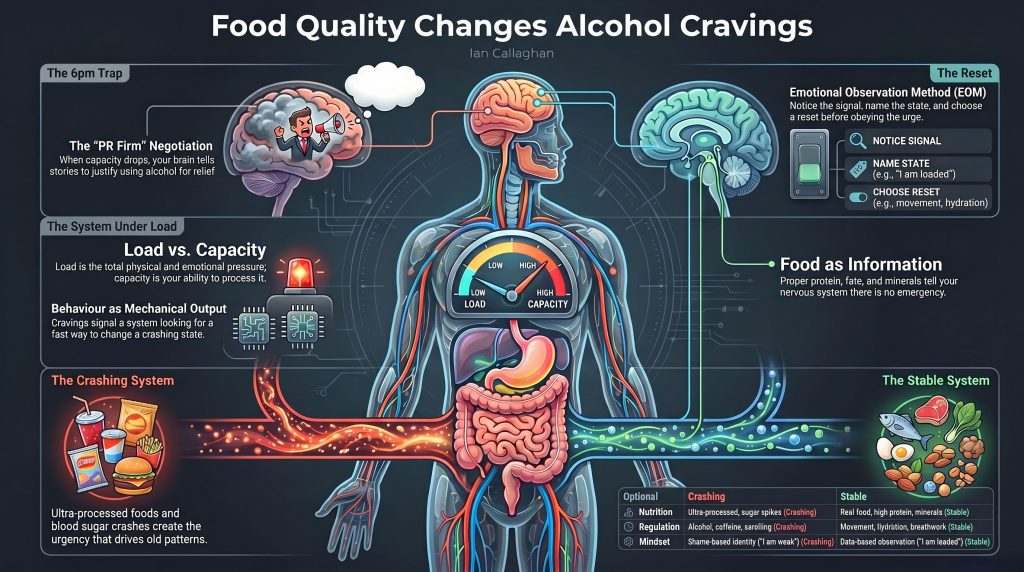
Food quality changes alcohol cravings because cravings do not come from nowhere. They come from state, Load, learned pattern and available capacity. If the body is running on poor sleep, ultra-processed food, blood sugar crashes, stress, pain and emotional suppression, the old alcohol pattern gets louder because the system is looking for a fast way to change state.
That does not mean a steak and a few greens magically cure alcohol use. It means the machine you live inside is affected by what you put into it, how you sleep, how much pressure you are carrying, what you have trained your body to use for relief, and whether you have any better way to regulate yourself when the old pattern starts talking.
This is the Under Load explanation.
You are not weak because you crave alcohol. You are not broken because your hand goes looking for food, scrolling, rage, shutdown or a drink when life gets heavy. You are looking at output from a system carrying more Load than it currently has the capacity to process.
That distinction matters because it changes the whole job. If the craving means you are broken, the only tools left are shame, fear, willpower and self-attack. If the craving means the system is under Load, you can investigate it. You can read the signal. You can change inputs. You can reduce pressure. You can build capacity. You can train a different response without making yourself the enemy.
That is the bit most people never get taught.
They are taught to judge the behaviour, not understand it. They are taught to label the person rather than read the pattern. They are taught to count the days, confess the failure, restart the clock and drag another sack of shame into tomorrow. Meanwhile, the actual machine is still running on poor food, broken sleep, stress, pain, emotional backlog and old operating systems.
Then everybody acts surprised when the craving comes back.
I am not surprised. I have lived in that machine. I drank for 45 years. I also quit cocaine more than 20 years ago, stopped smoking after being the sort of bloke who could easily hammer through 40 a day, lost over 5 stone after alcohol went, reversed prediabetes, and spent 40-plus years around real food rather than powdered wellness nonsense. This is not a theory for me. It is not a tidy model I borrowed from a book and dressed up with a few clever words. It is a working explanation for what happens when the human system is overloaded and reaches for the fastest relief route it knows.
Food quality affects alcohol cravings because it changes the terrain. It does not remove life. It does not remove grief, stress, pain, loneliness, anger, old memories or the PR Firm in your head. But it can change the internal conditions that those things land on. A stable system hears a craving differently from a crashing system. A fed body has more options than a body running on caffeine, biscuits and spite.
That is where the work starts.
Food quality and alcohol cravings are not separate conversations
Food quality affects alcohol cravings because it changes the internal conditions from which the craving grows. That sentence matters because most people are still treating alcohol cravings as if they live in some separate moral cupboard, away from sleep, stress, pain, gut health, blood sugar, mood, environment and old identity.
They do not.
A craving is not a little demon floating about in the air waiting for you to walk past a pub. A craving is a state event. It has a physical component, an emotional component, a learned-pattern component and a story attached to it. By the time your head says, “I fancy a drink,” the machine has usually been building towards that moment for hours.
Sometimes it started before you even got out of bed. Bad sleep. Woke up flat. Back sore. Phone in hand too early. Coffee before water. No proper food. Work stress. Family stress. News, noise, traffic, messages, bills, frustration, irritation, another day of performing fine when you are anything but fine. Then, 6 pm arrives, and everyone looks at the craving as if it appeared from nowhere.
It did not appear from nowhere. It had a full production crew.
This is where people get shafted by bad advice. They are told to use willpower, count days, distract themselves, download another app, drink water, go for a walk, eat a boiled egg, brush their teeth, phone a mate, repeat a mantra, and pretend that if they just cared enough, they would stop wanting the thing.
Some of those tools can help in the moment. I am not sneering at anything that gets someone through a rough evening without picking up. Suppose brushing your teeth stops you from pouring wine down your neck, fine. Brush your teeth like you are polishing the gates of heaven. But if the deeper pattern is never understood, you are just throwing random bits of advice at a machine you have not bothered to open.
I do not look at cravings that way.
I look at the system.
I want to know what happened before the craving. I want to know what you ate, how you slept, whether your blood sugar has been all over the place, whether you spent the day running on caffeine and resentment, whether pain has been chewing at you, whether you were lonely, whether you had a proper meal, whether you moved your body, whether your nervous system has been redlining since lunchtime, and what story your PR Firm started selling when the state dropped.
That is not overcomplicating it. That is looking at the actual bloody machine.
Most people do the opposite. They stare at the drink. They stare at the chocolate. They stare at the crisps, the takeaway, the biscuits, the late-night toast, the empty wrapper, the bottle, the shopping basket, and they make the visible output the whole story. Then they build an identity around it.
Weak. Greedy. Hopeless. Addict. No discipline. Failure.
And now the original Load has a fresh layer of shame poured over it. Brilliant. Now the system needs relief from the shame as well.
That is how people get trapped. Not because they are stupid. Because they have been taught to moralise a mechanical signal.
This is especially true when alcohol has been removed. People think the job is finished because the bottle is gone. It is not finished. It is only clearer. When alcohol is removed, the system can no longer use its favourite chemical shortcut, so every other pressure in the machine becomes more obvious. Food gets louder. Sugar gets louder. Boredom gets louder. Pain gets louder. Old resentment gets louder. Sleep problems get louder. The phone becomes more seductive. The sofa becomes magnetic. The kitchen starts calling like a dodgy old mate outside the pub.
That does not mean quitting alcohol was a mistake. It means alcohol was masking how much Load the system was carrying.
Once the mask is off, you can either panic and call yourself broken or learn to operate the machine properly.
That is the choice.
Why does good quality food change alcohol cravings?
Food quality changes alcohol cravings because the body does not make decisions from an abstract place. It makes decisions from state. It makes decisions based on chemistry, energy, pain, sleep, stress, threat, habit, memory, and environment. Your “choice” at 6 pm is not floating in a vacuum. It is being shaped by the whole day.
If the day has been built on unstable food, no proper protein, low mineral intake, dehydration, caffeine, stress, and no movement, the evening choice is made within a loaded system. You may still have agency, but it has to cut through more noise. That is what people miss when they reduce everything to willpower.
Willpower is real, but it is not magic. It is affected by fatigue. It is affected by hunger. It is affected by stress. It is affected by pain. It is affected by the story running in your head. It is affected by whether the body believes relief is available through better routes or only through the old route.
Food quality matters because it helps decide whether your body reaches 6 pm steady, or arrives like a knackered old van with smoke under the bonnet and the fuel light screaming.
Good food is not a moral badge. It is information. It tells the system that fuel, building blocks, salt and minerals, fat, and protein are coming in, and that chewing, digestion, and satiety are happening properly. It tells the body there is no emergency. It gives the nervous system one less reason to shout.
Ultra-processed food often tells a very different story. It can tell the system to keep eating without ever feeling properly fed. It can deliver fast energy without deep nourishment. It can create a hit and a dip, then another hit and another dip. It can keep the mouth busy while the body remains under-supported. It can produce a fake version of comfort that does not actually build capacity.
Then the person says, “Why am I craving a drink?”
Because the system wants a shift. Because the system has learned that alcohol changes state. Because the system is tired of carrying the load. Because the body has been given stimulation rather than support. Because the PR Firm has been waiting all day for the state to drop low enough to make its pitch.
That is why I care about food quality in this conversation. Not because I want people obsessing over purity, macros, apps, calorie spreadsheets or whether a tomato has the right spiritual vibration. I care because food is one of the simplest ways to change the baseline from which his craving operates
A solid meal before the danger window can change the entire evening. Not always. Not perfectly. But often enough to make it one of the first levers worth pulling.
And the best bit is that it is not complicated.
Real food. Enough protein. Enough fat. Enough minerals. Enough fluid. Enough chewing. Enough actual nourishment that your body believes you are not trying to run a recovery programme on crumbs and black coffee.
That is not glamorous. That is why it works.
What people get wrong about food quality and alcohol cravings
The first thing people get wrong is thinking food quality is about being good. It is not. I could not care less about clean-eating halo-polishing, beige wellness morality, or some influencer arranging blueberries as if they have discovered human biology.
Food quality matters because it affects the state of the body you are asking to make better decisions in.
There is a massive difference between eating food that supports a stable system and eating food-like material engineered to be cheap, repeatable, hyper-palatable and easy to overconsume. Modern ultra-processed food is not just “a bit naughty.” It is designed to hit reward pathways, keep you grazing, blur hunger signals and make normal food feel boring. Soft, sweet, salty, oily, fast, low-effort, low-chew, low-satiety, high-repeat. That is not accidental. That is the business model.
A packet of biscuits is not designed for quiet moderation. A share bag is not designed for sharing. Breakfast cereal with cartoon colours and a health claim slapped on the box is not there to build a steady human being. It is there to be cheap to make, easy to sell, easy to repeat and easy to justify. The language around it is always softer than the effect. Treat. Snack. Little pick-me-up. Balance. Energy. On the go. Convenience.
Convenient for whom?
Because it is not very convenient when you are flat, hungry, wired, guilty and negotiating with a bottle at 6 p.m.
Then people wonder why they feel flat, wired, hungry, foggy, irritable and restless by early evening.
The body is not confused. It is responding.
If someone has spent the day on toast, cereal, biscuits, meal deals, crisps, energy drinks, caffeine, no proper protein, no decent fat, no minerals, no sunlight, no movement and four hours of broken sleep, then the evening craving is not some mysterious sign that they are doomed. It is a predictable state collapse.
The machine wants a shift. Alcohol used to provide one. Sugar provides one. Scrolling provides one. Rage provides one. Shutdown provides one.
The problem is not that those routes do nothing. The problem is that they work quickly and charge interest. Alcohol gives relief today and collects payment tomorrow. Ultra-processed food gives comfort now and often leaves the system heavier, hungrier, flatter and more dysregulated later. Scrolling looks like rest, while it keeps the nervous system twitching like a fruit machine. Rage discharges pressure but usually leaves wreckage. Shutdown avoids the signal but teaches the system that avoidance is the route.
This is why food quality and alcohol cravings belong in the same conversation. You cannot run the body on chaos and expect calm choices to emerge from it just because you listened to a podcast once.
The second thing people get wrong is thinking cravings are purely mental. They are not. The mind gets involved, obviously, but by the time the mind starts doing its little courtroom speech, the body has usually already shifted. There is tension. There is urgency. There is agitation. There is a narrowing. There is that strange pull towards something that promises to change how you feel quickly.
This is the internal department that makes the old pattern sound reasonable. It does not come in screaming like a villain. It comes in wearing a decent suit and holding a folder full of convincing bullshit.
“You have had a hard day.”
“You deserve one.”
“You are not that bad.”
“It is Friday.”
“You can start again tomorrow.”
“You have eaten badly anyway, so what is the point?”
“Just take the edge off.”
“Everyone else gets to relax.”
The PR Firm does not need to be right. It only needs to be persuasive while your state is low.
That is why the state matters more than the story.
The third thing people get wrong is thinking that once they stop drinking, they should instantly become calm, healthy, motivated and magically fond of herbal tea. That is not how the system works. If alcohol has been used for years as a regulatory tool, removing it leaves a gap in the regulatory strategy. The body still needs to be downshifted. It still needs comfort. It still needs energy. It still needs a connection. It still needs a way to process stress.
If you do not give it a better route, it will search for the nearest familiar substitute.
Often, that substitute is sugar. Sometimes it is bread. Sometimes it is takeaway food. Sometimes it is scrolling until midnight. Sometimes it is getting angry over nothing because rage gives the body movement and heat. Sometimes it shuts down because collapse feels safer than feeling everything.
None of that means you are failing. It means the old operating system is still trying to protect you using blunt tools.
The work is not to hate the tools. The work is to retire them properly.
The Under Load explanation
Under Load means the system is carrying more physical, emotional, environmental, or identity-related pressure than it can currently process. When the load exceeds the capacity, old outputs become more likely.
That is the clean version. The lived version is messier.
Load can be physical. Poor sleep, unstable food, pain, inflammation, dehydration, illness, caffeine overload, blood sugar crashes, hormonal shifts, digestive stress, no daylight and no movement all count. The body does not care whether you think they are important. It adds them to the total.
Load can be emotional. Grief, resentment, shame, fear, anger, boredom, guilt, loneliness, dread, pressure, bitterness and pretending to be fine all count. You can dress it up, shove it down, act hard, crack jokes, keep busy and tell everyone you are all right. The machine still carries it.
Load can be environmental. Noise, screens, money pressure, work stress, family chaos, relationship tension, too many decisions, no quiet, no space, constant notifications and a life that never gives the system a clean downshift all count.
Load can be identity-based. This one gets ignored, but it is massive. If you still see yourself as the drinker, the grazer, the failure, the one who always caves, the one who cannot trust themselves, the one who is “just like this,” then the old operating system is still installed. You are trying to build new behaviour while dragging an old identity behind you like a corpse on a rope.
Capacity is what you have available to carry that Load without the old output taking over.
This is why the usual morality script is so useless. It looks at the output and calls it a weakness. Under Load looks at the whole system and asks what the output was trying to regulate.
That does not remove responsibility. It puts responsibility somewhere useful.
There is a huge difference between saying, “I drank because I am useless,” and saying, “The craving hit after three nights of poor sleep, poor food, stress, pain and a day spent pretending I was fine, then the PR Firm sold me the old relief route.”
The first version creates shame and usually another craving. The second version creates data.
Data can be used. Shame adds more weight to the bar.
This is where the Under Load model matters for people who are sick of being spoken to like naughty children. It stops reducing behaviour to character. It also stops making excuses. Both extremes are useless. The shame crowd says everything is your fault. The excuse crowd says nothing is your responsibility. Neither one builds a better operator.
The truth is more useful than both.
The craving may not be your fault in the childish blame sense, but it is now your responsibility to learn what it is doing. Not because you are bad. Because you are the one living with the consequences.
If your system is under Load, you have four practical jobs.
Notice the Load.
Reduce what can be reduced.
Build capacity where capacity is low.
Train better outputs before the old ones run automatically.
That is not romantic. It is not a pretty little healing quote. It is maintenance. It is mechanics. It is the daily work of becoming less vulnerable to the old relief routes.
And yes, food quality sits right at the start because it is one of the few things you can often change today. You might not fix grief today. You might not fix money stress today. You might not fix chronic pain today. You might not fix a relationship today. But you can usually stop arriving at the danger window underfed, overstimulated and running on nutritional fumes.
That is not everything.
It is a damn good first lever.
State before story
Your brain tells stories from the state it is in.
That is one of the most important things to understand if food quality and alcohol cravings keep showing up together. A tired brain tells tired stories. A hungry brain tells hungry stories. A blood-sugar-crashed brain tells desperate stories. A stressed nervous system tells threat stories. A lonely body tells abandonment stories. A dysregulated system tells relief stories.
Then you mistake the story for truth because it arrived in your own voice.
At 10 am, after decent sleep, proper food and a calm start, you might genuinely think, “I am done with drinking. I want my health back. I know what this costs me. I am not going back there.”
At 6 pmm, after no proper lunch, three coffees, a stressful day, a flare-up of pain, a passive-aggressive message, too much noise, no movement, and a blood sugar crash, the story changes. Now the same brain says, “What is the point? I deserve something. I need to switch off. One drink will not matter. I can restart tomorrow.”
Same person. Different state. Different story.
This is why arguing with the thought can be a waste of time if you never change the state beneath it. You are trying to win a debate with a nervous system that is asking for regulation. It does not want your motivational quote. It wants the feeling to change.
Food quality matters here because it helps set the baseline you operate from. A proper meal does not make you spiritually superior. It gives the body information. You are fed. You have fuel. You have protein. You have minerals. You are not in emergency mode.
That information changes the internal weather.
A body that has eaten proper food is not immune to cravings, but it is better resourced than a body running on cereal, biscuits, toast, seed-oil-fried rubbish, meal deals, and “I will eat later.” A fed system has more options than a crashing system.
That is the point. Not purity. Not perfection. Options.
This is also why people can be so confused by their own behaviour. They think, “But I meant it this morning. I really meant it.” Yes, you did. Morning, you meant it from a different state. Evening-you is negotiating from a body that may be tired, hungry, irritated, overloaded and desperate for relief.
Both versions are you.
The question is, which version are you setting up to win?
If you keep leaving evening-you unsupported, do not be shocked when evening-you keeps handing the microphone to the PR Firm. The PR Firm does not need a fair fight. It needs fatigue, hunger, stress and a familiar route. Give it those, and it will make drinking, grazing, scrolling, or shutting down sound like common sense.
This is why I do not like vague motivational advice. “Just remember why you started” sounds great when you are calm. At 6 pm, when the body is under Load, memory is not always enough. You need structure. You need food. You need a reset. You need fewer triggers. You need the environment set before the argument starts.
You need to stop acting as if the version of you who is rested and focused is the same version who has to make the decision later.
Plan for the loaded version.
That is not pessimism. That is respect for the machine.
Behaviour is output, not identity.
Behaviour is output, not identity, and this one shift can save people years of self-hatred.
If you crave alcohol, that does not mean you are weak. If you hammer sugar after quitting drinking, that does not mean you have failed sobriety. If you use food to regulate an evening, that does not mean you are greedy. It means the system has found an output that changes state, and if you want to change it properly, you need to understand what it is doing for you.
That is not soft. It is more demanding than shame, because shame lets you stay vague. “I am useless” sounds dramatic, but it teaches you nothing. It does not tell you what happened before the craving. It does not tell you why the evening is dangerous. It does not tell you what the body needed. It does not tell you which story the PR Firm sold. It does not tell you what Load needs removing.
Mechanism gives you work.
What was the state?
What was the Load?
What did the behaviour regulate?
What did it cost?
What better reset could meet the same need without stealing from tomorrow?
That is how you stop turning every slip, craving or wobble into a full identity trial. You are not building a religion around failure. You are learning to read output.
A smoke alarm is not an identity. It is a signal.
A craving is the same. Loud, uncomfortable, sometimes badly timed, but still a signal.
This does not mean you shrug and say, “Well, it was just output,” while carrying on with the same old pattern. That is not the point. The point is that once you understand behaviour as output, you can trace it back to inputs. You can look at the chain instead of staring at the final link.
The output is the visible bit. The input chain is where the leverage lives.
Poor sleep was an input. Poor food was an input. Stress was an input. Pain was an input. Resentment was an input. Loneliness was an input. The old belief that you cannot cope without something was an input. Having alcohol in the house was an issue. The phone keeping you wired was an input. The lack of a real evening routine was an issue.
None of those inputs excuses the behaviour. They explain the route.
And when you understand the route, you can block it, redirect it or build a better one.
That is far more useful than sitting there calling yourself names after the event.
Most people are already brilliant at post-match analysis. They can tell you everything they did wrong after they have done it. What they cannot do yet is see the pattern before it completes. That is the skill. That is where EOM comes in later. But before you can interrupt the pattern, you have to stop turning the pattern into your identity.
You are not the craving.
You are the operator learning what the craving is trying to do.
What the machine is trying to do
The machine is trying to regulate.
That is the blunt answer underneath most alcohol cravings, food cravings, scrolling binges, rage spirals and shutdowns. The system wants to move from one state to another, and it will reach for whatever has worked before, especially when Load is high and capacity is low.
When someone says, “I just want a drink,” there is often a more honest sentence underneath it.
I want quiet.
I want relief.
I want warmth.
I want this day to end.
I want to stop thinking.
I want to stop being responsible for a bit.
I want confidence.
I want a pause.
I want the feeling gone.
Alcohol used to answer those sentences quickly. It did not solve the underlying state, but it moved it. That is why the body remembers. Highly palatable food can do a similar job. Sugar, refined starch, salt, industrial fats, soft textures and strong flavour systems can all create fast feedback. The system learns: that changed the feeling.
Again, not wisely. Quickly.
When you quit alcohol, the body may go looking for another lever. This is why so many people find sugar gets louder. Bread, biscuits, chocolate, crisps, ice cream, takeaways, grazing, random cupboard raids. Then they panic and think they are failing.
Maybe they are not failing.
Maybe the machine lost one regulator and is trying to find another.
That does not mean you ignore it. It means you stop turning it into shame and start giving the system better ways to regulate.
Proper food. Better sleep. Daylight. Movement. Breath. Honest language. Emotional observation. Less self-abuse. Less pretending. A real evening ritual that is not just “try not to drink while white-knuckling a nervous system that is already on fire.”
This is where people can misunderstand me, so let me be clear. I am not saying every craving is solved by food. I am not saying someone with serious alcohol dependence should swap medical advice for steak and sauerkraut. I am not saying withdrawal is a mindset issue. Alcohol withdrawal can be dangerous, and people need proper medical support where that applies.
What I am saying is that for a lot of people living in the post-acute, habitual, emotional, evening-negotiation zone, food quality is one of the biggest ignored levers in the system.
If the body is unstable, the old regulator looks more attractive.
If the body is supported, the old regulator loses some of its power.
That is not a cure-all. It is an honest mechanism.
And honest mechanisms beat magical thinking every time.
Blood sugar, ultra-processed food and the 6 pm trap
Blood sugar is not just a conversation about diabetes. It is a behaviour conversation.
If your food pattern keeps you spiking, crashing and grazing all day, you are creating the perfect conditions for urgency. Urgency is where old behaviours thrive. Alcohol cravings love urgency. Sugar cravings love urgency. The PR Firm loves urgency because it does not need you to be wise, grounded and well-fed. It needs you to be tilted enough to believe the old solution.
This is why “eat properly” sounds boring but matters. A decent meal before your danger window can be more useful than another hour of recovery content. Protein, fat, minerals, real food, fibre if you tolerate it, fermented foods if they suit you, enough salt where appropriate, enough water, and enough actual nourishment to tell the body it is not in a famine, wearing a Fitbit.
I am not telling everyone to eat the same way. I use OMAD because it suits me, but that does not mean someone who is early alcohol-free, sleeping badly and crashing at night should copy it unthinkingly. The principle is not “eat like Ian.” The principle is “feed the machine properly for the job you expect it to do.”
If 6 pm is when the old pattern wakes up, do not arrive there underfed, overstimulated, and pretending that motivation will save you.
That is bad logistics.
Eat before the danger window. Get your environment sorted before the PR Firm starts its speech. Know what the old story will be. Have a reset ready that actually changes state. Not some perfect-life fantasy. A real one you will do when tired.
Walk. Shower. Proper food. Breathwork. Ten minutes outside. Cook something. Clean the kitchen. Put the phone down. Message someone honest. Get out of the room where the pattern usually runs.
You are not trying to win an argument with alcohol. You are changing the conditions that make the argument convincing.
The 6 pm trap is not really about 6 pm. It is about the accumulated Load. For some people, the danger window is after work. For others, it is after the kids are in bed. For others, it is late evening when the house goes quiet. For others, it is Sunday afternoon, payday, Friday night, cooking dinner, walking past the shop, watching sport, sitting alone, or getting home after pretending all day.
The time matters less than the pattern.
There is usually a cue. There is usually a state. There is usually a story. There is usually a familiar route.
Food quality gives you a practical way to weaken the pattern before it starts. If your danger window is 6 pm, the work begins before 6 pm. Waiting until the craving is already fully alive is like waiting until the kitchen is on fire before checking whether you own a fire extinguisher.
Prepare earlier.
Eat earlier if that supports you. Hydrate earlier. Move earlier. Get outside earlier. Reduce caffeine earlier. Decide on the evening routine earlier. Know the PR Firm’s script earlier.
This is not about being scared of cravings. It is about not walking into an ambush you helped set up.
Gut, mood and the food signal
Food quality also changes alcohol cravings through the gut and mood connection. I am not going to dress this up like some smug gut-health influencer holding a £9 jar of cabbage like monks have blessed it. But the gut matters. Anyone who has eaten badly for a few days and felt their mood, sleep, energy and cravings shift already knows it, even if they do not have the scientific language for it.
Your gut is not just a waste pipe. It is part of the signalling system. Digestion, inflammation, microbial balance, nutrient availability, blood sugar regulation, and gut-brain communication all affect how you feel and behave. If your gut is irritated, your energy is unstable, and your mood is flat, cravings often have a fertile ground in which to grow.
This is one of the reasons I care about real food, fermented food, bone broth, proper fats, quality protein and food that your body recognises. Not because I want everyone cosplaying as a rustic peasant on Instagram. Because the human system has spent a very long time working with real food, and about five minutes being battered by fluorescent snack dust, seed oil, emulsifiers, fake flavour systems and factory convenience.
If your gut is inflamed or irritated, your state may be noisier. If your digestion is poor, you can suffer from poor sleep. If sleep suffers, cravings get louder. If cravings get louder, the PR Firm gets more material. If the PR Firm gets more material, the old route starts to look reasonable.
That is the loop.
Food quality is not just about weight loss. In fact, making it solely about weight is one reason people miss the deeper benefit. The better question is not “Will this food make me thin?” The better question is, “What state does this food help create?”
Does it steady me?
Does it nourish me?
Does it keep me full?
Does it help me sleep?
Does it reduce noise?
Does it support tomorrow?
Or does it give me five minutes of mouth pleasure and leave the machine more loaded?
That is a better conversation than clean versus dirty, good versus bad, saint versus sinner.
Food is input. Behaviour is output. The middle bit is the machine.
Sleep debt and capacity
Poor sleep makes everything louder.
Hunger gets louder. Pain gets louder. Irritation gets louder. Anxiety gets louder. The PR Firm gets louder. The body has less bandwidth to pause, observe and choose, which is why a person can feel strong in the morning and dangerously negotiable at night.
That is not hypocrisy. That is the capacity dropping throughout the day.
By the evening, you may have spent hours dealing with people, making decisions, carrying pain, absorbing noise, drinking caffeine, skipping proper food, managing stress and pretending you are fine. Then you expect yourself to calmly override a deeply learned alcohol pattern at exactly the point your system has the least spare capacity.
That is not a serious plan. That is wishful thinking with a calendar app.
Sleep is central because it rebuilds capacity. Alcohol pretends to help sleep because it can knock you out, but being knocked out is not the same as being restored. Anyone who has woken at 3 am with the heart hammering, mouth dry, head racing,g and regret crawling round the room knows the difference.
Food quality feeds into sle, ep too. Late sugar, heavy ultra-processed meals, alcohol-free drinks loaded with rubbish, constant snacking, caffeine too late, digestive irritation, and dehydration can all make the night harder. Then poor sleep makes tomorrow’s cravings louder, and the loop carries on.
This is why you cannot separate the pieces.
Food, sleep, movement and mind are not lifestyle decorations. They are load and capacity levers.
People love separating them because it makes life easier to market. Here is the sleep hack. Here is the craving hack. Here is the protein hack. Here is the mindset hack. Here is the gut hack. Here is the alcohol-free hack. But the body does not live in separate marketing categories. It lives as a system.
If you eat rubbish late at night, sleep can worsen. If sleep worsens, blood sugar regulation and mood can worsen. If mood worsens, cravings can increase. If cravings increase, the PR Firm starts defending the old relief route. If the old route wins, tomorrow starts under more Load.
Then someone says, “I just cannot do this.”
Maybe they can. Maybe the system is just being asked to do it while carrying too much Load and getting too little support.
Sleep is not the glamorous part of recovery, but it is one of the most powerful. Protecting sleep is protecting tomorrow’s capacity. That might mean dealing with caffeine properly. It might mean eating earlier. It might mean stopping the doom scroll. It might mean not using alcohol-free drinks as a nightly ritual if they keep the old habit loop alive. It might mean building a proper evening shutdown instead of collapsing into bed with a nervous system that has been whipped all day.
Again, this is not perfection. It is maintenance.
Movement as signal, not punishment
Movement is not punishment for eating. It is not a sentence for drinking. It is not a way to earn food, burn shame or prove you are a better human being than yesterday.
Movement is a signal.
It tells the machine that you are alive, capable, mobile, and not trapped in the state you woke up in. It changes heat, breath, circulation, posture, chemistry and perception. It gives agitation somewhere to go. It gives stress an exit route that does not involve alcohol, sugar, scrolling or blowing up at someone who happened to be nearby.
For people under Load, movement need not be heroic. In fact, heroism is often stupid—a short walk. Gentle mobility. A few calf raises while the kettle boils. A slow walk after a meal. Cleaning the kitchen properly. Carrying shopping. Stretching. Getting outside. Doing what your actual body can do, not what some twenty-three-year-old online with perfect discs and no life pressure thinks counts.
The goal is not to burn calories.
The goal is to change state.
A craving often arrives with trapped energy attached: Restlessness, agitation, tension, pressure, a feeling that something has to happen now. Alcohol used to move that state. Movement can move it too, without borrowing relief from tomorrow.
That is the difference.
A better reset gives relief without adding future Load.
This matters because many people have a damaged relationship with movement. They only move when they are punishing themselves. They only exercise when they hate the mirror. They only walk when they feel guilty. That turns movement into another courtroom, and the nervous system already has enough bloody courtrooms.
Movement as a signal is different. It is not “I am bad, so I must suffer.” It is, “The machine is loaded, so I am giving it a route.”
That can be tiny. If you are in pain, disabled, exhausted, injured, older, heavier, anxious, or just starting again, you do not need a bootcamp fantasy. You need an honest signal that the body can tolerate. Ten minutes is real. Five minutes is real. Standing outside and breathing is real. Walking to the end of the road and back is real. A few careful movements while the kettle boils are real.
The old pattern loves all-or-nothing thinking. If you cannot do an hour, do nothing. If you cannot go to the gym, sit down. If you cannot train hard, you have failed. That is more PR Firm bullshit.
The machine does not need drama. It needs repeatable signals.
Mind is not mindset
Mind checks are not about fake positivity. I have no interest in telling someone to stand in the mirror and say they are unstoppable while their life is quietly on fire.
Mind means noticing the story layer.
What is the PR Firm selling?
Which identity is being activated?
What old belief has walked back into the room?
What emotion are you refusing to feel?
What are you calling boredom that might actually be withdrawal from chaos?
What are you calling hunger that might be loneliness?
What are you calling a craving that might be a nervous system desperate for a downshift?
This is where the work gets uncomfortable, because food and alcohol are often easier to talk about than the feelings underneath them. It is easier to say, “I need to cut back on snacks,” than “I do not know how to sit with myself at night.” It is easier to say, “I fancy a drink,” than, “I am overloaded, lonely and sick of being the reliable one.”
But the machine does not run on the polite version. It runs on what is actually there.
That is why emotional observation matters.
Mind is not about thinking your way out of biology. It is about seeing the story that biology is producing. When the system is under Load, the mind often becomes a salesman. It does not simply report reality. It argues for relief.
The PR Firm is brilliant at this. It will use truth, half-truth, memory, resentment, boredom and fairness to sell the old route.
“You have been good all week.”
True, maybe.
“You deserve a break.”
Also true, probably.
“A drink would give you one.”
There is the trap.
The need is real. The proposed solution is the old pattern wearing a helpful face.
Mind work is seeing that distinction before you obey it. You do deserve rest. You do need relief. You may well need comfort, quiet, connection, warmth or a break from responsibility. But alcohol is not the only route to those states, and if it costs you tomorrow, sleep, trust, mood, health and self-respect, it is not relief. It is a loan shark.
This is also where food can get tangled. “I deserve something” can become wine, chocolate, takeaway, biscuits or three hours of scrolling. The problem is not wanting comfort. The problem is having no better comfort route than the one that keeps adding Load.
So mind is not mindset. Mind is pattern recognition.
What is the real need?
What is the old story?
What is the cleaner route?
That is usable.
Where the Emotional Observation Method fits
The Emotional Observation Method, or EOM, fits in the gap between signal and obedience.
That gap is everything.
The old pattern wants fusion. It wants the craving and the self to become one thing. It wants “I need a drink” to feel like the truth, not a sentence produced by a system under Load. It wants no space, no observation, no pause, no interruption. Just state, story, behaviour, regret, repeat.
EOM breaks that chain by teaching you to see the pattern as it happens.
You notice the body signal. You notice the state shift. You notice the PR Firm story. You notice the promised relief. You notice the old output lining itself up. You notice the urge to merge with it.
Then you name it.
This is a state shift.
This is the old pattern defending itself.
This is the system looking for regulation.
This is not a command.
That is not magic. It is training. At first, the gap might be tiny. Ten seconds. One breath. One moment where you see the machinery before it owns the room. Good. That is where the work starts.
Food quality helps because it improves the state you are working from. EOM helps because life will still press buttons even when you eat well. Better food, better sleep and better movement lower the background chaos, but they do not remove grief, stress, pain, loneliness, boredom, anger or old identity. EOM gives you a way to stand in the signal without automatically obeying the old output.
That is emotional sovereignty in practical form.
Not theory. Not a poster. Not another notebook full of advice you never use.
A usable skill at 6pm when the old voice turns up with a familiar promise.
Here is what that might look like in real life.
You get home. You feel edgy. The day has been long, the food has been poor, and the house is too quiet. The first thought is not even “I want a drink.” It is just discomfort. Restlessness. Irritation. A feeling that you need something. Then the PR Firm starts shaping it. “A drink would sort this.”
Without EOM, that thought becomes a command. You negotiate, resist, fight, cave or white-knuckle the evening.
With EOM, you interrupt the sequence earlier.
You notice the body first. Tight chest. Heavy head. Jaw clamped. Agitation in the legs. Heat behind the eyes. You name the state. “Loaded.” Then you notice the story. “The PR Firm is selling alcohol as relief.” Then you check the machine. “I have eaten badly, slept badly and carried stress all day.” Then you choose the reset. Proper food, shower, walk, breath, message, bed, whatever fits the real moment.
That is not glamorous. That is the point. It works in ordinary life.
EOM is not about becoming emotionless. It is not about suppressing cravings until you crack. It is about seeing emotion as information before it becomes instruction.
The craving is information.
The story is informative.
The body state is information.
The old pattern is information.
None of it has to be obeyed automatically.
What to do first
When food quality and alcohol cravings show up together, do not start with a massive life overhaul. That is how people turn one useful insight into a punishment regime and then wonder why they rebel against it by Thursday.
Start with observation.
For three to seven days, watch the machine without turning every signal into a drama about your identity. When do cravings show up? What time? What happened before them? How did you sleep? What did you eat? Did you eat enough? Were you hydrated? Were you in pain? Were you stressed, bored, angry, lonely, overstimulated or underfed? What did the PR Firm say? What did the craving promise? What did the behaviour usually deliver? What did it cost later?
That is not passive. That is data collection.
You do not need a perfect journal with coloured pens and a gratitude sticker. Use notes on your phone if that is all you will actually do. Write the useful bits—time, state, food, sleep, stress, craving, story, action, aftermath. The aim is not to produce a beautiful document. The aim is to stop being ambushed by the same pattern while acting as if it is new every time.
A pattern observed repeatedly becomes less magical. Once you see that the same craving follows the same inputs, you can stop treating it as a mysterious personal flaw.
Once you can see the pattern, reduce the obvious Load. Eat a proper meal before the danger window. Stop running on caffeine and fumes. Get alcohol out of the immediate environment if having it there turns the evening into a negotiation. Put the phone down before it turns your nervous system into a casino. Move earlier in the day. Get daylight. Drink water. Sort your sleep routine. Stop pretending the basics are beneath you while the basics are kicking your arse.
Then build capacity. Proper food, repeated. Sleep, protected. Movement is used as a signal. Breathwork, practised before the crisis, not just during it. Emotional observation is trained daily. Honest language. Better defaults. Less shame. More evidence.
Capacity is not built by one heroic act. It is built by repetition. The machine learns from what you repeatedly show it.
Then choose the next practical reset.
A practical reset is the next action that changes state without increasing future Load. Alcohol usually fails that test. Ultra-processed emotional eating often fails that test. Scrolling until midnight fails that test. Picking a fight fails that test. Avoiding everything that fails that test.
A proper meal often passes. A walk often passes. A shower often passes. Breathwork often passes. Getting to bed passes. Prepping tomorrow’s food passes. Writing the real feeling down passes. Sending one honest message passes. Standing outside under the sky passes.
This is not about becoming a wellness monk. It is about choosing resets that do not keep you chained to the same loop.
If this still feels too vague, use the four-part check.
Food. Have I fed the system properly, or am I trying to run emotional regulation on caffeine, snacks and fumes?
Sleep. Am I dealing with today’s craving, or am I dealing with three bad nights wearing today’s clothes?
Movement. Has the stress had anywhere to go, or has it been stored in the body all day?
Mind. What story is the PR Firm selling, and what state is that story coming from?
That is enough to start.
Do not make it more complicated, so you can avoid doing it.
A practical example of the loop
Let’s make this concrete, because abstract advice is where people go to hide.
Imagine someone has stopped drinking for a few weeks. They are proud, but evenings are getting messy. Sugar is through the roof. Alcohol thoughts are louder than expected. They are annoyed because they thought quitting would make them feel better by now.
Their day looks like this.
They wake up tired after broken sleep. They check their phone in bed and immediately feel stressed. They have coffee but no water. Breakfast is skipped because they are trying to be “good.” Mid-morning, they have a biscuit or cereal bar because energy drops. Lunch is a supermarket meal deal eaten while working. Afternoon is caffeine and another snack. They sit most of the day. Work pressure builds. They act fine. By late afternoon, they are irritable, hungry, tired and overstimulated.
Then 6 pm hits.
The craving arrives.
The old interpretation says, “I am weak. I must really want alcohol. I am failing.”
The Under Load interpretation says, “The system is underfed, underslept, overstimulated and emotionally loaded. It is reaching for the fastest known regulator.”
Now the solution changes.
Instead of arguing with the craving like a barrister, they change the inputs. They eat a proper meal before the danger window. They reduce caffeine after midday. They put the phone away at the time it normally starts winding them up. They go for a short walk after work, not as exercise punishment but as a state shift. They have a simple evening reset ready before the PR Firm starts talking. They observe the craving rather than fuse with it.
After a few days, the craving may not vanish, but it often changes. It becomes less urgent. Less convincing. Less like a command and more like a signal.
That is progress.
The goal is not never to feel anything. The goal is to stop being run by every state change the machine produces.
What not to do
Do not turn food quality into another religion.
People love doing this. They take a useful lever and turn it into a weapon. Suddenly, every meal is a test of worth. Every imperfect choice becomes evidence. Every craving becomes a chance to beat themselves up for not being pure enough.
That is just the same old shame loop in a different outfit.
Food quality matters, but you are not trying to become a sanctimonious prick with a chopping board. You are trying to reduce Load and build capacity. That means your food needs to be practical, repeatable and rooted in real life.
Do not starve yourself while trying to quit drinking unless there is a very good reason and proper support. Some people can fast well. Some cannot, especially in early alcohol-free life when sleep, cravings and mood are unstable. Copying someone else’s eating pattern without reading your own system is not discipline. It is outsourcing common sense.
Do not live on alcohol-free drinks and sweets while telling yourself it is all fine because at least you are not drinking. In the early days, fair enough, sometimes survival is survival. But if that becomes the permanent plan, the system may stay loaded. You might have removed alcohol but kept the same evening ritual, the same reward loop, the same mouth comfort and the same avoidance pattern.
Do not mistake “natural” for automatically useful either. You can overdo anything. You can use “healthy” food as another control strategy. You can use supplements to avoid sorting meals. You can use fasting as punishment. You can use exercise as self-harm with better branding. The question is always the same: Does this reduce load and build capacity, or does it add pressure while pretending to be discipline?
Do not ignore medical support if you are physically dependent on alcohol. That is not the moment to be heroic. Withdrawal can be serious. Get proper help where needed. The Under Load model is about understanding behaviour and cravings as part of a system. It is not a replacement for medical care.
And do not wait for the perfect week. The perfect week is a myth. Less stress, better sleep, more money, no pain, no family pressure, no work nonsense, no emotional mess, no temptation, no old pattern. Lovely. Also not coming.
Start inside the actual mess.
That is where the machine is.
Bringing it back to the real world
If your food quality is poor, your sleep is broken, your stress is high, your movement is low, your pain is chewing at you, your phone is frying your attention, your mind is full of old stories and your environment is built around the old pattern, alcohol cravings are not surprising.
They are understandable.
That does not mean you obey them. It means you stop treating them like proof you are doomed and start reading them as output from a system under Load.
Food quality changes alcohol cravings because it changes the internal conditions from which cravings grow. Better food will not remove every craving, and anyone selling that needs a slap with a wet kale leaf. But better food can lower background chaos, stabilise energy, support sleep, reduce unnecessary load, and give you more capacity to notice the old pattern before it becomes behaviour.
Then the Emotional Observation Method helps you use that capacity.
You see the signal. You hear the PR Firm. You notice the old output. You choose the next reset. Not perfectly. Not like a saint. Like an operator learning the machine.
That is the work.
You do not need another identity built around being broken. You need a working understanding of your system and enough practical support to apply it when the old pattern starts talking.
If you want help applying this instead of collecting more advice, use the Sober Beyond Limits pathway. Food, sleep, movement, mind, state, Load, cravings, the PR Firm and EOM all belong in the same working system. That is where change happens, not in another saved post you never use.
The pathway is not about collecting nicer advice. Most people already have too much advice. Advice is not the missing bit. Application is. Repetition is. Seeing the pattern early enough is. Having a reset that fits your actual life is. Building capacity before the next wobble is. Learning to trust yourself through evidence instead of another motivational speech.
This is where food quality becomes part of a bigger rebuild. You are not just changing what is on the plate. You are changing the state that the plate creates. You are not just avoiding alcohol. You are removing the need for alcohol to be the fastest available regulator. You are not just trying to be disciplined. You are becoming harder for the old pattern to hijack.
That is the difference between white-knuckling and rebuilding.
White-knuckling says, “I must not drink.”
Rebuilding says, “I am changing the system that made drinking feel necessary.”
One is a fight.
The other is a way out.
FAQ
What is really driving food quality and alcohol cravings?
Food quality and alcohol cravings are usually driven by state, Load, learned pattern and available capacity, not one single cause. Poor food quality can destabilise the system, and alcohol cravings can appear when the body looks for a fast state shift it has used before.
For many people, the craving is not just about alcohol. It is about the system wanting relief, energy, downshift, comfort, stimulation or escape. Alcohol has often been trained as the fast route, so it appears when the body is under pressure.
Can food quality and alcohol cravings improve without labels or shame?
Yes. Shame usually adds Load and makes the system want more relief. Observation gives you data without turning the behaviour into identity, which means you can take responsibility without using self-hatred as the fuel.
Labels can sometimes help people find support, but they can also become a cage if a person starts to believe the behaviour is who they are. The more useful move is to study the pattern, reduce the load, and build better regulation routes.
What should I change first when food quality and alcohol cravings show up?
Start with the state. Look at sleep, food, hydration, movement, stress, pain and the story your PR Firm is selling you. Then choose one practical reset that reduces Load rather than adding more.
For many people, the first practical change is a proper meal before the danger window. Not a perfect diet. Not a full life overhaul. Just stop arriving at the hardest part of the day underfed, wired and expecting willpower to do all the heavy lifting.
How does the Emotional Observation Method help?
The Emotional Observation Method helps you see the craving pattern as it happens. You learn to notice the body signal, the state shift, the PR Firm story and the old output before they become automatic behaviour.
EOM gives you a gap. In that gap, the craving becomes information instead of instruction. You can then choose a reset that changes state without adding tomorrow’s Load.
Does eating better remove alcohol cravings completely?
Not always. Better food quality can reduce unnecessary Load and improve the state you are operating from, but stress, grief, boredom, pain, loneliness and old rituals can still activate cravings. Food is one lever, not the whole machine.
The point is not to expect food to do everything. The point is to stop making the machine fight poor inputs while you are trying to change a deeply learned behaviour.
Why do sugar cravings often increase after quitting alcohol?
Alcohol is a fast state-change tool. When it goes, the system may look for another fast regulator, and sugar or ultra-processed food can step into that gap. That does not mean you are failing. It means the machine needs better regulation routes.
In early alcohol-free life, sugar can feel like an emergency substitute. That may be understandable, but if it becomes the permanent route, the system may stay stuck in a loop of spikes, crashes, comfort and regret.
Is this just about willpower?
No. Willpower can help in short bursts, but it is unreliable when the system is exhausted, hungry, stressed, underslept and emotionally loaded. State changes choice, so the stronger move is to reduce Load, build capacity and observe the pattern before the old output takes over.
Willpower works better when the machine is supported. Expecting willpower to carry everything while sleep, food, stress and environment are a mess is not strength. It is bad engineering.
What is the simplest first step today?
Pick one danger window and support it properly. Eat real food before it, hydrate, move your body, know what your PR Firm is likely to say, and have one practical reset ready before the old pattern starts negotiating.
Do not try to fix your whole life before tea. Read the next pattern. Reduce one Load. Build one bit of capacity. Choose a better reset. Then repeat it tomorrow.
Is ultra-processed food always the problem?
No single thing is always the problem, but ultra-processed food can add Load for many people because it is easy to overconsume, is often low in real satiety, and is designed to keep you coming back. If it leaves you hungrier, flatter, more restless or more likely to crave alcohol later, that is useful data.
This is not about moralising food. It is about noticing how certain foods affect your state.
Can I still use fasting if I get alcohol cravings?
Maybe, but read your own machine. Fasting can suit some people very well, but if it leaves you crashing into the evening, obsessing over food, sleeping badly or hearing the alcohol PR Firm more loudly, it may not be the right lever at that stage.
The goal is not to prove discipline. The goal is to reduce Load and build capacity. Suppose fasting helps; that’s fine. If it makes the old pattern louder, adjust it.
What does “Under Load” mean in simple terms?
Under Load means your system is carrying more pressure than it can currently process. That pressure can come from food, sleep, pain, stress, emotion, environment or identity. When Load is too high, old behaviours like drinking, sugar, scrolling, rage or shutdown become more likely.
Why does the PR Firm get louder at night?
The PR Firm gets louder when capacity drops. By evening, you may be tired, hungry, stressed, overstimulated and carrying the emotional weight of the day. That lower state makes the old argument sound more convincing.
This is why the evening plan has to start before the evening. Support the state before the PR Firm starts selling.
What should a proper meal look like for reducing cravings?
A proper meal should support the machine. That usually means enough protein, decent fat, real food, minerals, hydration and enough substance to leave you steady rather than grazing. It does not have to be fancy. It has to work.
The best meal is the one that helps you reach your danger window with more capacity and less chaos.
Where does Sober Beyond Limits fit into this?
Sober Beyond Limits is the practical pathway to applying this work rather than collecting more advice. It brings food, sleep, movement, mind, state, Load, cravings, the PR Firm and the Emotional Observation Method into one working system.
The aim is not just to stop drinking. The aim is to stop being run by old operating systems and build a life where alcohol is no longer the fastest available way to change state.
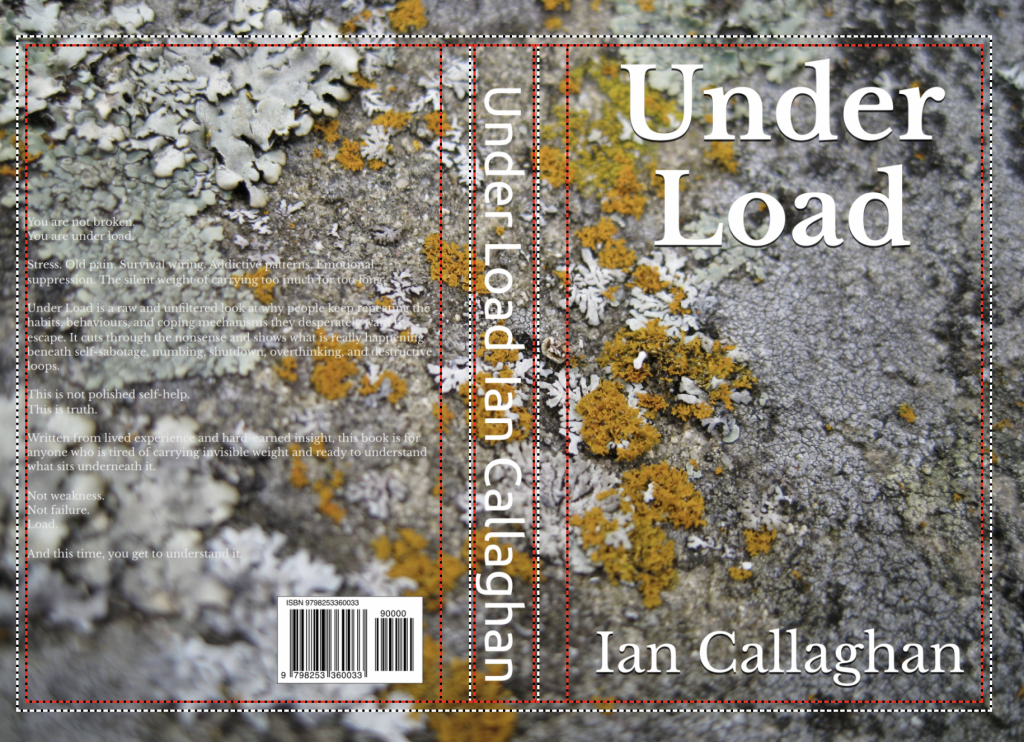
Under Load by Ian Callaghan | The Mechanical Guide to Addiction Recovery
You already know what you’re doing. You’ve known for years.
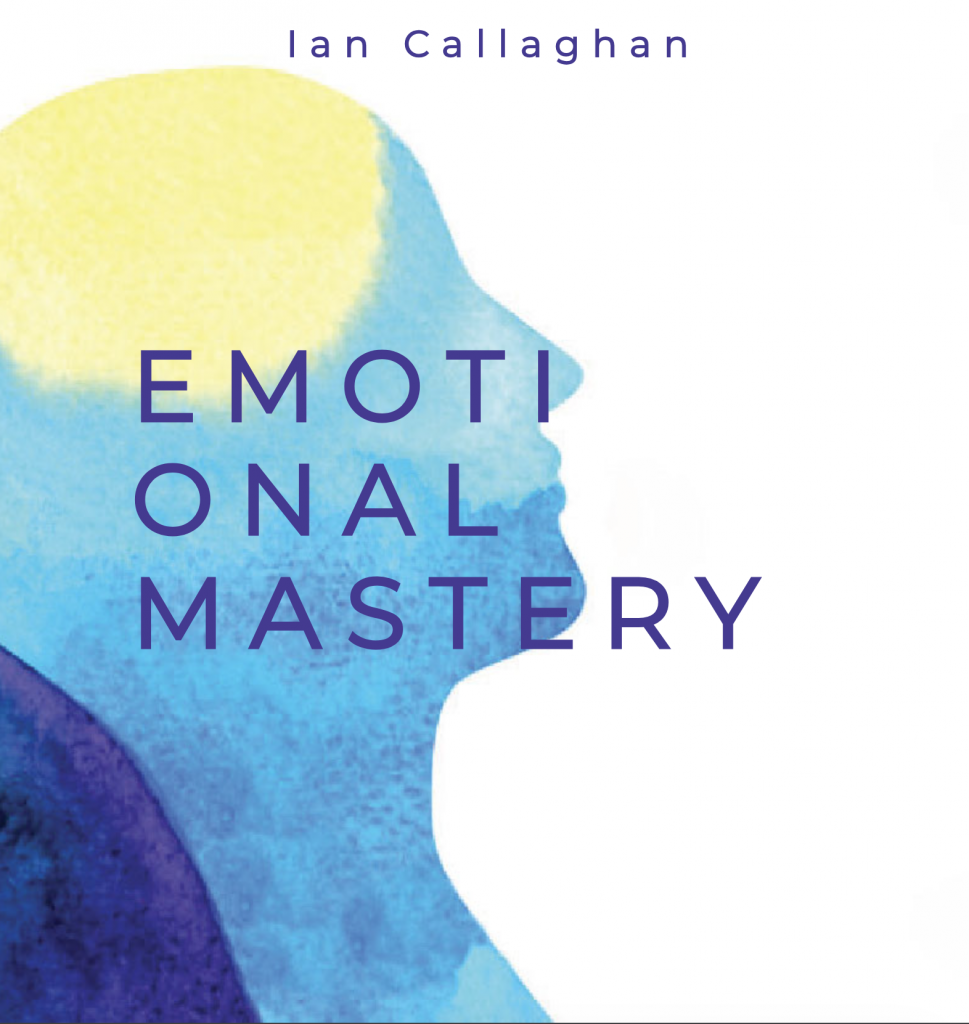
Emotional Mastery: The Emotional Operating System
The Emotional Mastery book is a practical manual for understanding and regulating the human nervous system using the Emotional Operating System framework.
Instead of analysing emotions or retelling your past, the Emotional Mastery book teaches you how to read emotional states as system feedback, identify overload, and restore stability under pressure.
No labels. No therapy-speak. No endless healing loops.
Just a clear, operational approach to emotional regulation that actually holds when life applies load.
Instant digital download.