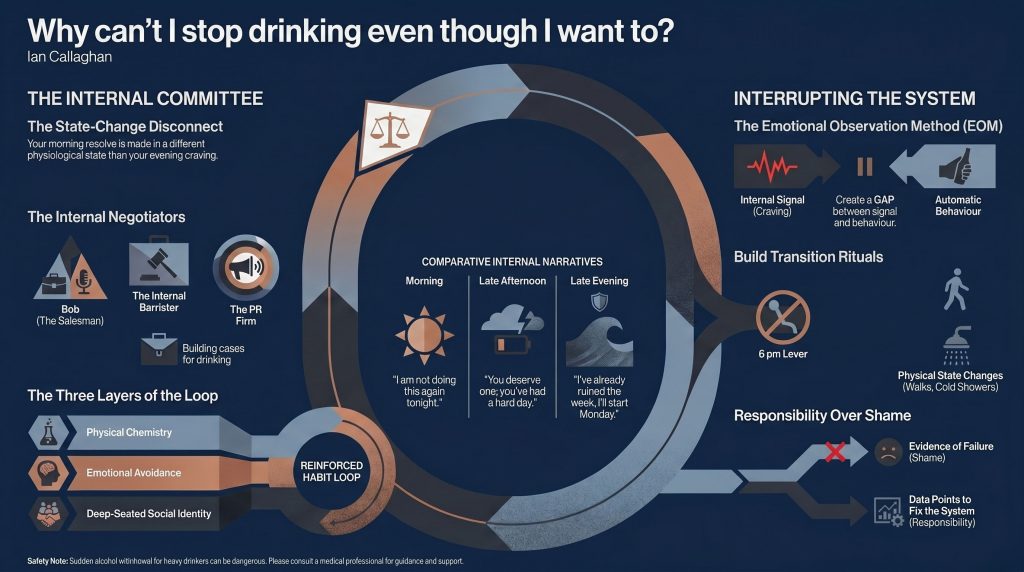
Why can’t I stop drinking even though I want to? There is a particular kind of hell in wanting to stop drinking and still finding yourself doing it again.
Not the dramatic Hollywood version of addiction where everything is on fire, and everyone can see it. I mean the quieter version. The one where you wake up in the morning with that dry mouth, that thick head, that low-level dread in your chest and the same tired sentence running through your mind.
I am not doing this again tonight.
And you mean it. That is the part that people who have never been caught in this loop struggle to understand. You are not always lying in that moment. You are not always making some half-arsed promise you know you will break. In the morning, with the regret still fresh and your body still paying the bill, you often do mean it. You know the drink is costing you. You know your sleep is wrecked. You know your mood is flatter than it should be. You know your patience is thinner. You know your confidence is taking a kicking. You know your relationships, your work, your energy and your self-respect are all being taxed by something that was supposed to help you relax.
Then the day happens.
Work happens. Stress happens. Boredom happens. Loneliness happens. Family pressure happens. Pain happens. Hunger happens. Fatigue happens. Your nervous system gets overloaded all day, and by late afternoon, the version of you who made that clear, sober morning decision is no longer the one in charge. That is when the internal negotiation starts.
You deserve one.
You have had a hard day.
Just tonight.
You can stop tomorrow.
You are not as bad as other people.
You have already ruined the week; may as well start fresh on Monday.
That voice does not usually sound like an enemy. That is why it works. It sounds like you. It borrows your memories, your stress, your excuses, your tiredness and your pain, then uses all of it to build a case for the very thing you swore off only a few hours earlier.
That is why the question “Why can’t I stop drinking even though I want to?” is so important. It is not a stupid question. It is not a weak question. It is not a question asked by someone who needs another motivational quote or a lecture on units.
It is the question asked by someone who is starting to realise that information is not enough.
Because you already know enough.
You know alcohol is not doing you any favours. You know it damages sleep, mood, health, motivation, hormones, digestion, relationships and self-trust. You know alcohol is linked to serious health risks, including cancer. You know it can worsen anxiety and low mood. You know it can become physically and psychologically dependent. You do not need another patronising leaflet telling you to drink water between drinks.
The real question is not whether alcohol is harmful.
The real question is why the part of you that knows that keeps getting overruled by the part of you that wants relief now.
That is where the real work starts.
Before anything else, a serious safety note
If you are drinking heavily every day, if you shake when you do not drink, if you sweat, vomit, hallucinate, feel severely agitated, have seizures, or need alcohol to feel normal, do not suddenly stop without medical advice.
Alcohol withdrawal can be dangerous and, in some cases, life-threatening. Speak to your GP, NHS 111, a local alcohol service or emergency medical support if you are worried about withdrawal.
This article is not a detox plan. It is not medical advice. It is not telling anyone to white-knuckle a dangerous withdrawal at home. It is about understanding the loop that keeps so many people drinking after they have already decided they want to stop.
Because for a lot of people, the terrifying part is not only the alcohol. It is the feeling that they can no longer trust themselves around it.
You are not fighting a drink; you are fighting a system
One of the biggest mistakes people make is treating drinking as if it were only a single decision.
Do I drink or do I not drink?
That sounds simple, but for many people it is nowhere near that simple. By the time you reach for the bottle, open the can, walk into the pub or stop at the shop, the decision has often been prepared long before the drink appears.
Alcohol may have become part of your internal operating system. It may be how you mark the end of the day. It may be how you avoid silence. It may be how you soften stress, numb resentment, quiet anxiety, dodge boredom, delay grief, reduce social discomfort or create a fake sense of reward in a life that has become all pressure and no real recovery.
That does not make alcohol a solution. It makes it a lever.
And once the brain and body learn that pulling that lever changes state quickly, the system starts defending it.
Bad day? Pull the lever.
Argument? Pull the lever.
Lonely evening? Pull the lever.
Work pressure? Pull the lever.
Kids in bed? Pull the lever.
Partner opens wine? Pull the lever.
Friday night? Pull the lever.
Sunny afternoon? Pull the lever.
Tuesday for no obvious reason? Pull the lever anyway.
After a while, you are not making a single clear decision about a drink. You are up against habit, memory, chemistry, identity, emotional avoidance, social conditioning, routine and a nervous system that has learned to associate alcohol with relief.
This is why willpower often collapses. Not because you are weak, but because willpower is a conscious tool, and the drinking loop often starts before conscious reasoning has even got its boots on.
In my own language, this is where Bob walks in.
Bob is the voice in the system that argues for the old behaviour. Bob is not some cartoon devil on your shoulder. Bob is much slicker than that. Bob is the polished internal salesman who knows exactly where the pressure points are. He knows when you are tired. He knows when you are hungry. He knows when you feel rejected, trapped, bored, lonely, ashamed or resentful. He knows how to turn discomfort into permission.
Bob rarely starts with, “Let’s wreck your life.”
Bob starts with, “You deserve one.”
That is why he is dangerous.
Then the Internal Barrister gets involved. This is the part of the mind that starts building a legal case for the behaviour after another part of you has already decided against it. It gathers evidence. It calls stress to the witness stand. It brings fatigue as an expert. It reminds you of other people who drink more than you. It notes that you went three days last week, so you are clearly fine. It argues that this is not the right time to stop. It cross-examines your morning promise until it sounds naive.
By the time the drink is in your hand, it feels like you made a decision.
But often, the case was built before you even noticed the courtroom had opened.
Why knowing better does not automatically make you do better
There is a lazy idea that people keep drinking because they do not understand the consequences.
Sometimes that is true. Some people are genuinely misinformed. The alcohol industry has done a brilliant job of wrapping a toxic, dependence-producing drug in friendship, reward, sophistication, stress relief and celebration. Plenty of people still have no idea how badly alcohol can affect sleep, anxiety, heart health, cancer risk, metabolic health and the nervous system.
But a lot of people do know.
They know too much, if anything. They have read the articles. They have watched the videos. They have tracked their sleep. They have noticed the anxiety. They have seen the weight creep on. They have felt the shame. They have made the promises. They have had awful mornings.
The problem is that information does not automatically override the state.
You can know alcohol is harming you and still crave it when your nervous system is screaming for relief. You can know one drink becomes ten and still believe the little internal lie that this time will be different. You can know tomorrow will be worse and still choose tonight because tonight feels urgent and tomorrow feels theoretical.
That is not a lack of intelligence. That is a state problem.
When the body is overloaded, the brain does not always ask, “What is best for my long-term health?” It asks, “What gets me out of this feeling quickest?”
Alcohol answers quickly.
Badly, expensively and destructively, but quickly.
That speed is part of the trap.
The drink is often the final output, not the first cause
If you only look at the drinking, you miss the machinery underneath it.
The drink is usually the visible behaviour. It is the thing other people notice. It is the thing you count, hide, justify, regret or promise to control. But the drink often arrives at the end of a chain that started hours, days or years earlier.
There is usually a physical layer, an emotional layer and an identity layer.
The physical layer is the body adapting to alcohol. Repeated alcohol use affects reward pathways, stress chemistry, sleep architecture, blood sugar, mood regulation and the autonomic nervous system. Your system can begin to expect alcohol at certain times or in certain states. That is when a craving stops feeling like a casual thought and starts feeling like a bodily demand. It is no longer “I quite fancy a drink.” It is “Something is wrong, and I need to fix it now.”
The emotional layer is what alcohol is being used to avoid, soften or escape. This is not always some dramatic hidden trauma, although for some people it is. Sometimes it is the ordinary grind of being alive with no real release valve. Stress. Resentment. Exhaustion. Grief. Loneliness. Anger. Shame. Social discomfort. Feeling trapped and feeling invisible. Feeling like the whole day belongs to everyone else, and the drink at the end is the only thing that feels like yours.
The identity layer is the part people often miss. Alcohol becomes who you are in certain rooms. The wine person. The pub bloke. The fun one. The one who can handle it. The one who drinks after work. The one who relaxes with a few. The one who says, “I am not into all that sober stuff.”
When you stop drinking, you are not only removing a substance. You may also be threatening a version of yourself that has existed for years. That version may be unhealthy, exhausted and quietly miserable, but it is familiar. And the familiar can feel safer than freedom.
This is why part of you wants to stop and part of you fights like hell to keep drinking. You are not one clean, unified decision-making machine. You are a whole internal committee, and some parts of you still believe alcohol is protection.
Wanting to stop is real, but it is not the whole job
Wanting to stop matters. I would never dismiss that. That first honest moment where you say, “I do not want to live like this anymore,” can be powerful.
But wanting to stop is not the same as being equipped to stop.
This is where people drown themselves in shame. They think, “If I really wanted to stop, I would stop.” It sounds logical, but it is often bollocks.
People want to stop all sorts of destructive patterns and still struggle. Smoking. Gambling. Cocaine. Doom scrolling. Porn. Overeating. Rage reactions. People-pleasing. Avoidance. Self-sabotage. The pattern is not always a lack of desire. The pattern is that the behaviour has been linked to relief, reward, escape, control, identity or emotional survival.
So the better question is not only, “Do I want to stop drinking?”
The better question is, “What is alcohol currently doing for me that I have not learned how to do another way?”
That question changes the whole conversation.
Does alcohol permit you to stop?
Does it quieten anxiety?
Does it help you avoid conflict?
Does it give you a fake sense of connection?
Does it create a boundary where you have none?
Does it replace proper rest?
Does it numb grief?
Does it turn down the noise in your head?
Does it make an unbearable life feel temporarily bearable?
If the answer is yes, then the drink is not the only issue. The drink is the tool your system is using because the real need is not being met cleanly.
That does not make alcohol harmless. It makes the pattern understandable. And once something is understandable, it becomes workable.
The 6 pm switch-off trap
A lot of people are certain in the morning.
They wake up feeling rough and disgusted with themselves. They pour away what is left. They search online. They read posts like this. They feel the fear, and they mean the promise.
Then the day gets its hands on them.
By late afternoon,n they are running on poor sleep, caffeine, stress, low food quality, unresolved emotion and a nervous system that has had no real recovery. Then they get home and expect one morning decision to overpower the full weight of the day.
That is a bad plan.
The evening craving is often not random. It is predictable. It turns up when the system has been running all day and is looking for an off switch.
This is why so many people drink after work. Not because they are weak, but because the drink has become the ritual that tells the body the day is over. The problem is that alcohol does not really switch you off. It sedates you, disrupts recovery, fragments sleep, increases next-day load, and often leaves the nervous system more unstable.
So the next morning starts lower.
More tired. More anxious. More inflamed. More ashamed. More depleted.
Then the next evening, there are demands for relief again.
That is the loop.
It is not just a drinking problem. It is a load problem, a state problem and a system problem.
If your danger window is 5 pm to 8 pm, that window needs a plan in place before you arrive. Not a vague hope. A plan.
Food ready. Alcohol out of the house. No detour past the shop. A different routine when you get in. A walk. A shower. Breathwork. Cold water, if it is safe and appropriate for you. A proper meal. A call. A meeting,g if that is your thing. A community check-in. Something that tells your body, “The day is over,” without pouring ethanol into the system.
A craving is often an unfulfilled transition.
Build the transition, and you take power away from the drink.
Morning and evening, you are not in the same state
This is one of the simplest but most important things to understand.
The version of you who makes the promise in the morning is not always the same version of you who has to keep it in the evening.
Morning, you may be ashamed, but clearer. Evening. You may be hungry, tired, overstimulated, resentful, and desperate for relief.
Morning, you make the promise. Evening, you inherit the stress.
Then, when evening comes, you drink, and in the morning, you call the whole person a liar.
But what often happened is not that you lacked morals. Your state change,d and your strategy did not.
That distinction matters.
If you rely on morning motivation to survive evening collapse, you will keep losing the same fight. You have to design your life around the point where the old pattern normally wins. That does not mean wrapping yourself in bubble wrap or pretending you will never have stress. It means becoming honest about the danger point and preparing for it like an operator, not hoping your way through it like a passenger.
Why moderation feels so seductive
Moderation sounds grown-up. It sounds balanced, sensible and socially acceptable. And for some people, moderation may genuinely work.
For a lot of people caught in the drinking loop, though, moderation is not freedom. It is a full-time negotiation department.
How many drinks? Which days? Only weekends? Only beer? No spirits? Only with food? Not before 6 p.m.? Not alone? Not in the house? Only on holiday? Only special occasions?
Then Bob starts redefining special.
A hard Tuesday becomes special. A sunny evening becomes special. A stressful meeting becomes special. A family barbecue becomes special. A bad mood becomes special. A good mood becomes special. Being alive apparently becomes special.
This is where the PR Firm gets involved.
The PR Firm is the part of you that rebrands a bad idea until it sounds reasonable. It turns “I am repeating the same destructive pattern” into “I am practising balance.” It turns “I am scared to face the evening sober” into “I do not want to be extreme.” It turns “I cannot moderate” into “I just need better rules.”
For some people, stopping completely is not extreme. It is quiet. It is the end of the admin. It is the end of the courtroom. It is no longer necessary to negotiate with a substance that keeps winning.
That does not mean everyone has to use the same language, join the same groups or adopt the same identity. It simply means being honest about your own data.
If moderation has failed you fifty times, maybe the problem is not that you have not found the perfect rule yet. Maybe the problem is that alcohol has a seat at the table it no longer deserves.
Shame keeps the loop alive.
Shame feels like it should help because it feels severe.
You think that if you hate yourself enough, you will finally change. You think one more brutal morning of calling yourself weak, pathetic, stupid or broken will somehow scare you straight.
But shame usually does the opposite.
Shame creates threat. Threat increases the need for relief. Relief has been linked to alcohol. So shame drives you back towards the very thing you are ashamed of.
This is why the morning beating rarely works.
You idiot. You weak bastard. You have done it again. What is wrong with you? You are pathetic.
That language does not create safety or clarity. It creates more internal load. And when the load gets too high, the old escape hatch starts looking attractive again.
This does not mean letting yourself off the hook. I am not interested in fluffy self-compassion that becomes another excuse to avoid responsibility. There is a difference between responsibility and self-attack.
Responsibility says, “This is mine to change.”
Shame says, “I am broken.”
Responsibility gives you something to work with. Shame turns you into the enemy.
If you want to stop drinking, you have to stop using self-hatred as your main management tool. It has not worked. It has probably made the loop worse.
My own lived experience with this
I drank for 45 years before I stopped.
That is not a line I use for drama. It is context. It means I am not writing this as someone who has read a few books and decided to build a neat little content niche. I know what it is to keep doing something after part of you already knows it is costing you. I know what it is to be fully informed and still not fully honest. I know what it is to have the internal negotiation running like a corrupt legal system in the background.
For me, stopping was not a glamorous rock-bottom story. It was a wake-up call. It was the point where I stopped dressing the truth up in softer language. I could either lose one thing or keep risking everything else.
Alcohol was not just a drink in my life. It was a state changer. It was part of how I switched off, avoided, rewarded myself and performed being fine. It was part of how I kept delaying a truth I already knew.
When I stopped, I did not do it by pretending the craving voice did not exist. I learned to observe it. That is a massive difference.
I did not need to become powerless. I needed to become conscious of the machinery.
That is what my Emotional Observation Method is built around. It is not about fighting every thought, believing every thought or turning recovery into theatre. It is about creating space between signal and action.
A craving can appear without you obeying it. A thought can appear without being true. A feeling can rise without needing to be drowned. Bob can speak without being put in charge. The Internal Barrister can present a case without you accepting the verdict. The PR Firm can spin the story without you having to buy the campaign.
That space is where power comes back.
Not in a slogan. Not in a perfect morning routine. In the tiny moment where the old pattern starts, and you finally see it as a pattern rather than an instruction.
What a craving really is
A craving is not just wanting a drink.
It is a signal package.
It can include bodily sensations, emotions, memories, predictions, language, images, smells, routines, and the environment. You might feel it in your chest, gut, jaw, hands or legs. You might suddenly become irritable. You might imagine the sound of the can opening or the glass being poured. You might feel pulled towards the shop before you have consciously decided to go. You might get a thought that feels urgent and reasonable at the same time.
Most people respond too late. They wait until the craving has become a command.
The work is learning to spot the earlier signal.
Before “I need a drink,” there may be something else.
I am overloaded. I am hungry. I am angry. I am lonely. I feel trapped. I need the day to end. I do not know how to sit with this feeling. I want to disappear for a bit. I want someone to take the weight off me. I want relief, and I want it now.
That earlier signal is the useful information.
The drink is the final demand. The earlier the signal, the more leverage you get
The Emotional Observation Method, or EOM, is my framework for creating a gap between emotional signal and automatic behaviour.
In plain English, it means you stop treating every internal event like an order.
You observe the signal before you exhibit the behaviour.
That matters because most destructive patterns do not start with the action. They start with the interpretation. Something happens in the body; the mind builds a story around it; Bob adds a sales pitch; the Internal Barrister argues the case; the PR Firm sanitises the consequences; and suddenly the old behaviour feels inevitable.
EOM interrupts that sequence.
It asks what is happening in the system before the system drags you into another round of the same old crap.
What is the signal? Where is it in the body? What story arrived with it? What is Bob trying to sell me? What relief is being promised? What will this cost me tomorrow? What do I actually need right now? What action would support the version of me I say I want to become?
That is not soft. That is not spiritual wallpaper. That is operator behaviour.
The operator does not smash the machine because a warning light comes on. The operator reads the signal and responds properly.
What to do when you want to drink tonight
When the craving hits, do not turn it into a debate. Debate is Bob’s courtroom. If you let the Internal Barrister drag you in there, you can lose an hour arguing with yourself and still end up at the shop.
Start by naming the process.
Say, “This is the loop starting.”
Not “I am failing.” Not “I am weak.” Not “Here we go again.”
This is the loop starting.
That one sentence separates you from the urge. You are observing the process instead of becoming it.
Then change state before you make a decision. Do not decide from the peak of the craving. Move your body. Get outside. Eat proper food. Have a shower. Phone someone. Use breathwork. Put your shoes on and walk away from the environment where the old pattern normally wins. Your job is not to win a philosophical argument with alcohol. Your job is to get through the first wave without obeying it.
Cravings rise, peak and fall. They feel permanent when you are inside them, but they are not permanent. What makes them dangerous is the belief that they must be solved immediately.
After you have changed state, ask the honest question.
What do I actually need?
Not what do I want? Not what Bob is selling. What do I actually need?
Food. Rest. Space. Connection. A boundary. Sleep. Pain management. Emotional release. A different routine. A proper conversation. A plan for tomorrow. A life that does not require sedation every evening.
That question is where the deeper work begins.
What not to do
Do not build your whole plan around willpower. Willpower is useful, but it is not a full operating system. It gets tired. It weakens under stress. It collapses when sleep, food, mood and environment are all working against you.
Do not keep alcohol in the house and call it a test. That is not a strength. That is setting Bob up with a home office.
Do not romanticise the drink you keep regretting. Your brain will edit the advert and delete the consequences. You have to remember the whole film, not just the first scene.
Do not make promises from a state you cannot access later. Morning certainty is not enough. Build evening protection.
Do not confuse privacy with isolation. You do not have to announce your life to everyone, but if nobody knows you are struggling, you are carrying a heavy burden with no external support.
Do not use one slip as evidence that you cannot change. That is Bob turning data into a death sentence. A slip is information. It tells you where the system failed. Use it.
Why “I am not that bad” is such a dangerous sentence
One of the most common ways people stay stuck is comparison.
I am not drinking in the morning. I still work. I still pay bills. I am not on a park bench. I only drink at night. I only drink wine. I only drink beer. I know people worse than me.
That may all be true.
It may also be irrelevant.
The question is not whether someone else is worse. The question is whether alcohol is costing you more than you are willing to admit.
Is it stealing your sleep? Is it raising your anxiety? Is it making you unreliable to yourself? Is it flattening your mood? Is it affecting your body? Is it damaging your relationships? Is it keeping you stuck in a version of life you say you do not want?
If the answer is yes, then “not that bad” is not freedom. It is the PR Firm trying to keep the account.
You do not need to wait until life is completely wrecked before you change direction.
You are allowed to get off the road because you can see where it leads.
The first goal is not a perfect life; it is one clean interruption
People often make quitting alcohol too big a deal in the first moment.
They imagine forever. They imagine every holiday, wedding, birthday, barbecue, grief, celebration and lonely evening for the rest of their life. No wonder the brain panics.
The first job is smaller and more practical.
Interrupt the loop once.
Notice the signal. Name the process. Change state. Do not obey Bob for the next ten minutes. Then the next ten. Then the next hour. Then get to bed sober.
That might not sound glamorous, but it is how self-trust begins to be rebuilt.
Not through grand declarations. Through kept promises.
Every time you do not obey the old loop, you give the system new evidence.
I can feel this and not drink.
I can have a hard evening and not drink.
I can be bored and not drink.
I can be angry and not drink.
I can want relief and choose something that does not destroy tomorrow.
That evidence matters. Your brain has years of evidence for the old pattern. You need to start collecting evidence for the new one.
What recovery can look like without shame, labels or theatre
Some people need medical support. Some people need meetings. Some people need therapy. Some people need community. Some people need medication. Some people need structured programmes. I am not here to tell everyone there is only one way.
What I will say is this. You do not have to turn your entire identity into a wound to change your life. You do not have to perform brokenness for other people. You do not have to adopt language that makes you feel smaller. You do not have to wait for rock bottom. You do not have to call yourself powerless if that does not help you.
But you do have to become honest.
Honest about the cost. Honest about the pattern. Honest about the excuses. Honest about the role alcohol is playing. Honest about the times of day you are most vulnerable. Honest about the people, places, emotions and routines that keep pulling you back. Honest about whether moderation is genuinely working or just keeping the negotiation alive.
That honesty is not punishment.
It is the beginning of freedom.
A practical starting point for the next seven days
If you are reading this because you want to stop drinking, do not finish the article and then drift back into the same routine. Do something concrete.
For the next seven days, track the loop without dressing it up.
Write down what time the craving starts. What happened before it? What you ate. How did you sleep? What emotion was present? What Bob said. What excuse appeared? What your body felt like. What you did next. What helped. What made it worse?
Do not do this as a punishment exercise. Do it as a mechanic looking at a fault.
You are looking for patterns.
Maybe the craving always follows hunger. Maybe it follows conflict. Maybe it follows loneliness. Maybe it follows boredom. Maybe it follows overwork. Maybe it follows pain. Maybe it follows the moment you sit in the same chair, put the telly on and enter the old routine.
Once you see the pattern, you can stop acting surprised by it.
And when you stop acting surprised, you can start designing around it.
That is how change becomes practical.
Frequently asked questions
Why can’t I stop drinking even though I really want to?
Because wanting to stop is only one part of the system. Alcohol may have become linked to relief, stress reduction, identity, routine, social connection or emotional avoidance. When your nervous system is overloaded, the part of you that wants long-term freedom can be overruled by the part of you that wants immediate relief. That does not mean you are weak. It means the loop needs to be understood and interrupted earlier.
Does struggling to stop drinking mean I am an alcoholic?
Not everyone finds that label useful. The more important question is whether alcohol is costing you more than you are willing to keep paying. If you repeatedly promise yourself you will not drink and then drink anyway, if you struggle to control the amount, if alcohol is affecting your sleep, mood, health, relationships or self-respect, then the pattern deserves serious attention regardless of the label.
Can I stop drinking without AA?
Some people find AA helpful. Others do not connect with it. Stopping without AA is possible for some people, but the support structure still matters. That might include medical advice, therapy, coaching, community, peer support, education, nervous system regulation, habit redesign and practical lifestyle changes. The key is not whether you follow one specific route. The key is whether you build a route that actually interrupts your pattern.
Can I stop drinking without rehab?
Some people stop without rehab. Others need residential treatment or medical detox, especially if they are physically dependent or at risk from withdrawal. If you drink heavily every day or experience withdrawal symptoms, get medical advice before stopping. Rehab is not the only path, but safety comes first.
Why do I keep drinking after promising myself I won’t?
Because the promise is usually made in one state and tested in another, one morning you may be clear and regretful. In the evening, you may be stressed, tired, hungry, lonely, or emotionally overloaded. If you do not plan for the state in which the old pattern wins, the old pattern will continue to have the advantage.
Why does alcohol feel like the only thing that helps me relax?
Because your system has learned to associate alcohol with a fast state change, it may feel like relaxation. Still, alcohol often disrupts sleep, recovery and nervous system regulation, which can leave you more anxious and depleted later. The work is building real transition rituals and recovery tools, so alcohol is no longer the only off-switch your body recognises.
Is moderation worth trying?
That depends on your own evidence. If moderation genuinely works for you and does not lead to constant negotiation, consequences, or obsession, that is your data. If moderation repeatedly fails, keeps you mentally trapped, or always turns into more than you intended, then it may be time to stop pretending the next rule will magically fix the pattern.
What should I do first if I want to stop drinking?
Start with safety, honesty and pattern recognition. If withdrawal may be a risk, speak to a medical professional. If it is safe for you to stop, remove alcohol from the house, identify your danger window, build a plan for that time of day, eat properly, change your evening routine, and track the craving loop so you can see what is actually driving it.
Why do I feel anxious after drinking?
Alcohol can disrupt sleep, affect stress chemistry, alter blood sugar, increase next-day nervous system load and intensify anxiety in many people. Some people call this “hangxiety.” It is not just guilt. It can be a physical and neurological rebound after alcohol.
What if I slip?
A slip is not proof that you cannot change. It is data. Look at what happened before it, what state you were in, what excuse appeared, what environment you were in, and what support or structure was missing. Then adjust the system. Do not let Bob turn one slip into a full relapse by selling you the lie that you have ruined everything.
Final word
If you cannot stop drinking even though you want to, you are not dealing with a simple information problem. You are dealing with a loop that has probably been built over the years. A physical loop, an emotional loop, an identity loop, a nervous system loop, a negotiation loop and a shame loop, all feeding each other while you stand in the middle, wondering why one honest morning promise keeps collapsing by the evening.
That is why another round of self-hatred will not fix it. Neither will pretending alcohol is harmless, waiting until life gets bad enough to justify change, or letting Bob, the Internal Barrister and the PR Firm keep dressing the same old pattern up as stress relief, moderation, reward or “just tonight.”
The way out starts when you stop staring only at the drink and start observing the machinery that comes before it. The signal before the urge. The story before the excuse. The state before the collapse. The need underneath the craving. That is where the gate is, and that is where the work has to happen.
You do not need to win your whole future in one heroic moment. You need to catch the loop earlier than you caught it yesterday. You need to see the internal sales pitch before you buy it. You need to notice the body state before Bob turns it into a command. You need to protect tomorrow before tonight starts pretending it does not matter.
That is not a weakness. That is not recovery theatre. That is you taking the operator’s seat back, one honest interruption at a time.
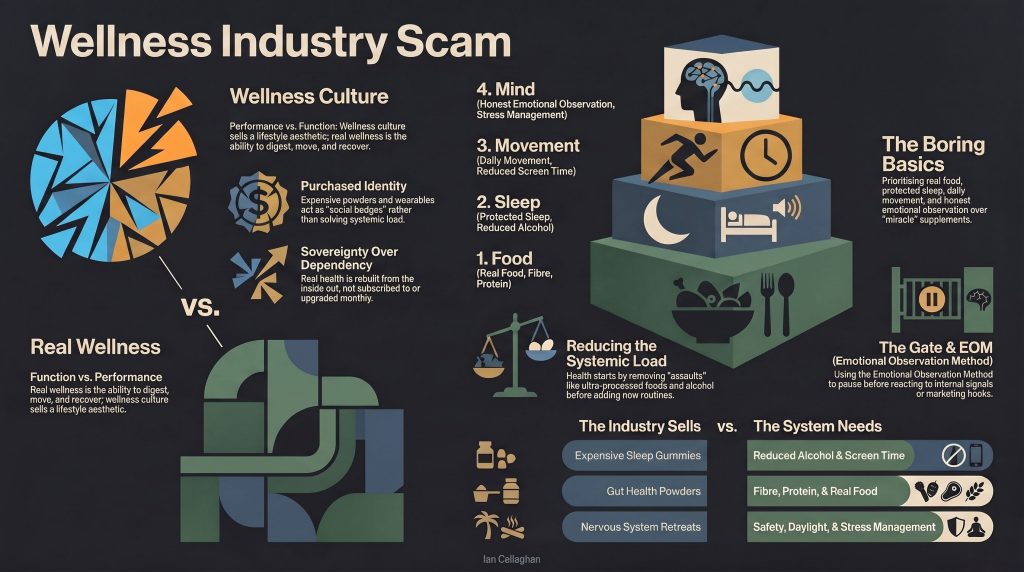
The wellness industry scam is not that health is fake. Health is real. Repair is real. Food, sleep, movement, emotional regulation, nervous system capacity and honest self-awareness all matter. The scam is the way the wellness industry sells expensive products, status, routines, retreats and identity to people who are already exhausted, inflamed, stressed and under load, while often ignoring the boring basics that would actually give the body a chance to recover.
The uncomfortable truth about the wellness industry
The wellness industry has done a brilliant job of convincing ordinary, tired, stressed, overloaded people that health is something they have to keep buying. Not something they rebuild. Not something they protect. Not something they understand from the inside out. Something they purchase, upgrade, subscribe to, photograph and perform.
That is the scam.
Not health itself. Not meditation. Not breathwork. Not cold water. Not real food. Not movement. Not proper nervous system regulation. I use those tools. I teach those tools. I live by a lot of those tools. I would be a hypocrite if I sat here pretending they do not work, because used properly, they absolutely can.
The scam starts when those tools get dragged into the marketing machine, stripped of context, polished into a lifestyle aesthetic and sold back to exhausted people as proof they are not enough without them.
Most people do not need another £47 powder, another miracle supplement, another nervous system reset course, another tracker, another influencer routine or another bloke in linen trousers telling them to align with abundance while flogging a subscription.
Most people need proper food, better sleep, daylight, movement, less alcohol, fewer ultra-processed foods, fewer assaults on the nervous system, more honest connections, and a clearer understanding of what their bodies are actually trying to tell them.
That is not glamorous enough for the wellness industry because it does not create dependency. It does not need a subscription. It does not need a luxury retreat. It does not photograph well next to a ceramic mug and a beige blanket.
But it works. And once you realise that, the whole wellness game starts looking very different.
Why am I writing this
I am not writing this as some bloke sneering from the outside because he saw a few dodgy adverts online.
I am a British Army veteran, a qualified chef, an NLP Master Practitioner, a Reiki Master, a coach, and the creator of the Emotional Observation Method. I drank for 45 years, quit alcohol, rebuilt my own food, sleep, movement and mind from the ground up, lost weight, live with long-term military injury and pain, and now coach people through cravings, stress, emotional regulation, sobriety, compulsive behaviour, food, midlife overload and identity change.
So when I talk about wellness, I am not talking about a lifestyle aesthetic. I am talking about what survives real life.
I am talking about the wet Tuesday version of wellness. The version that still has to work when your back hurts, your sleep is poor, your head is noisy, your finances are stretched, your relationships are under strain, your old coping mechanism is tapping on the window. Bob has turned up with a full legal argument for why you should drink, binge, scroll, spend, eat crap, isolate or blow your life up again.
That is where the truth lives. Not on a retreat. Not in the branding. Not in the influencer kitchen. In the ordinary moment when your system is under load, you still need to make the next decision.
What is the wellness industry actually selling?
The wellness industry does not only sell health products. It sells identity. That is why it works so well.
The powder is not just a powder. It is a signal that you are the kind of person who takes care of yourself. The wearable is not just a wearable. It is a signal that you are optimised. The retreat is not just a retreat. It is a signal that you are healing. The green juice is not just a green juice. It is a little social badge that says you are trying, improving, upgrading, becoming.
That is the hook.
Wellness stopped being about function and became a costume. You can see it everywhere. The right water bottle. The right mat. The right gut health powder. The right supplement stack. The right morning routine. The right wearable. The right breathwork app. The right retreat photo where everyone looks peaceful, thin, expensive and spiritually constipated in a field.
It sells the idea that health has a look. Worse than that, it sells the idea that if your life does not look like that, you are doing something wrong.
If your breakfast is not photogenic, if your house is not calm, if your body is not lean, if your nervous system is not regulated, if your sleep is wrecked, if your cravings are loud, if your anxiety is up, if your digestion is off, if Glucipher is dragging you towards sugar at 9 pm and Bob is telling you that one drink, one binge or one scroll does not count, then apparently you are not aligned enough, disciplined enough or committed enough.
Bollocks.
That is not wellness. That is class signalling with a turmeric latte.
A single parent working shifts does not need to be told they are failing because they have not got time for a two-hour morning routine. A midlife bloke with back pain, poor sleep, debt stress and a liver that spent decades processing lager does not need a cacao ceremony before he is allowed to rebuild. A woman dealing with perimenopause, work pressure, ageing parents, teenage kids and a nervous system that has been running red for years does not need another shiny expert telling her she is out of alignment.
They need the load reduced. That is where real wellness starts.
Why does the wellness industry feel like a scam?
The wellness industry feels like a scam because it often sells solutions without looking at the system that created the problem.
A person is exhausted, so they are sold energy. They are anxious, so they are sold calm. Their digestion is wrecked, so they are sold gut health. Their sleep is poor, so they are sold magnesium sprays, sleep gummies and weighted blankets. Their cravings are out of control, so they are sold willpower hacks. Their life is overloaded, so they are sold another routine to squeeze into it.
Nobody stops and asks the obvious questions. How much alcohol is in a week? How much ultra-processed food is going in? How many hours of proper sleep are happening? How much protein, fat and fibre is the body getting? How much daylight is reaching the eyes? How much movement is built into the day? How much stress is normalised because everyone around them is also running on fumes? How many emotions are being buried under food, booze, shopping, work, porn, scrolling, resentment or people-pleasing? How often is Bob running the meeting while the actual operator sits in the corner, wondering what the hell happened?
These are not glamorous questions, but they are useful questions.
The body does not live in the aesthetic. It lives in the inputs. Your nervous system does not care what colour your yoga mat is. Your gut does not care whether the powder came in a recyclable pouch with a leaf on the label. Glucipher does not give a toss whether the sugar is organic, handmade, small-batch, or blessed under a full moon. Bob does not become less manipulative because you renamed him your inner protector and bought a nicer journal.
Your system responds to what you repeatedly do, consume, tolerate, ignore and justify. That is where the work starts.
Is the wellness industry making people feel broken?
Yes, a lot of wellness marketing makes people feel broken because broken people are easier to sell to.
That does not mean every practitioner is a fraud or every product is useless. It means the machine around wellness often relies on insecurity. The person has to believe something is missing. They have to believe they are not calm enough, clean enough, disciplined enough, feminine enough, masculine enough, healed enough, spiritual enough, lean enough, regulated enough or optimised enough.
Then the offer appears: buy this, and you will feel like the kind of person who has their life together.
That is clever marketing, but it is also dangerous.
People do not buy wellness products because they love powders. They buy them because they are tired of feeling tired. They buy them because their mood is unstable, their appetite is all over the place, their stomach is bloated, their joints hurt, their skin looks dull, their libido has vanished, their patience is gone, their sleep is broken,n and their body feels like a house they no longer understand.
Then the industry steps in with a smile and says, here, buy this.
It rarely says,” Let us look at the whole system. That is the conversation I care about, because I do not see people as broken. I see systems under load.
That is not me being poetic. It is the most useful frame I have found after decades of alcohol, food issues, pain, stress, personal development, coaching and rebuilding. When you stop treating every behaviour as a moral failure and start seeing it as a signal, the shame drops and the work becomes clearer.
Bob is not proof that you are weak. Bob is the old operating system, trying to keep a familiar pattern alive. Glucipher is not proof that you have no discipline. It is the sugar-seeking part of the system looking for fast relief. The PR Firm is not wise. It is internal spin, building a case for the behaviour that keeps you stuck. The Gate is the gap where you notice the signal before you obey it. EOM is the practice of observing emotion without immediately becoming its employee.
That is real power. Not pretending you are healed because you bought another product. Real power is understanding the mechanism.
Are wellness products worth the money?
Some wellness products are worth the money when they solve a specific problem, meet a genuine need and do not distract you from the basics. That is the honest answer.
Supplements can help when there is a real deficiency or a clear reason to use them. Wearables can help if the data changes behaviour rather than creating an obsession. Breathwork apps can be useful if they help you build state control. Cold water can build capacity if it is used intelligently. Therapy, coaching, bodywork, strength training, meditation, nutrition support and good education can all be valuable.
The problem starts when products replace ownership.
A gut powder will not undo a diet built around ultra-processed food. A sleep spray will not cancel out alcohol, late-night scrolling and chronic stress. A nervous system course will not help much if you keep living in a way that tells the body it is never safe. A retreat will not save you if you come home to the same inputs, the same avoidance, the same old operating system, and the same refusal to stand at The Gate.
The useful question is not whether a product is good or bad. The better question is what job you are asking that product to do. If it is supporting a system you are already rebuilding, fair enough. If it is rescuing you from the basics you keep avoiding, that is Bob in a wellness hoodie.
Why do people keep buying wellness products when the basics work?
People keep buying wellness products because buying feels easier than changing. That is not an insult. It is human.
Buying gives immediate relief. It creates a little hit of hope. It feels like action. The parcel arrives. The label looks clean. The routine feels new. The brain gets to say, good, we are doing something.
But doing something is not the same as changing the system.
This is where the PR Firm gets clever. It can make avoidance sound like research. It can make another purchase sound like a commitment. It can make procrastination look like preparation. It can tell you that once you find the right supplement, the right podcast, the right protocol, the right coach, the right plan or the right device, then you will finally start.
Meanwhile, the boring basics sit there untouched. Sleep is still wrecked, food is still chaotic, alcohol is still normalised, movement is still inconsistent, stress is still unmanaged, emotions are still buried, Bob is still negotiating, Glucipher is still driving, and The Gate is still unused.
That is why simple is so powerful and so inconvenient for the industry. Simple does not mean easy. Simple means clear. The body needs better inputs, fewer assaults and repeated signals of safety. That is not a hack. It is a rebuild.
What is real wellness compared with wellness culture?
Real wellness is function. Wellness culture is often performance.
Real wellness asks whether you can sleep, digest, move, recover, think clearly, regulate emotion and make better choices under pressure. Wellness culture often asks whether your life looks like wellness from the outside.
That difference matters.
A person can have the supplements, the mat, the retreats, the morning routine, the water bottle, the expensive leggings, the wearable and the perfect kitchen, while still being metabolically wrecked, emotionally avoidant, secretly drinking too much, sleeping badly, eating processed rubbish and reacting from old patterns all day.
Another person can live a very ordinary life, cook real food, walk daily, protect their sleep, stop poisoning themselves with alcohol, lift a few weights, get outside, breathe properly, observe their emotions, tell Bob to shut up when needed, and slowly become stronger than they have been in years.
One looks like wellness. The other is wellness.
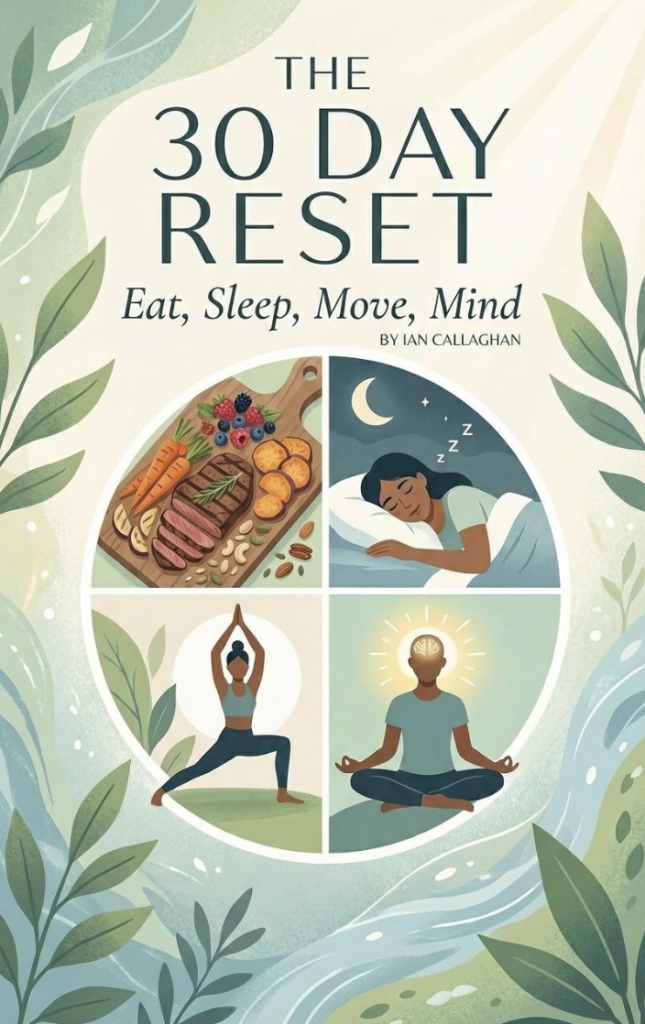
That is why I keep coming back to Food, Sleep, Movement and Mind. Food is the input. Sleep is the repair window. Movement is the signal. Mind is the operator. Get those four wrong for long enough, and the system starts screaming. Get them right consistently enough,h and the system starts coming back online.
Not overnight. Not in some fake thirty-day glow-up where everyone pretends healing is photogenic. But steadily, mechanically and honestly.
Is nervous system regulation being used as wellness marketing?
Yes. Nervous system regulation is real, but wellness marketing has turned it into another thing people feel they have to buy.
Nervous system language is useful when it helps people understand their bodies. It becomes bullshit when it is used as a sales fog. People are now being sold regulation as if it were a new luxury product. Regulate your nervous system with this mat. Reset your nervous system with this retreat. Heal your nervous system with this breathwork bundle. Calm your nervous system with this drink, this course, this candle, this wearable, this app, this £900 weekend in a converted barn with herbal tea and forced vulnerability.
The nervous system is real. Regulation is real. State change is real. The vagal brake is real. Breath, cold water, movement, safety, connection, sleep and emotional awareness can all change state.
But the body is not stupid.
You cannot sprinkle nervous system language over an overloaded life and call it healing. If you are drinking most nights, sleeping badly, eating ultra-processed food, never moving, living on caffeine, scrolling until midnight, suppressing every emotion and letting Bob run the old scripts, your nervous system is not going to be fooled by a candle and a lavender pillow spray.
It wants evidence. Repeated evidence. It wants to know whether the body is fed properly, whether sleep is protected, whether recovery is happening, whether movement exists, whether the threat is being reduced, whether connection is present, and whether emotion is being processed rather than buried under another coping mechanism.
That is why real regulation is built, not bought.
How do you spot wellness marketing bullshit?
You spot wellness marketing bullshit by looking for the move underneath the message.
Is the product helping you understand your body, or making you feel dependent on the seller? Does the claim sound specific, grounded and realistic, or does it promise total transformation with very little effort? Are they talking about food, sleep, movement, stress, alcohol, emotional regulation and daily habits, or jumping straight to a product? Do they explain who the product is not for, or is everyone apparently the perfect customer? Would the advice still be useful if you removed the branding? Does it reduce load, or does it give you another thing to track, buy, manage and feel guilty about? Would you still want it if nobody saw you using it? Is this genuine support, or is Bob and the PR Firm dressing avoidance up as self-improvement?
Those questions matter because modern wellness marketing does not always look like an advert. Sometimes it looks like education. Sometimes it looks like empowerment. Sometimes it looks like trauma awareness. Sometimes it looks like science. Sometimes it looks like spirituality. Sometimes it looks like a personal story that happens to end with a discount code.
That does not automatically make it bad. It means you need to stay awake.
What should you do instead of buying more wellness products?
Start by stripping it back, not forever and not as punishment, but as an audit.
Look at your food without turning it into calorie-counting, guilt or influencer nonsense. Are you giving the body real materials to rebuild with, or are you asking it to run on edible entertainment? Protein, proper fats, fibre, minerals and actual meals are not old-fashioned. They are the foundation.
Look at your sleep as infrastructure, not self-care. Alcohol, late food, stress, screens and blood sugar chaos do not magically stop at bedtime. The body has to process whatever you throw at it. If sleep is wrecked, cravings, mood, appetite, HRV, patience and decision-making all take the hit.
Look at movement without punishing yourself. You do not need to train like a twenty-seven-year-old influencer with no injuries and a ring light. You need to signal life to the system. Walk. Stretch. Lift if you can. Swim if you can. Move within your capacity and build from where you are.
Look at your mind without drowning it in motivational fluff. Catch Bob. Watch the PR Firm. Notice Glucipher. Practise EOM. Stand at The Gate and stop letting every internal signal become an instruction.
That is where real change happens. Not because you bought a new identity, but because you became the operator again.
A simple real wellness audit
Before you buy another product, ask this properly.
Are you sleeping enough to repair? Are you eating enough real food to stabilise energy, mood and cravings? Are you drinking alcohol and pretending it is not affecting your nervous system? Are you moving at your actual capacity daily? Are you getting daylight, fresh air and some rhythm to the day? Are you using food, booze, scrolling, shopping, porn, work or drama to avoid emotion? Are you practising emotional observation, or are you reacting to every signal as if it is an instruction? Are you trying to buy your way out of a pattern you have not been willing to face?
This is where EOM becomes practical. You notice the urge. You observe the emotion. You do not immediately obey it. You do not shame it either. You stop at The Gate and look properly.
You ask what the signal actually is. Is it need, fear, boredom, pain, loneliness, status anxiety, old identity, genuine curiosity or clever marketing landing at the right weak spot?
That pause is everything.
The wellness industry depends on your insecurity outpacing your awareness. It needs you to feel discomfort and click before you question it. It needs you to believe the answer is outside you. It needs you to mistake consumption for change.
When you build the pause, the machine loses grip. You can still buy the powder if you want. You can still use the wearable. You can still go to the retreat. You can still do the breathwork. You can still take the supplement. But now you are the operator, not the mark.
That is the difference.
So is the entire wellness industry a scam?
No. That would be too easy and dishonest.
Good people are doing good work. Breathwork can change state. Meditation can train awareness. Cold water can build capacity when used intelligently. Proper nutrition can transform energy, mood, cravings and metabolic health. Strength work can rebuild confidence. Therapy can be life-changing. Coaching can help people see patterns they have been trapped in for years. Supplements can be useful when there is a genuine need.
But the industry around those tools is full of bollocks. It is full of overpromising. It is full of people selling identity instead of function. It is full of fear-based marketing disguised as empowerment. It is full of complexity where simplicity would do. It is full of luxurious aesthetics that pretend to be healthy. It is full of people who have never been properly under load, telling exhausted humans to raise their vibration.
That is why it needs to be called out. Not because people should reject wellness, but because people deserve better than wellness theatre.
They deserve tools that work in real life. Not just on a retreat. Not just when the lighting is right, not just when the fridge is full, nobody is ill, the bills are paid, and the nervous system is already calm. Real wellness has to work when you are tired, stressed, sore, skint, lonely, triggered, tempted, angry, ashamed, bored or standing in the kitchen at 9 p.m. with Bob and Glucipher both trying to run the evening.
That is where the work has to hold.
The real problem is dependency, not wellne.ss
The wellness industry is not a scam because health is fake. Health is real. Repair is real. Nervous system regulation is real. Food matters. Sleep matters. Movement matters. Emotional awareness matters. Ritual matters. Community matters. Support matters.
The scam is the selling of dependency to people who need sovereignty.
The scam is convincing exhausted people that the answer is always another product, another protocol, another identity, another upgrade, another expert, another retreat, another performance. It is making simple human repair look exclusive, expensive, and complicated, then selling it back to people who already know, deep down, that their lives are asking for something more honest.
You were never meant to spend your whole life chasing wellness. You were meant to build a body, mind and life you do not need to escape from every night.
That is the work. And it starts with taking back the authority they have been selling back to you in instalments.
FAQ
Is the wellness industry a scam?
The wellness industry is not entirely a scam, but much of its marketing is built around selling expensive products, status, and identity to people who need basic system repair. Real wellness starts with food, sleep, movement, stress reduction, emotional regulation, reduced alcohol, intake fewer ultra-processed foods ,and better daily ihabits
Why does the wellness industry feel fake?
The wellness industry can feel fake because it often turns useful health tools into lifestyle performance. Real practices like meditation, breathwork, cold water, nutrition and movement can work. Still, the marketing around them often sells an expensive identity rather than helping people understand what their bodies actually need.
What is the biggest problem with wellness culture?
The biggest problem with wellness culture is that it can make ordinary people feel broken, inferior, or behind because their lives do not look calm, expensive, or perfectly optimised. It often rewards appearance over function and sells products before addressing the system’s real needs.
Are wellness products worth buying?
Some wellness products are worth buying if they solve a specific problem and support a system you are already rebuilding. They become a problem when they distract from the basics: food, sleep, movement, stress, alcohol, emotional regulation, sunlight, connection and daily habits.
Are supplements a waste of money?
Supplements are not automatically a waste of money. They can help when there is a clear reason to use them. They are a poor replacement for proper food, sleep, movement, sunlight, emotional regulation and removing the behaviours that are creating the problem in the first place.
What is real wellness?
Real wellness is function, not aesthetic. It means being able to sleep, digest, move, think clearly, recover from stress, regulate emotion and make better choices under pressure. It is built through repeated daily inputs, not bought through a product identity.
Why do people buy wellness products?
People buy wellness products because they want relief, hope and a sense of control. Buying something can feel like an action, especially when someone is tired, anxious, inflamed, ashamed or desperate for change. The danger is mistaking buying for rebuilding.
How do I spot wellness marketing bullshit?
Look for vague promises, fear-based messaging, expensive identity language, before-and-after fantasy, claims that ignore food, sleep, movement, stress and alcohol, and products that make you feel dependent on the seller. Good wellness support should help you understand your body, not outsource your authority.
What should I focus on instead of wellness trends?
Focus on food, sleep, movement and mind. Eat real food, protect sleep, move daily within your capacity, reduce alcohol and ultra-processed foods, get daylight, manage stress and practise emotional observation. Those basics are not glamorous, but they are the foundation of real change.
How does EOM help with wellness marketing?
EOM, the Emotional Observation Method, helps you notice the emotional signal before you obey it. Instead of buying, drinking, eating, scrolling or reacting automatically, you pause at The Gate and ask what is actually happening. That pause helps you become the operator again.
CTA
If this hit a nerve, that is probably because you already knew half of it before you read it.
You do not need more wellness theatre. You need a working system.
That is what I break down inside my books, my coaching and the Midlife Reset community. Food, sleep, movement, mind, cravings, stress, alcohol, emotional regulation, Bob, Glucipher, The Gate, EOM, and the real work of becoming the operator again.
Anhedonia After Quitting Alcohol: Why Everything Feels Grey and What Actually Fixes It
TL;DR | Anhedonia After Quitting Alcohol
Anhedonia After Quitting Alcohol. You stopped drinking, and instead of feeling amazing, you feel nothing. Flat. Grey. Like someone turned the colour down on your life. That’s anhedonia, and it’s not depression, it’s not weakness, and you haven’t broken yourself permanently. It’s a predictable neurochemical consequence of what alcohol did to your dopamine system over the years of drinking. The grey lifts. But only if you understand what’s causing it and give your brain what it actually needs to rebuild. This post explains the mechanism, the honest timeline, and the specific things that accelerate recovery. None of it involves a twelve-step programme or a rehab centre.
You quit drinking, and you expected to feel better.
Everyone said you would—the health content, the sobriety influencers, the before-and-after stories. Better sleep. More energy. Clearer skin. Sharper mind. Pride in yourself. A sense of freedom you’d forgotten existed.
What you got instead was grey.
Not sad, exactly. Not depressed in the way you’d recognise it. Just flat. Like someone reached into your chest and turned the dimmer switch down on everything. Food tastes fine, but doesn’t excite you. Things you used to enjoy feel like going through motions. You sit in a room full of people you love and feel weirdly disconnected from it all. Sunday morning comes,, and instead of being relievedthat you didn’t drink last nigh,t, you feel a low, ambient nothint you can’t name or explain.
And the thought creeps in: what if this is what sober life feels like? What if I’ve been using alcohol to feel anything at all for so long that without it I’m… this?
I know that thought. I sat inside it.
I drank for 45 years. Not always heavily, not always chaotically, but consistently, and for long enough that my brain had completely rewired itself around alcohol as its primary source of reward. When I stopped, over 17 months ago now, the relief lasted about three weeks. Then the grey arrived, and I didn’t have a name for it or a framework for understanding it, which made it significantly harder to sit with than it needed to be.
This post is what I wish someone had handed me then. Not a list of coping strategies. Not a mindfulness exercise. The actual mechanism. Because once you understand what’s happening in your brain, the grey stops feeling like a life sentence and starts feeling like what it actually is: a repair process with a timeline.
What Anhedonia Actually Is
Anhedonia is the clinical term for the inability to feel pleasure. Not reduced pleasure. The absence of it, or close enough to absence that the difference doesn’t matter much when you’re living through it.
It shows up in early sobriety as a very specific cluster of experiences. Nothing feels worth looking forward to. Hobbies feel hollow. Social connection feels effortful and unrewarding. You can laugh at something and register that it’s funny without actually feeling the laugh. Music you used to love plays in the background of your life like it’s happening in another room.
It is also, without question, one of the leading drivers of relapse. Not cravings in the dramatic sense. Just the quiet, daily conclusion that sober life doesn’t feel like anything and drinking at least felt like something. That’s how powerful this state is. That’s how important it is to understand it before it makes that argument to you.
What Alcohol Did to Your Dopamine System
To understand anhedonia, you have to understand what alcohol was doing to your brain’s reward system for all those years, and the maths on it is genuinely quite confronting.
Dopamine is your brain’s primary reward and motivation chemical. It’s released in response to biologically meaningful stimuli: food, sex, connection, achievement, and novelty. When dopamine hits your reward circuit, you feel pleasure, motivation, and the drive to repeat the behaviour. This is how humans are supposed to experience life. Small, real, accumulated dopamine hits from real activities.
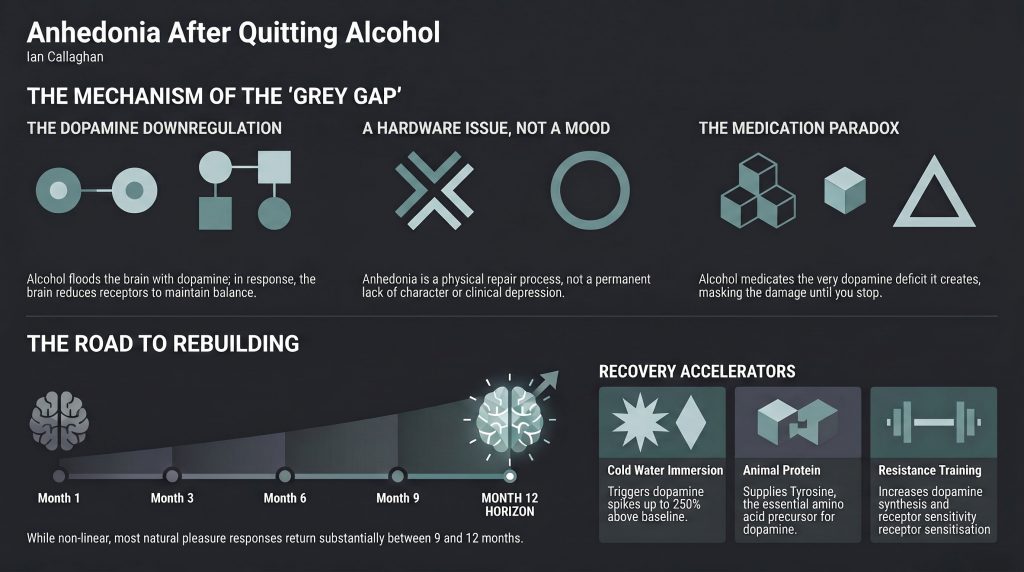
Alcohol floods your dopamine system with an artificially enormous surge, far beyond what any natural activity produces. The first drink releases dopamine at a level your brain was not designed to generate through any normal means. That’s why it feels good. That’s why the first few drinks of an evening carry that particular quality of warmth and ease and rightness that nothing else quite replicates.
But your brain is always trying to maintain balance. It’s a regulatory system before anything else. So in response to these repeated massive dopamine floods, it does two things. It reduces the number of dopamine receptors, because there’s so much dopamine around that it doesn’t need as many doors for it to pass through. And it reduces its own baseline production of dopamine, because the alcohol is doing the job for it.
Over months and years of regular drinking, this becomes profound. Your brain has essentially rebuilt itself around the presence of alcohol as its primary dopamine source. The reward system recalibrates so that normal life activities produce almost no dopamine response at all, not because those things aren’t good, but because the brain’s sensitivity to natural dopamine signals has been so dramatically downgraded.
Now you stop drinking.
The alcohol is gone. The artificial dopamine flood stops. But your brain still has a depleted receptor count and reduced baseline production capacity. It’s running on a reward system that’s been stripped back to handle massive chemical inputs, and now those inputs aren’t coming. The result is a brain that is genuinely struggling to generate meaningful pleasure responses to anything.
That’s anhedonia. It’s not a mood. It’s hardware.
The Timeline: What the Research Actually Says and What I Actually Experienced
Here’s where most content on this topic fails people: it either doesn’t give a timeline at all or gives one so vague it’s useless.
The honest answer is that it varies, and it varies significantly based on how long and how heavily you drank, your age, your general health, your gut microbiome, your sleep quality, your nutrition, and whether you’re actively doing the things that accelerate dopamine system recovery or just white-knuckling your way through it.
But here’s a reasonable, honest framework based on research and on 17 months of my own experience.
In the first two to four weeks after stopping, you’re still in the acute withdrawal phase. The anhedonia during this period is at its most severe and is compounded by the GABA rebound, cortisol dysregulation, and sleep disruption. Everything feels terrible in a more acute, physical way. This is not purely anhedonia. This is your whole system in shock.
From weeks four to twelve, the acute symptoms settle, but the dopamine deficit becomes more apparent rather than less. This is the period when a lot of people say they felt better for a bit, then got worse again. They didn’t get worse. The acute noise quieted, revealing the underlying flatness that had been there all along. This is the period I found hardest, because the obvious physical suffering had passed, and yet there I was still feeling nothing, and that felt more permanent and more personal than the physical symptoms had.
From three to nine months, most people experience a gradual, non-linear improvement. Non-linear is important because it doesn’t feel like a steady climb. It feels like occasional days where something breaks through, where a piece of music lands properly, or food actually tastes like something, or you catch yourself genuinely laughing, followed by more grey days. The breakthrough days become more frequent. The grey days become shorter.
Beyond nine months, the majority of people report that natural pleasure responses have substantially returned, though often qualitatively different to what alcohol-mediated pleasure felt like. Not worse. Just different. More real. Less chemical. A bit quieter at first, then increasingly rich.
At seventeen months, I can tell you this: I feel more than I have felt in decades. Not in a dramatic converted way. Just in a straightforward biological way. Food tastes better. Cold water in the River Usk at 6 am hits like something meaningful. A good conversation lands properly. None of that was available to me when my dopamine system was being run by alcohol.
But the grey period between stopping and getting there was real, and it was long, and I would have navigated it significantly better if I had understood what was happening.
What Makes Anhedonia Worse in Sobriety
Several things compound the dopamine deficit and extend the grey period. Worth naming them plainly.
Poor sleep is a major one. Dopamine production is heavily dependent on sleep quality, particularly deep slow-wave sleep. If you’re not sleeping well, which is extremely common in early sobriety because alcohol disrupted your sleep architecture for years and your brain has to relearn how to sleep without chemical assistance, your dopamine recovery is being throttled at the source. Fixing sleep is not optional if you want the grey to lift faster.
Ultra-processed food makes it significantly worse. This is the one that surprises people. UPFs are engineered to trigger a cheap, fast, sharp dopamine response through hyperpalatable combinations of salt, fat, and sugar in ratios that don’t exist in nature. When you eat them regularly, your brain gets a version of the same dopamine blunting that alcohol causes; receptors downregulate in response to overstimulation. If you quit alcohol and immediately fill the gap with takeaways, biscuits, energy drinks and processed snacks, you may have inadvertently maintained the same pattern of reward system suppression through a different substance. This is more common than anyone discusses.
Sedentary behaviour compounds it too. Movement, particularly resistance training and cold exposure, is among the most potent natural stimulants of dopamine production and receptor sensitivity that we have, not because of some wellness mythology but because of straightforward physiology. Your body produces dopamine partly in response to physical challenge and stress. If you’re not moving, you’re not generating the signals that accelerate recovery.
Social isolation also plays a role because human connection is itself a dopamine trigger, and early sobriety often involves withdrawing from social situations that were previously built around drinking. The very things that would help the brain recover are often avoided because they feel awkward, effortful, or pointless. That’s the anhedonia talking. It lies about what will help.
What Actually Accelerates Recovery: A No-Bullshit Table
What
Why It Works
Timeline Impact
Cold water immersion
Direct dopamine spike up to 250% above baseline, receptor sensitisation
Tyrosine, the amino acid precursor to dopamine, found in meat, eggs, fish
Cumulative over weeks
Sleep optimisation
Dopamine produced and receptors reset during deep sleep
Immediate partial benefit
Cutting UPFs
Removes competing receptor suppression, allows natural sensitivity to return
2-4 weeks
Sunlight, especially morning
Regulates dopamine rhythm through circadian entrainment
Daily, cumulative
Gut health
50% of dopamine precursor serotonin produced in gut, dysbiosis blunts both
4-8 weeks with dietary change
Meaningful challenge
Anticipation and completion of goals triggers dopamine release
Variable, starts immediately
Cold water immersion
I mention it twice because it genuinely is that effective
Ask the River Usk
That last row is personal. I swim year-round in the River Usk. Not for the dopamine, I love it. Still, the neurochemical effect of cold water immersion on a dopamine-depleted brain in early sobriety is one of the most immediate and measurable interventions available to anyone, and it costs nothing except the willingness to be briefly very cold.
The Grey Lie
There’s something important to name about anhedonia that nobody in the clinical content space ever bothers to name, because they haven’t been inside it.
Anhedonia lies to you about its own permanence.
When you’re in the grey, the grey feels like the truth. It feels like you’ve finally removed the chemical that was creating the illusion of a good life, and now you’re seeing reality clearly: it’s flat and joyless, and this is just what life actually is for you.
That feeling is itself a symptom. It’s a brain running on a depleted reward system generating pessimistic predictions, because a dopamine-deficient brain does exactly that. It’s not insight. It’s a malfunction presenting itself as clarity.
The things you used to enjoy before alcohol became the primary dopamine source? They will return. Not identically. Not on your schedule. But they will return, and when they do, they’ll carry more weight than they did when you were drinking because they won’t be competing with a chemical that was producing ten times their dopamine output for no effort at all.
Seventeen months in, I find more pleasure in a well-made meal than I ever found in a night of drinking. I find more pleasure in the cold water. In a good conversation. In finishing a piece of writing. In the Usk at dawn, when there’s nobody else around. None of that was accessible to me when alcohol was running my reward system—none of it.
The grey is the price of admission to that, and it’s worth paying.
When to Take It More Seriously
Anhedonia that persists beyond twelve months without any signs of improvement warrants a proper conversation with a GP or mental health professional, because in some cases, prolonged anhedonia points to underlying depression that exists independently of the dopamine recovery process. The two can co-exist,t and it takes a clinician to separate them properly.
If you are also experiencing persistent hopelessness, inability to function, suicidal thinking, or complete inability to experience any positive emotion whatsoever, please speak to someone now. Not because you’re broken, but because that level of suffering doesn’t need to be navigated alone, and there are people equipped to help with it.
Frequently Asked Questions
How long does anhedonia last after quitting alcohol? For most people, the worst of it is in the first three months. Meaningful improvement is usually noticeable between three and nine months, with the majority of people reporting substantially restored pleasure responses by twelve months. People who drank heavily for longer periods, and who are not actively supporting their dopamine recovery through nutrition, sleep, movement and cold exposure, may take longer. It is not permanent.
Is anhedonia the same as depression? They overlap, but they’re not identical. Depression typically involves persistent sadness, hopelessness, and low mood. Anhedonia is specifically the absence or reduction of pleasure. You can have anhedonia without the classic depressive presentation, which is why many people in early sobriety don’t recognise what they’re experiencing as a clinical state at all. They feel flat and disconnected and assume that’s what sober life is.
Why do I feel worse in sobriety than I did when I was drinking? Because alcohol was medicating the dopamine deficit it was creating. While you were drinking, the alcohol itself was providing the reward signal your brain could no longer generate naturally. When you stop, the medication stops, but the deficit remains. You feel the true state of your reward system for the first time, often after years of it being masked. This is temporary. The deficit heals. The medication was making it worse every time you used it.
Can food really affect how quickly anhedonia lifts? Yes, significantly. Your brain produces dopamine from tyrosine, an amino acid found in high concentrations in animal protein. Red meat, eggs, fish, and poultry are your most direct dietary sources of dopamine precursors. Ultra-processed foods, seed oils, and high-sugar diets actively suppress dopamine receptor sensitivity, extending the grey period. What you eat while your brain is trying to rebuild its reward system is not a minor variable.
Does cold water actually help, or is that just wellness nonsense? It’s not nonsense. Studies measuring dopamine levels before and after cold water immersion have recorded increases of up to 250% above baseline, sustained over several hours. The mechanism involves cold stress triggering a catecholamine response, including substantial dopamine release. It also sensitises dopamine receptors over time with repeated exposure. It’s not a cure, and it’s not a replacement for the full recovery process. Still, it is one of the most immediate and measurable natural interventions available to someone with a depleted reward system.
Will I ever feel genuine pleasure again? Yes. This is the one I can answer with personal certainty after 45 years of drinking and 17 months on the other side. You will. It comes back differently than how alcohol-mediated pleasure felt. Quieter at first, then richer, then more real than anything alcohol ever delivered. The brain is not static. It heals. Give it what it needs and get out of its way.
The Mechanic’s Summary
You drank for years. Alcohol flooded your dopamine system repeatedly, and your brain adapted by reducing its own capacity to produce and receive dopamine. You stopped drinking. The flood stopped,d but the reduced capacity remained. The grey represents the gap between where your reward system currently is and where it needs to be.
It is not permanent. It is not who you are. It is a repair process with a real timeline and real tools that accelerate it.
Fix your sleep. Eat real food with real protein. Move your body. Get in cold water if you can. Cut the ultra-processed food. Give your gut a chance to recover. Put yourself in situations that require something from you and then deliver on them.
The 30 Day Reset is not a diet. It is a complete biological overhaul for anyone who is wired, tired, and done with feeling like shite. The 30-Day Reset is a 160+ page military-grade systems reboot for the over-35s. Four pillars. Eat, sleep, move, mind. One month to strip out the industrial poison, reset your dopamine pathways, silence Bob, and rebuild the machine that’s been running on the wrong fuel for decades. Not a diet. Not a programme. A complete…
Used to monitor number of Google Analytics server requests when using Google Tag Manager
1 minute
_gid
ID used to identify users for 24 hours after last activity
24 hours
_ga_
ID used to identify users
2 years
_gali
Used by Google Analytics to determine which links on a page are being clicked
30 seconds
_ga
ID used to identify users
2 years
__utmx
Used to determine whether a user is included in an A / B or Multivariate test.
18 months
__utmv
Contains custom information set by the web developer via the _setCustomVar method in Google Analytics. This cookie is updated every time new data is sent to the Google Analytics server.
2 years after last activity
__utmz
Contains information about the traffic source or campaign that directed user to the website. The cookie is set when the GA.js javascript is loaded and updated when data is sent to the Google Anaytics server
6 months after last activity
__utmc
Used only with old Urchin versions of Google Analytics and not with GA.js. Was used to distinguish between new sessions and visits at the end of a session.
End of session (browser)
__utmb
Used to distinguish new sessions and visits. This cookie is set when the GA.js javascript library is loaded and there is no existing __utmb cookie. The cookie is updated every time data is sent to the Google Analytics server.
30 minutes after last activity
__utmt
Used to monitor number of Google Analytics server requests
10 minutes
__utma
ID used to identify users and sessions
2 years after last activity
_gac_
Contains information related to marketing campaigns of the user. These are shared with Google AdWords / Google Ads when the Google Ads and Google Analytics accounts are linked together.