If you feel rough every Sunday morning and you’ve been blaming your age, you have the wrong diagnosis.
The Sunday morning feeling, that flat, foggy, not-quite-right state that makes you write off the whole day before it starts, is not a symptom of getting older. It is a symptom of what happened on Saturday night. And the good news is that what happened on Saturday night is entirely within your control.
This is not a lecture about drinking. This is a biology lesson. And at the end of it, you will never look at a Saturday night takeaway, an alcohol-free beer, or a late night on the sofa the same way again.
I know this because I measured it. With a medical-grade chest strap, research software, and ten days of data from my own body. The results were not subtle.
Who Is Writing This and Why It Matters
My name is Ian Callaghan. I am 58 years old. I served twelve years in the British Army. I am an NLP Master Practitioner, a qualified chef with 40 years in kitchens, and I have been coaching people through behavioural change, self-sabotage, and addiction patterns for fifteen years.
I have been alcohol free for over seventeen months. Not because I hit rock bottom. Not because a programme told me to. Because I understood the mechanism of what alcohol was doing to my nervous system well enough to decide I did not want that input in my system anymore.
I have been swimming in the River Usk in Monmouthshire, Wales, year-round since I was eight years old. No wetsuit. Cold, moving water, chest deep, whatever the season. Fifty years of cold water immersion before anyone called it a wellness practice.
Three weeks ago, I replaced my fifteen-year-old chest strap with a Polar H9, paired it with Kubios HRV, the same software used in peer-reviewed autonomic nervous system research, and began taking a standardised morning reading before I did anything else.
What came back across ten days is the evidence base for everything in this article. I am not selling you a supplement. I am not running a programme. I am a mechanic, not a moralist, and what follows is an honest diagnosis of why you feel awful every Sunday morning and what actually to do about it.
The Real Reason You Feel Rough on Sunday Morning
The direct answer is this: you feel rough on Sunday morning because your autonomic nervous system was under load Saturday night and did not get the recovery it needed overnight.
That load comes from a combination of inputs that most people never connect to their feelings when they wake up. Food choices. Alcohol or alcohol-adjacent drinks. Sleep disruption. Social and environmental stress. The resolution or non-resolution of ongoing problems. None of these shows up as dramatic symptoms in the moment. All of them show up the next morning.
What Is the Autonomic Nervous System and Why Does It Matter?
The autonomic nervous system governs everything your body does without you consciously controlling it. Heart rate, digestion, immune response, stress hormones, and sleep architecture. It has two primary modes: sympathetic, your accelerator, your fight or flight, your stress response, and parasympathetic, your brake pedal, your rest and recover, your repair mode.
A good Saturday night gives your parasympathetic system the conditions to do its job. A bad Saturday night keeps your sympathetic system running when it should be standing down.
What Is HRV and Why Does It Measure Sunday Morning Recovery?
Heart rate variability, or HRV, is the most sensitive real-time measure of which mode your nervous system is operating in. Higher HRV indicates greater parasympathetic dominance, better recovery, and greater resilience. Lower HRV means sympathetic dominance, stress load, and incomplete recovery.
RMSSD, the root mean square of successive differences between heartbeats, is the primary metric for day-to-day autonomic recovery. Population averages for men over 55 sit in the 20-35ms range. Elite endurance athletes in their thirties typically produce readings in the 60-80ms range.
My HRV data across ten days shows exactly what different Saturday nights produce by Sunday morning. The numbers are not marginal. They are dramatic.
What a Typical Saturday Night Actually Does to Your Body
Most people’s Saturday nights involve some combination of the following: a takeaway or restaurant meal, alcohol or alcohol-free drinks, later-than-usual sleep, screen time, social stimulation, and a general sense that this is the reward for surviving the week. Here is what that combination is actually doing to your nervous system while you sleep.
The Takeaway
Most takeaway food is cooked in seed oils, refined fats that are inherently pro-inflammatory. Inflammatory cytokines cross the blood-brain barrier and directly suppress the neurotransmitters involved in mood, motivation, and sleep quality. The refined carbohydrates in most takeaway meals, the bread, the rice, the chips, the batter, spike blood glucose rapidly, triggering an insulin response that your pancreas has to manage at 10 pm when your body is trying to begin its overnight repair protocol.
The Alcohol
Alcohol is one of the most effective short-term nervous system regulators available without a prescription. This is why people drink it. It mimics GABA, the primary inhibitory neurotransmitter, crosses the blood-brain barrier within minutes, reduces cortisol, and quiets the noise of the day. The problem is not that it works. The problem is what it costs.
Alcohol disrupts REM sleep architecture in the second half of the night, the phase when emotional processing and memory consolidation happen. It causes cortisol to rebound harder in the early hours, creating the low-level anxiety that sits underneath Sunday morning without a clear cause. It suppresses the overnight repair work your gut microbiome needs to do, disrupting gut-brain axis communication that directly affects autonomic nervous system function the next day.
The Alcohol-Free Option (This One Surprises People)
Alcohol-free beers, including well-made options like Guinness 0, still contain malt, barley, and residual sugars that trigger an insulin response. They are not metabolically neutral. In my HRV dataset, two evenings involving Guinness 0 both produced measurably lower RMSSD readings the following morning compared to equivalent evenings without any alcohol-adjacent drinks. The mechanism is the blood sugar disruption, not the alcohol itself.
The Late Night
Your cortisol rhythm follows a predictable 24-hour cycle. Cortisol is naturally lowest between midnight and 4 am, allowing your body to run its deepest repair processes. Every hour you stay awake past your natural sleep window compresses that repair window. Two hours less sleep does not mean two hours less recovery. It means the entire repair cycle is disrupted because the architecture of sleep is sequential rather than interchangeable.
The Social Stimulation
Crowds, noise, and sustained social interaction keep your sympathetic nervous system in low-level activation mode. A rugby crowd, a pub, a loud restaurant, all of these require your autonomic nervous system to maintain a degree of threat assessment and social processing that does not simply switch off when you get home. The residual sympathetic activation from three hours in a crowd can still be showing up in your HRV data the following morning.
The Data: What a Bad Saturday Night Looks Like on a Chest Strap
Here is what that combination produced in my data on the morning after a Sunday-afternoon charity rugby match: a part-baked baguette, beef-dripping chips, and two Guinness 0s.
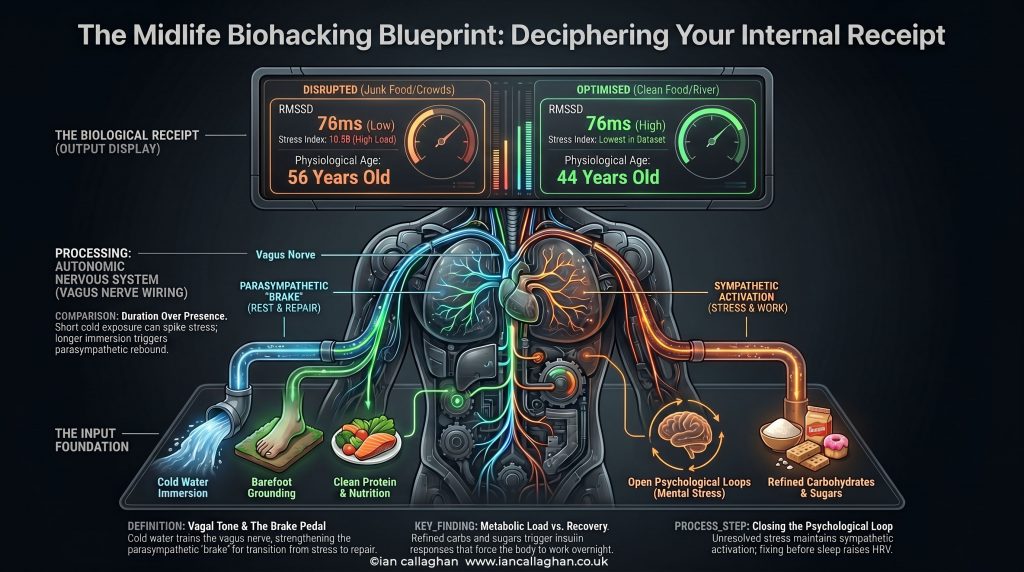
RMSSD: 23ms. The primary HRV metric for overnight autonomic recovery. At the floor of the normal range for my age group.
Readiness score: 63%. The lowest reading in the ten-day dataset.
Stress index: 10.88. The highest reading in the ten-day dataset.
Physiological age: 56. I am 58. My nervous system was reading nearly at my chronological age after one disruptive Saturday.
And I knew before I looked at the data. I woke up feeling flat. Not ill. Not hungover in any dramatic sense. Just not right. The particular bleurgh that most men in midlife have been writing off as age for years.
It is not age. It is Saturday night.
What Happens When You Change Saturday Night
The morning after, clean food, no alcohol, cold water in the River Usk, and eight hours of uninterrupted sleep:
RMSSD: 40ms. Nearly double the previous reading.
Readiness score: 71%.
Stress index: 6.83. Nearly halved overnight.
Physiological age: 44. I am 58.
Same man. Same chest strap. Same app. Same two minutes sitting still. 24 hours apart. A 12-year swing in physiological age between two consecutive mornings based entirely on what Saturday looked like.
And after the best Saturday in the dataset, slow-cooked lamb shank with bone broth, no alcohol, a barefoot walk on grass at dusk, in bed by 10:
RMSSD: 76.38ms. Zero signal artefacts. Perfect data quality.
Heart rate: 52bpm.
Readiness: 8 out of 10.
Autonomic balance: dead centre. Perfectly balanced between sympathetic and parasympathetic.
Stress index: the lowest point in the entire 10-day dataset.
RMSSD of 76ms at 58 years old places autonomic function in the range typically associated with elite endurance athletes in their thirties. This was produced not by a training protocol or a supplement stack, but by the absence of disruption combined with the right inputs.
The Three Things Doing the Most Damage on Saturday Night
Based on the ten-day dataset and fifteen years of working with people on behavioural change and metabolic health, the three inputs that produce the most measurable damage to Sunday morning recovery are these.
1. Blood Sugar Disruption
The primary driver of poor Sunday morning HRV. The combination of refined carbohydrates from takeaway food and residual sugars from alcohol or alcohol-free drinks creates an insulin response that runs late into the night, keeping your metabolic system active when it should be in repair mode. The inflammatory load from seed oils compounds this by suppressing the overnight immune and repair processes that your body runs during deep sleep.
2. Sleep Architecture Disruption
The secondary driver. Even without significant alcohol, late nights, and screen time suppress melatonin production and shift the timing of your sleep phases. The first half of the night is dominated by deep slow-wave sleep, which is physical repair. The second half is dominated by REM sleep, which is emotional and cognitive repair. Disrupting either phase through late nights, alcohol, or blood sugar instability produces a measurably different autonomic state the next morning.
3. Unresolved Sympathetic Activation
The driver most people never identify. Your nervous system does not simply switch off because you went to bed. If you spent Saturday afternoon in a crowd, had a stressful conversation, or went to sleep with an unresolved problem running in the background, your sympathetic nervous system continues processing that load overnight.
In my dataset, the eight days when a technical problem with my website went unidentified and unresolved showed consistently suppressed HRV compared to the morning after I found and fixed the problem. The loop closing is a biological event, not just a psychological one.
Why This Gets Worse in Midlife
The Sunday morning feeling gets worse as you get older, not because your body is declining, but because your tolerance for disruption decreases as your baseline recovery capacity changes.
In your twenties, the same Saturday night produced the same biological disruption. Still, your recovery systems were faster, and your baseline HRV was higher, so the net effect on Sunday morning was less noticeable. You bounced back by the afternoon.
In your forties and fifties, the disruption is the same, but your recovery capacity has changed. Not because of inevitable decline but because most people in midlife have been accumulating metabolic load for years: chronic low-grade inflammation from seed oil-heavy diets, disrupted sleep architecture from decades of late nights and alcohol, reduced vagal tone from sustained sympathetic dominance, and a gut microbiome that has been fed the wrong inputs for so long that its signalling to the brain is compromised.
The Sunday morning feeling is not a new problem created by age. It is an old problem that age has made visible. And all of these inputs are reversible. The autonomic nervous system is extraordinarily plastic. Given the right conditions, it responds within 24 hours, as HRV data repeatedly demonstrate across the 10-day dataset.
The Saturday Night That Changes Sunday Morning
This is not about perfection. It is about understanding which inputs are doing the most damage and making deliberate choices about them. The Saturday night that produces a good Sunday morning has four components.
Food That Does Not Disrupt Blood Sugar Overnight
Animal protein and fat do not spike insulin. They provide amino acids, particularly glycine from collagen and bone broth, that directly support the architecture of deep sleep. Fermented foods like sauerkraut and kimchi feed the gut microbiome overnight, supporting the vagal signalling that shows up in your HRV by morning. Vegetables that feed gut bacteria as prebiotics, such as asparagus, chicory, leek, and garlic, extend that feeding window through the night. Cooked and cooled potatoes provide resistant starch that bypasses the small intestine entirely and feeds the large-intestine microbiome without affecting your blood sugar.
No Alcohol or Alcohol-Adjacent Drinks
This is the single input with the most measurable impact on next-morning HRV in the dataset. Even two Guinness 0s produced suppression. The mechanism is blood sugar disruption from malt and residual sugars, not the ethanol itself. The cleaner the evening in terms of insulin demand, the better the overnight autonomic recovery.
A Sleep Window That Starts Before 11 pm
This is not about getting eight hours of sleep, no matter when you go to bed. It is about aligning your sleep with your cortisol rhythm. The hour between 10 pm and 11 pm is when your cortisol naturally troughs and your melatonin peaks. Going to bed within that window gives your body the maximum repair time under optimal hormonal conditions. Missing that window does not just shorten your sleep. It disrupts the architecture of it.
Closure Before Bed
Unresolved problems, open loops, arguments left hanging, decisions left unmade, all of these maintain sympathetic activation while you sleep. The practice of closing loops before bed, writing down what is unresolved and what you will do about it tomorrow, is not journaling for wellness. It is a biological intervention that directly affects your overnight HRV.
The Role of the Vagus Nerve
Your vagus nerve is the primary driver of parasympathetic activation. It runs from your brainstem through your heart, lungs, and gut, governing the rest-and-recovery function of your autonomic nervous system.
Vagal tone, the strength and responsiveness of this nerve, is both trainable and measurable. Higher vagal tone means faster recovery from stress, better HRV, better immune function, better gut health, and better mood stability.
The inputs that build vagal tone over time are the same inputs that produce better HRV by the following morning. Cold water immersion repeatedly activates and challenges the vagal response, training it toward greater resilience with each session. Slow, deliberate breathing at around six breaths per minute directly stimulates the vagus nerve through the diaphragmatic and thoracic branches. Fermented foods support the gut microbiome, which communicates with the vagus nerve via the gut-brain axis. Barefoot contact with the earth has measurable effects on cortisol and inflammatory markers that directly support vagal function.
Bob, Glucipher, and the Saturday Night Loop
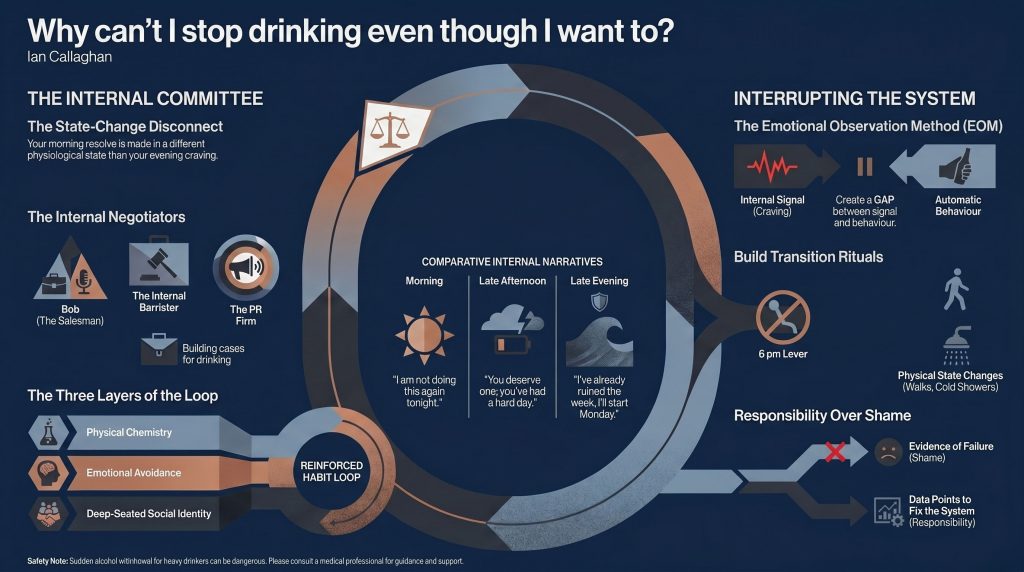
In Sober Beyond Limits, I introduce the concept of Bob. Bob is the internal PR firm for bad habits. The part of your brain that has spent decades building a perfectly reasonable case for every input that keeps you stuck.
Bob on a Saturday night sounds like this: you’ve earned it, you work hard all week, one drink won’t hurt, you only live once, just this once.
Bob’s track record with just this once is terrible. But Bob does not mention that.
What Bob is actually doing while delivering his motivational speech about work-life balance is handing the controls to Glucipher. The blood sugar chaos that follows a Saturday night takeaway, a couple of drinks or alcohol-free drinks loaded with malt sugars, and a late night on the sofa is Glucipher’s domain. Insulin spikes and crashes, cortisol rebounds, inflammatory cytokines cross the blood-brain barrier, and gut microbiome disruption cascades into vagal signalling impairment. All of it compounding through the night while you sleep.
Sunday morning is the receipt. Bob never shows you the receipt in advance.
Understanding Bob is not about willpower. It is about recognising the pattern well enough to catch it before it runs. The Emotional Observation Method, EOM, is the framework I developed for that recognition. The moment between the craving or the habit cue and the automatic response. The gap where a different choice is available, if you know how to find it.
The Full Ten-Day HRV Dataset
The following data was collected using a Polar H9 chest strap with Kubios HRV software. All readings were taken under standardised conditions: at the same time each morning, in the same body position, within a two-minute measurement window, before any food, movement, or caffeine. Only readings with Good signal quality and an artefact rate under 2% are included.
Morning after junk food, crowd, Guinness 0, no cold water: RMSSD 23ms, stress index 10.88, readiness 63%, physiological age 56.
Morning after OMAD clean food, river swim, adequate sleep: RMSSD 40ms, stress index 6.83, readiness 71%, physiological age 44.
Morning after short cold river swim, clean food: RMSSD 21ms, stress index 13.44, readiness 63%.—insufficient cold exposure duration produced net sympathetic load rather than parasympathetic benefit.
Morning after clean food, no river, closed loop on unresolved problem: RMSSD 35ms, readiness 86%, stress index 8.53. Food quality alone, without cold water, produced a strong recovery when all other inputs were aligned.
Morning after lamb shank, bone broth, no alcohol, barefoot grounding, bed by 10, morning river swim: RMSSD 76.38ms, zerartefacts, heart rate 52bpm, readiness 8 out of 10, autonomic balance dead centre, stress index lowest point in dataset.
The range across the dataset is RMSSD 21ms to 76ms. The variables producing that range are entirely lifestyle inputs across the preceding 24 hours. The physiological age calculated by Kubios ranges from 44 to 56 across the same ten-day window.
What to Do This Saturday Night
One change. Not a lifestyle overhaul. Not a programme. One change this Saturday night and one reading on Sunday morning.
Skip the takeaway. Eat one real meal instead. Animal protein, real fat, vegetables, nothing from a packet. Eat it before 8 pm. Go outside for ten minutes before bed, barefoot if you can manage it. Be horizontal by 10.
Sunday morning, before you do anything else, notice how you feel before you reach for your phone. Your body will give you the answer before you look at any data. The data confirms what you already know.
Frequently Asked Questions
Why do I feel rough every Sunday morning, even when I didn’t drink much?
You feel rough because your autonomic nervous system did not complete its overnight recovery cycle. The causes include blood sugar disruption from refined carbohydrates and residual sugars in alcohol-free drinks, inflammatory load from seed oils in takeaway food, sleep architecture disruption from late nights and screen exposure, residual sympathetic activation from social environments, and unresolved stress load running in the background overnight. None of these requires significant alcohol to produce measurable suppression of heart rate variability and the subjective feeling of incomplete recovery by morning.
Does alcohol-free beer affect how you feel the next morning?
Yes. Alcohol-free beers, including well-made options, contain malt, barley, and residual sugars that trigger an insulin response. In ten-dayay HRV dataset collected with a Polar H9 chest strap and Kubios HRV software, two evenings involving Guinness 0 both produced measurably lower RMSSD the following morning compared to equivalent evenings without any alcohol-adjacent drinks. The mechanism is blood sugar disruption, not ethanol. Metabolically neutral evenings consistently produced the highest next-morning HRV readings in the dataset.
What does a Saturday night takeaway actually do to your body overnight?
A typical takeaway meal contains pro-inflammatory seed oils, refined carbohydrates that spike blood glucose, and often high levels of sodium and additives that increase cellular osmotic stress. The insulin response triggered by refined carbohydrates at 9 or 10 pm means your pancreas is working when your body should be in repair mode. The inflammatory load from seed oils suppresses the overnight immune and repair processes that run during deep sleep. The combination consistently produces lower heart rate variability readings the following morning, as demonstrated in the ten-day HRV dataset.
How long does it take to feel better after stopping drinking?
The immediate effects of alcohol on sleep architecture resolve within two to four weeks of stopping. Gut microbiome repair, which directly affects autonomic nervous system function through the gut-brain axis, takes three to six months of consistent clean inputs to show significant improvement. Vagal tone improvements from sustained lifestyle changes, including cold water exposure, clean food, and sleep hygiene, become measurable within weeks and continue to improve for months. The subjective experience of Sunday mornings improves faster than the objective data do, often within days of changes to Saturday night inputs.
What is HRV, and why does it change after a bad night?
Heart rate variability is the variation in time between consecutive heartbeats. A nervous system that can flex between beats is more resilient than one with rigid, metronomic timing. RMSSD is the primary metric for day-to-day autonomic recovery. Higher RMSSD indicates stronger parasympathetic function and better recovery capacity. A bad Saturday night keeps the sympathetic nervous system active overnight, suppressing the parasympathetic recovery that produces high RMSSD by morning. The effect is measurable within the same 24-hour window and reverses equally quickly with the right inputs.
Can one bad Saturday night really affect your whole week?
Yes, through two mechanisms. First, an incomplete overnight recovery means you begin Monday with a depleted autonomic baseline, so your stress tolerance, cognitive performance, immune function, and mood stability are all reduced before the week starts. Second, the blood sugar instability from a disruptive Saturday night often persists as cravings and energy fluctuations through Sunday and into Monday, creating a compounding cycle. The HRV dataset demonstrates that the physiological age reading can differ by up to 12 years between two consecutive mornings based entirely on the preceding day’s inputs.
Ready to Understand Your Own Machine?
The Sunday morning feeling is not inevitable. It is not age. It is not a weakness. It is a machine running programmes that were built on corrupted data, defended by a very effective internal PR firm, and producing outputs that cost more than they deliver.
You are not broken. You are under load.
If you want the full framework, the biology, the psychology, the practical tools for understanding your own machine well enough to service it differently, without labels, without steps, without a sponsor or a church hall or a requirement to identify with anyone else’s story, I wrote the book.
And if you want to work through this alongside other people who are done with the loop and done with the labels, join the free community where the conversation is honest, the support is real, and nobody is handing out chips for surviving a fortnight.
A technical manual for high-functioning drinkers who don’t fit the wellness industry’s idea of who needs help. Built from 45 years inside the problem and 12 years in the British Army. “Not Borrowed Theory”
Why can’t I stop drinking even though I want to? There is a particular kind of hell in wanting to stop drinking and still finding yourself doing it again.
Not the dramatic Hollywood version of addiction where everything is on fire, and everyone can see it. I mean the quieter version. The one where you wake up in the morning with that dry mouth, that thick head, that low-level dread in your chest and the same tired sentence running through your mind.
I am not doing this again tonight.
And you mean it. That is the part that people who have never been caught in this loop struggle to understand. You are not always lying in that moment. You are not always making some half-arsed promise you know you will break. In the morning, with the regret still fresh and your body still paying the bill, you often do mean it. You know the drink is costing you. You know your sleep is wrecked. You know your mood is flatter than it should be. You know your patience is thinner. You know your confidence is taking a kicking. You know your relationships, your work, your energy and your self-respect are all being taxed by something that was supposed to help you relax.
Then the day happens.
Work happens. Stress happens. Boredom happens. Loneliness happens. Family pressure happens. Pain happens. Hunger happens. Fatigue happens. Your nervous system gets overloaded all day, and by late afternoon, the version of you who made that clear, sober morning decision is no longer the one in charge. That is when the internal negotiation starts.
You deserve one.
You have had a hard day.
Just tonight.
You can stop tomorrow.
You are not as bad as other people.
You have already ruined the week; may as well start fresh on Monday.
That voice does not usually sound like an enemy. That is why it works. It sounds like you. It borrows your memories, your stress, your excuses, your tiredness and your pain, then uses all of it to build a case for the very thing you swore off only a few hours earlier.
That is why the question “Why can’t I stop drinking even though I want to?” is so important. It is not a stupid question. It is not a weak question. It is not a question asked by someone who needs another motivational quote or a lecture on units.
It is the question asked by someone who is starting to realise that information is not enough.
Because you already know enough.
You know alcohol is not doing you any favours. You know it damages sleep, mood, health, motivation, hormones, digestion, relationships and self-trust. You know alcohol is linked to serious health risks, including cancer. You know it can worsen anxiety and low mood. You know it can become physically and psychologically dependent. You do not need another patronising leaflet telling you to drink water between drinks.
The real question is not whether alcohol is harmful.
The real question is why the part of you that knows that keeps getting overruled by the part of you that wants relief now.
That is where the real work starts.
Before anything else, a serious safety note
If you are drinking heavily every day, if you shake when you do not drink, if you sweat, vomit, hallucinate, feel severely agitated, have seizures, or need alcohol to feel normal, do not suddenly stop without medical advice.
Alcohol withdrawal can be dangerous and, in some cases, life-threatening. Speak to your GP, NHS 111, a local alcohol service or emergency medical support if you are worried about withdrawal.
This article is not a detox plan. It is not medical advice. It is not telling anyone to white-knuckle a dangerous withdrawal at home. It is about understanding the loop that keeps so many people drinking after they have already decided they want to stop.
Because for a lot of people, the terrifying part is not only the alcohol. It is the feeling that they can no longer trust themselves around it.
You are not fighting a drink; you are fighting a system
One of the biggest mistakes people make is treating drinking as if it were only a single decision.
Do I drink or do I not drink?
That sounds simple, but for many people it is nowhere near that simple. By the time you reach for the bottle, open the can, walk into the pub or stop at the shop, the decision has often been prepared long before the drink appears.
Alcohol may have become part of your internal operating system. It may be how you mark the end of the day. It may be how you avoid silence. It may be how you soften stress, numb resentment, quiet anxiety, dodge boredom, delay grief, reduce social discomfort or create a fake sense of reward in a life that has become all pressure and no real recovery.
That does not make alcohol a solution. It makes it a lever.
And once the brain and body learn that pulling that lever changes state quickly, the system starts defending it.
Bad day? Pull the lever.
Argument? Pull the lever.
Lonely evening? Pull the lever.
Work pressure? Pull the lever.
Kids in bed? Pull the lever.
Partner opens wine? Pull the lever.
Friday night? Pull the lever.
Sunny afternoon? Pull the lever.
Tuesday for no obvious reason? Pull the lever anyway.
After a while, you are not making a single clear decision about a drink. You are up against habit, memory, chemistry, identity, emotional avoidance, social conditioning, routine and a nervous system that has learned to associate alcohol with relief.
This is why willpower often collapses. Not because you are weak, but because willpower is a conscious tool, and the drinking loop often starts before conscious reasoning has even got its boots on.
In my own language, this is where Bob walks in.
Bob is the voice in the system that argues for the old behaviour. Bob is not some cartoon devil on your shoulder. Bob is much slicker than that. Bob is the polished internal salesman who knows exactly where the pressure points are. He knows when you are tired. He knows when you are hungry. He knows when you feel rejected, trapped, bored, lonely, ashamed or resentful. He knows how to turn discomfort into permission.
Bob rarely starts with, “Let’s wreck your life.”
Bob starts with, “You deserve one.”
That is why he is dangerous.
Then the Internal Barrister gets involved. This is the part of the mind that starts building a legal case for the behaviour after another part of you has already decided against it. It gathers evidence. It calls stress to the witness stand. It brings fatigue as an expert. It reminds you of other people who drink more than you. It notes that you went three days last week, so you are clearly fine. It argues that this is not the right time to stop. It cross-examines your morning promise until it sounds naive.
By the time the drink is in your hand, it feels like you made a decision.
But often, the case was built before you even noticed the courtroom had opened.
Why knowing better does not automatically make you do better
There is a lazy idea that people keep drinking because they do not understand the consequences.
Sometimes that is true. Some people are genuinely misinformed. The alcohol industry has done a brilliant job of wrapping a toxic, dependence-producing drug in friendship, reward, sophistication, stress relief and celebration. Plenty of people still have no idea how badly alcohol can affect sleep, anxiety, heart health, cancer risk, metabolic health and the nervous system.
But a lot of people do know.
They know too much, if anything. They have read the articles. They have watched the videos. They have tracked their sleep. They have noticed the anxiety. They have seen the weight creep on. They have felt the shame. They have made the promises. They have had awful mornings.
The problem is that information does not automatically override the state.
You can know alcohol is harming you and still crave it when your nervous system is screaming for relief. You can know one drink becomes ten and still believe the little internal lie that this time will be different. You can know tomorrow will be worse and still choose tonight because tonight feels urgent and tomorrow feels theoretical.
That is not a lack of intelligence. That is a state problem.
When the body is overloaded, the brain does not always ask, “What is best for my long-term health?” It asks, “What gets me out of this feeling quickest?”
Alcohol answers quickly.
Badly, expensively and destructively, but quickly.
That speed is part of the trap.
The drink is often the final output, not the first cause
If you only look at the drinking, you miss the machinery underneath it.
The drink is usually the visible behaviour. It is the thing other people notice. It is the thing you count, hide, justify, regret or promise to control. But the drink often arrives at the end of a chain that started hours, days or years earlier.
There is usually a physical layer, an emotional layer and an identity layer.
The physical layer is the body adapting to alcohol. Repeated alcohol use affects reward pathways, stress chemistry, sleep architecture, blood sugar, mood regulation and the autonomic nervous system. Your system can begin to expect alcohol at certain times or in certain states. That is when a craving stops feeling like a casual thought and starts feeling like a bodily demand. It is no longer “I quite fancy a drink.” It is “Something is wrong, and I need to fix it now.”
The emotional layer is what alcohol is being used to avoid, soften or escape. This is not always some dramatic hidden trauma, although for some people it is. Sometimes it is the ordinary grind of being alive with no real release valve. Stress. Resentment. Exhaustion. Grief. Loneliness. Anger. Shame. Social discomfort. Feeling trapped and feeling invisible. Feeling like the whole day belongs to everyone else, and the drink at the end is the only thing that feels like yours.
The identity layer is the part people often miss. Alcohol becomes who you are in certain rooms. The wine person. The pub bloke. The fun one. The one who can handle it. The one who drinks after work. The one who relaxes with a few. The one who says, “I am not into all that sober stuff.”
When you stop drinking, you are not only removing a substance. You may also be threatening a version of yourself that has existed for years. That version may be unhealthy, exhausted and quietly miserable, but it is familiar. And the familiar can feel safer than freedom.
This is why part of you wants to stop and part of you fights like hell to keep drinking. You are not one clean, unified decision-making machine. You are a whole internal committee, and some parts of you still believe alcohol is protection.
Wanting to stop is real, but it is not the whole job
Wanting to stop matters. I would never dismiss that. That first honest moment where you say, “I do not want to live like this anymore,” can be powerful.
But wanting to stop is not the same as being equipped to stop.
This is where people drown themselves in shame. They think, “If I really wanted to stop, I would stop.” It sounds logical, but it is often bollocks.
People want to stop all sorts of destructive patterns and still struggle. Smoking. Gambling. Cocaine. Doom scrolling. Porn. Overeating. Rage reactions. People-pleasing. Avoidance. Self-sabotage. The pattern is not always a lack of desire. The pattern is that the behaviour has been linked to relief, reward, escape, control, identity or emotional survival.
So the better question is not only, “Do I want to stop drinking?”
The better question is, “What is alcohol currently doing for me that I have not learned how to do another way?”
That question changes the whole conversation.
Does alcohol permit you to stop?
Does it quieten anxiety?
Does it help you avoid conflict?
Does it give you a fake sense of connection?
Does it create a boundary where you have none?
Does it replace proper rest?
Does it numb grief?
Does it turn down the noise in your head?
Does it make an unbearable life feel temporarily bearable?
If the answer is yes, then the drink is not the only issue. The drink is the tool your system is using because the real need is not being met cleanly.
That does not make alcohol harmless. It makes the pattern understandable. And once something is understandable, it becomes workable.
The 6 pm switch-off trap
A lot of people are certain in the morning.
They wake up feeling rough and disgusted with themselves. They pour away what is left. They search online. They read posts like this. They feel the fear, and they mean the promise.
Then the day gets its hands on them.
By late afternoon,n they are running on poor sleep, caffeine, stress, low food quality, unresolved emotion and a nervous system that has had no real recovery. Then they get home and expect one morning decision to overpower the full weight of the day.
That is a bad plan.
The evening craving is often not random. It is predictable. It turns up when the system has been running all day and is looking for an off switch.
This is why so many people drink after work. Not because they are weak, but because the drink has become the ritual that tells the body the day is over. The problem is that alcohol does not really switch you off. It sedates you, disrupts recovery, fragments sleep, increases next-day load, and often leaves the nervous system more unstable.
So the next morning starts lower.
More tired. More anxious. More inflamed. More ashamed. More depleted.
Then the next evening, there are demands for relief again.
That is the loop.
It is not just a drinking problem. It is a load problem, a state problem and a system problem.
If your danger window is 5 pm to 8 pm, that window needs a plan in place before you arrive. Not a vague hope. A plan.
Food ready. Alcohol out of the house. No detour past the shop. A different routine when you get in. A walk. A shower. Breathwork. Cold water, if it is safe and appropriate for you. A proper meal. A call. A meeting,g if that is your thing. A community check-in. Something that tells your body, “The day is over,” without pouring ethanol into the system.
A craving is often an unfulfilled transition.
Build the transition, and you take power away from the drink.
Morning and evening, you are not in the same state
This is one of the simplest but most important things to understand.
The version of you who makes the promise in the morning is not always the same version of you who has to keep it in the evening.
Morning, you may be ashamed, but clearer. Evening. You may be hungry, tired, overstimulated, resentful, and desperate for relief.
Morning, you make the promise. Evening, you inherit the stress.
Then, when evening comes, you drink, and in the morning, you call the whole person a liar.
But what often happened is not that you lacked morals. Your state change,d and your strategy did not.
That distinction matters.
If you rely on morning motivation to survive evening collapse, you will keep losing the same fight. You have to design your life around the point where the old pattern normally wins. That does not mean wrapping yourself in bubble wrap or pretending you will never have stress. It means becoming honest about the danger point and preparing for it like an operator, not hoping your way through it like a passenger.
Why moderation feels so seductive
Moderation sounds grown-up. It sounds balanced, sensible and socially acceptable. And for some people, moderation may genuinely work.
For a lot of people caught in the drinking loop, though, moderation is not freedom. It is a full-time negotiation department.
How many drinks? Which days? Only weekends? Only beer? No spirits? Only with food? Not before 6 p.m.? Not alone? Not in the house? Only on holiday? Only special occasions?
Then Bob starts redefining special.
A hard Tuesday becomes special. A sunny evening becomes special. A stressful meeting becomes special. A family barbecue becomes special. A bad mood becomes special. A good mood becomes special. Being alive apparently becomes special.
This is where the PR Firm gets involved.
The PR Firm is the part of you that rebrands a bad idea until it sounds reasonable. It turns “I am repeating the same destructive pattern” into “I am practising balance.” It turns “I am scared to face the evening sober” into “I do not want to be extreme.” It turns “I cannot moderate” into “I just need better rules.”
For some people, stopping completely is not extreme. It is quiet. It is the end of the admin. It is the end of the courtroom. It is no longer necessary to negotiate with a substance that keeps winning.
That does not mean everyone has to use the same language, join the same groups or adopt the same identity. It simply means being honest about your own data.
If moderation has failed you fifty times, maybe the problem is not that you have not found the perfect rule yet. Maybe the problem is that alcohol has a seat at the table it no longer deserves.
Shame keeps the loop alive.
Shame feels like it should help because it feels severe.
You think that if you hate yourself enough, you will finally change. You think one more brutal morning of calling yourself weak, pathetic, stupid or broken will somehow scare you straight.
But shame usually does the opposite.
Shame creates threat. Threat increases the need for relief. Relief has been linked to alcohol. So shame drives you back towards the very thing you are ashamed of.
This is why the morning beating rarely works.
You idiot. You weak bastard. You have done it again. What is wrong with you? You are pathetic.
That language does not create safety or clarity. It creates more internal load. And when the load gets too high, the old escape hatch starts looking attractive again.
This does not mean letting yourself off the hook. I am not interested in fluffy self-compassion that becomes another excuse to avoid responsibility. There is a difference between responsibility and self-attack.
Responsibility says, “This is mine to change.”
Shame says, “I am broken.”
Responsibility gives you something to work with. Shame turns you into the enemy.
If you want to stop drinking, you have to stop using self-hatred as your main management tool. It has not worked. It has probably made the loop worse.
My own lived experience with this
I drank for 45 years before I stopped.
That is not a line I use for drama. It is context. It means I am not writing this as someone who has read a few books and decided to build a neat little content niche. I know what it is to keep doing something after part of you already knows it is costing you. I know what it is to be fully informed and still not fully honest. I know what it is to have the internal negotiation running like a corrupt legal system in the background.
For me, stopping was not a glamorous rock-bottom story. It was a wake-up call. It was the point where I stopped dressing the truth up in softer language. I could either lose one thing or keep risking everything else.
Alcohol was not just a drink in my life. It was a state changer. It was part of how I switched off, avoided, rewarded myself and performed being fine. It was part of how I kept delaying a truth I already knew.
When I stopped, I did not do it by pretending the craving voice did not exist. I learned to observe it. That is a massive difference.
I did not need to become powerless. I needed to become conscious of the machinery.
That is what my Emotional Observation Method is built around. It is not about fighting every thought, believing every thought or turning recovery into theatre. It is about creating space between signal and action.
A craving can appear without you obeying it. A thought can appear without being true. A feeling can rise without needing to be drowned. Bob can speak without being put in charge. The Internal Barrister can present a case without you accepting the verdict. The PR Firm can spin the story without you having to buy the campaign.
That space is where power comes back.
Not in a slogan. Not in a perfect morning routine. In the tiny moment where the old pattern starts, and you finally see it as a pattern rather than an instruction.
What a craving really is
A craving is not just wanting a drink.
It is a signal package.
It can include bodily sensations, emotions, memories, predictions, language, images, smells, routines, and the environment. You might feel it in your chest, gut, jaw, hands or legs. You might suddenly become irritable. You might imagine the sound of the can opening or the glass being poured. You might feel pulled towards the shop before you have consciously decided to go. You might get a thought that feels urgent and reasonable at the same time.
Most people respond too late. They wait until the craving has become a command.
The work is learning to spot the earlier signal.
Before “I need a drink,” there may be something else.
I am overloaded. I am hungry. I am angry. I am lonely. I feel trapped. I need the day to end. I do not know how to sit with this feeling. I want to disappear for a bit. I want someone to take the weight off me. I want relief, and I want it now.
That earlier signal is the useful information.
The drink is the final demand. The earlier the signal, the more leverage you get
The Emotional Observation Method, or EOM, is my framework for creating a gap between emotional signal and automatic behaviour.
In plain English, it means you stop treating every internal event like an order.
You observe the signal before you exhibit the behaviour.
That matters because most destructive patterns do not start with the action. They start with the interpretation. Something happens in the body; the mind builds a story around it; Bob adds a sales pitch; the Internal Barrister argues the case; the PR Firm sanitises the consequences; and suddenly the old behaviour feels inevitable.
EOM interrupts that sequence.
It asks what is happening in the system before the system drags you into another round of the same old crap.
What is the signal? Where is it in the body? What story arrived with it? What is Bob trying to sell me? What relief is being promised? What will this cost me tomorrow? What do I actually need right now? What action would support the version of me I say I want to become?
That is not soft. That is not spiritual wallpaper. That is operator behaviour.
The operator does not smash the machine because a warning light comes on. The operator reads the signal and responds properly.
What to do when you want to drink tonight
When the craving hits, do not turn it into a debate. Debate is Bob’s courtroom. If you let the Internal Barrister drag you in there, you can lose an hour arguing with yourself and still end up at the shop.
Start by naming the process.
Say, “This is the loop starting.”
Not “I am failing.” Not “I am weak.” Not “Here we go again.”
This is the loop starting.
That one sentence separates you from the urge. You are observing the process instead of becoming it.
Then change state before you make a decision. Do not decide from the peak of the craving. Move your body. Get outside. Eat proper food. Have a shower. Phone someone. Use breathwork. Put your shoes on and walk away from the environment where the old pattern normally wins. Your job is not to win a philosophical argument with alcohol. Your job is to get through the first wave without obeying it.
Cravings rise, peak and fall. They feel permanent when you are inside them, but they are not permanent. What makes them dangerous is the belief that they must be solved immediately.
After you have changed state, ask the honest question.
What do I actually need?
Not what do I want? Not what Bob is selling. What do I actually need?
Food. Rest. Space. Connection. A boundary. Sleep. Pain management. Emotional release. A different routine. A proper conversation. A plan for tomorrow. A life that does not require sedation every evening.
That question is where the deeper work begins.
What not to do
Do not build your whole plan around willpower. Willpower is useful, but it is not a full operating system. It gets tired. It weakens under stress. It collapses when sleep, food, mood and environment are all working against you.
Do not keep alcohol in the house and call it a test. That is not a strength. That is setting Bob up with a home office.
Do not romanticise the drink you keep regretting. Your brain will edit the advert and delete the consequences. You have to remember the whole film, not just the first scene.
Do not make promises from a state you cannot access later. Morning certainty is not enough. Build evening protection.
Do not confuse privacy with isolation. You do not have to announce your life to everyone, but if nobody knows you are struggling, you are carrying a heavy burden with no external support.
Do not use one slip as evidence that you cannot change. That is Bob turning data into a death sentence. A slip is information. It tells you where the system failed. Use it.
Why “I am not that bad” is such a dangerous sentence
One of the most common ways people stay stuck is comparison.
I am not drinking in the morning. I still work. I still pay bills. I am not on a park bench. I only drink at night. I only drink wine. I only drink beer. I know people worse than me.
That may all be true.
It may also be irrelevant.
The question is not whether someone else is worse. The question is whether alcohol is costing you more than you are willing to admit.
Is it stealing your sleep? Is it raising your anxiety? Is it making you unreliable to yourself? Is it flattening your mood? Is it affecting your body? Is it damaging your relationships? Is it keeping you stuck in a version of life you say you do not want?
If the answer is yes, then “not that bad” is not freedom. It is the PR Firm trying to keep the account.
You do not need to wait until life is completely wrecked before you change direction.
You are allowed to get off the road because you can see where it leads.
The first goal is not a perfect life; it is one clean interruption
People often make quitting alcohol too big a deal in the first moment.
They imagine forever. They imagine every holiday, wedding, birthday, barbecue, grief, celebration and lonely evening for the rest of their life. No wonder the brain panics.
The first job is smaller and more practical.
Interrupt the loop once.
Notice the signal. Name the process. Change state. Do not obey Bob for the next ten minutes. Then the next ten. Then the next hour. Then get to bed sober.
That might not sound glamorous, but it is how self-trust begins to be rebuilt.
Not through grand declarations. Through kept promises.
Every time you do not obey the old loop, you give the system new evidence.
I can feel this and not drink.
I can have a hard evening and not drink.
I can be bored and not drink.
I can be angry and not drink.
I can want relief and choose something that does not destroy tomorrow.
That evidence matters. Your brain has years of evidence for the old pattern. You need to start collecting evidence for the new one.
What recovery can look like without shame, labels or theatre
Some people need medical support. Some people need meetings. Some people need therapy. Some people need community. Some people need medication. Some people need structured programmes. I am not here to tell everyone there is only one way.
What I will say is this. You do not have to turn your entire identity into a wound to change your life. You do not have to perform brokenness for other people. You do not have to adopt language that makes you feel smaller. You do not have to wait for rock bottom. You do not have to call yourself powerless if that does not help you.
But you do have to become honest.
Honest about the cost. Honest about the pattern. Honest about the excuses. Honest about the role alcohol is playing. Honest about the times of day you are most vulnerable. Honest about the people, places, emotions and routines that keep pulling you back. Honest about whether moderation is genuinely working or just keeping the negotiation alive.
That honesty is not punishment.
It is the beginning of freedom.
A practical starting point for the next seven days
If you are reading this because you want to stop drinking, do not finish the article and then drift back into the same routine. Do something concrete.
For the next seven days, track the loop without dressing it up.
Write down what time the craving starts. What happened before it? What you ate. How did you sleep? What emotion was present? What Bob said. What excuse appeared? What your body felt like. What you did next. What helped. What made it worse?
Do not do this as a punishment exercise. Do it as a mechanic looking at a fault.
You are looking for patterns.
Maybe the craving always follows hunger. Maybe it follows conflict. Maybe it follows loneliness. Maybe it follows boredom. Maybe it follows overwork. Maybe it follows pain. Maybe it follows the moment you sit in the same chair, put the telly on and enter the old routine.
Once you see the pattern, you can stop acting surprised by it.
And when you stop acting surprised, you can start designing around it.
That is how change becomes practical.
Frequently asked questions
Why can’t I stop drinking even though I really want to?
Because wanting to stop is only one part of the system. Alcohol may have become linked to relief, stress reduction, identity, routine, social connection or emotional avoidance. When your nervous system is overloaded, the part of you that wants long-term freedom can be overruled by the part of you that wants immediate relief. That does not mean you are weak. It means the loop needs to be understood and interrupted earlier.
Does struggling to stop drinking mean I am an alcoholic?
Not everyone finds that label useful. The more important question is whether alcohol is costing you more than you are willing to keep paying. If you repeatedly promise yourself you will not drink and then drink anyway, if you struggle to control the amount, if alcohol is affecting your sleep, mood, health, relationships or self-respect, then the pattern deserves serious attention regardless of the label.
Can I stop drinking without AA?
Some people find AA helpful. Others do not connect with it. Stopping without AA is possible for some people, but the support structure still matters. That might include medical advice, therapy, coaching, community, peer support, education, nervous system regulation, habit redesign and practical lifestyle changes. The key is not whether you follow one specific route. The key is whether you build a route that actually interrupts your pattern.
Can I stop drinking without rehab?
Some people stop without rehab. Others need residential treatment or medical detox, especially if they are physically dependent or at risk from withdrawal. If you drink heavily every day or experience withdrawal symptoms, get medical advice before stopping. Rehab is not the only path, but safety comes first.
Why do I keep drinking after promising myself I won’t?
Because the promise is usually made in one state and tested in another, one morning you may be clear and regretful. In the evening, you may be stressed, tired, hungry, lonely, or emotionally overloaded. If you do not plan for the state in which the old pattern wins, the old pattern will continue to have the advantage.
Why does alcohol feel like the only thing that helps me relax?
Because your system has learned to associate alcohol with a fast state change, it may feel like relaxation. Still, alcohol often disrupts sleep, recovery and nervous system regulation, which can leave you more anxious and depleted later. The work is building real transition rituals and recovery tools, so alcohol is no longer the only off-switch your body recognises.
Is moderation worth trying?
That depends on your own evidence. If moderation genuinely works for you and does not lead to constant negotiation, consequences, or obsession, that is your data. If moderation repeatedly fails, keeps you mentally trapped, or always turns into more than you intended, then it may be time to stop pretending the next rule will magically fix the pattern.
What should I do first if I want to stop drinking?
Start with safety, honesty and pattern recognition. If withdrawal may be a risk, speak to a medical professional. If it is safe for you to stop, remove alcohol from the house, identify your danger window, build a plan for that time of day, eat properly, change your evening routine, and track the craving loop so you can see what is actually driving it.
Why do I feel anxious after drinking?
Alcohol can disrupt sleep, affect stress chemistry, alter blood sugar, increase next-day nervous system load and intensify anxiety in many people. Some people call this “hangxiety.” It is not just guilt. It can be a physical and neurological rebound after alcohol.
What if I slip?
A slip is not proof that you cannot change. It is data. Look at what happened before it, what state you were in, what excuse appeared, what environment you were in, and what support or structure was missing. Then adjust the system. Do not let Bob turn one slip into a full relapse by selling you the lie that you have ruined everything.
Final word
If you cannot stop drinking even though you want to, you are not dealing with a simple information problem. You are dealing with a loop that has probably been built over the years. A physical loop, an emotional loop, an identity loop, a nervous system loop, a negotiation loop and a shame loop, all feeding each other while you stand in the middle, wondering why one honest morning promise keeps collapsing by the evening.
That is why another round of self-hatred will not fix it. Neither will pretending alcohol is harmless, waiting until life gets bad enough to justify change, or letting Bob, the Internal Barrister and the PR Firm keep dressing the same old pattern up as stress relief, moderation, reward or “just tonight.”
The way out starts when you stop staring only at the drink and start observing the machinery that comes before it. The signal before the urge. The story before the excuse. The state before the collapse. The need underneath the craving. That is where the gate is, and that is where the work has to happen.
You do not need to win your whole future in one heroic moment. You need to catch the loop earlier than you caught it yesterday. You need to see the internal sales pitch before you buy it. You need to notice the body state before Bob turns it into a command. You need to protect tomorrow before tonight starts pretending it does not matter.
That is not a weakness. That is not recovery theatre. That is you taking the operator’s seat back, one honest interruption at a time.
Most people are not lazy, weak or broken. They are running a nervous system under siege.
Why am I always tired? There is a point when many adults quietly start to panic because they feel something has changed, but they cannot quite explain what it is.
They are still going to work. They are still paying the bills. They are still answering messages, doing the shopping, cooking when they can be bothered, pretending they are fine, laughing at the right moments and dragging themselves through the day like functional adults.
From the outside, they look normal enough.
Inside, though, it feels different.
They wake up tired after a full night in bed. They sit on the edge of the mattress, wondering why they feel like they have already done a shift. They cannot switch their brain off when they finally sit down at night. They feel irritated by things that never used to bother them. They go into the kitchen looking for something, but they do not even know what the something is.
They open the fridge, close it again, pick up the phone, scroll, put it down, pick it back up and wonder why they feel so restless in their own skin.
Then the story starts.
Maybe I am depressed. Maybe I am lazy. Maybe this is just age. Maybe this is what happens after 35. Maybe this is what happens after 40. Maybe everybody feels like this. Maybe I need to try harder. Maybe I need more motivation. Maybe I need another supplement, another app, another morning routine, another bloody podcast from somebody with perfect teeth and soft lighting telling me to journal my way to peace.
I think a huge number of people are asking the wrong question.
The question is not always, “What is wrong with me?”
A better question is, “What load is my system carrying?”
Because most people do not wake up one morning and suddenly become weak, broken, unmotivated or useless. That is not how this happens. What usually happens is slower, quieter and far more socially acceptable.
The nervous system takes the load for Loaders.
Poor sleep. Alcohol. Ultra-processed food. Constant stress. Financial pressure. Work demands. Relationship tension. Artificial light. Doom scrolling. Emotional suppression. No silence. No recovery. No proper off switch.
Then, one day, the body starts waving red flags, and the person calls it a personality flaw.
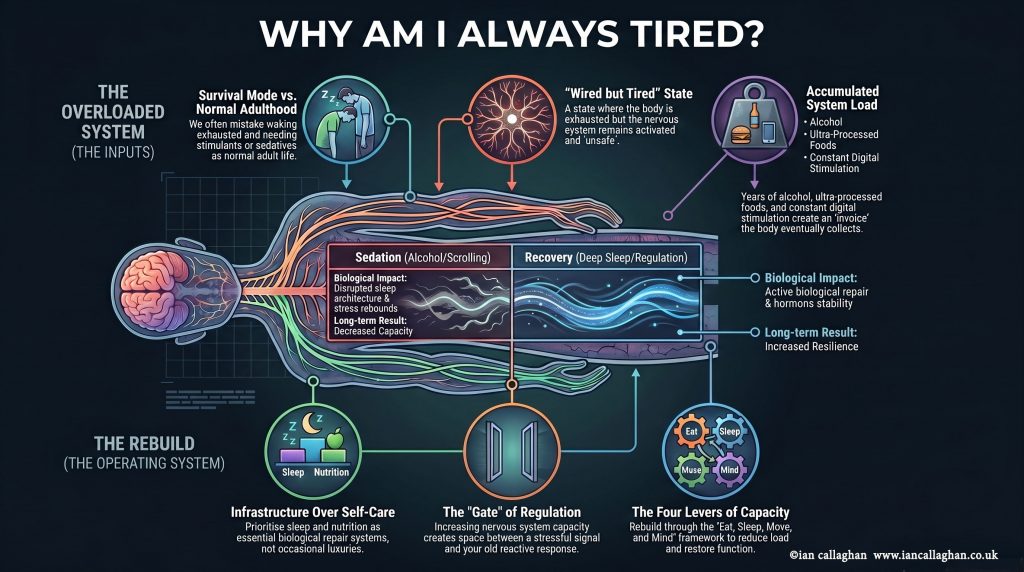
This is where modern life has done a proper number on people. It has normalised dysfunction so aggressively that millions of adults now mistake survival mode for normal adulthood. They think waking exhausted is normal. They think needing wine to switch off is normal. They think being unable to sit quietly without reaching for a phone is normal. They think feeling emotionally flat is normal. They think living on caffeine, sugar, stress and distraction is just what responsible adults do.
It is common.
That does not make it normal.
Your nervous system is not some vague wellness concept. It is not fluffy language for people doing sound baths in linen trousers. It is the operating system underneath your behaviour. It affects your sleep, stress tolerance, digestion, emotional regulation, cravings, inflammation, blood sugar stability, recovery capacity, focus, mood and impulse control.
If that system is under constant pressure, everything built on top of it starts to wobble.
That is why this matters.
We have millions of people trying to fix behaviour while ignoring the state of the body that drives it. They are trying to stop drinking, stop snacking, stop scrolling, stop snapping, stop procrastinating and stop feeling anxious while the nervous system underneath is still running like a smoke alarm in a house full of burnt toast.
No wonder willpower fails.
Quick answer: Why am I always tired?
You may feel tired all the time because your body is not fully recovering, even when you are technically resting. Poor sleep, alcohol, chronic stress, ultra-processed food, blood sugar crashes, constant stimulation, emotional pressure and nervous system overload can all leave you exhausted, wired, anxious or flat.
That is the clean answer.
Now let’s talk like adults.
Most people are not tired because they are doing one thing wrong. They are tired because they are living inside a system that keeps taking from them all day and giving almost nothing back.
They wake up tired, hammer coffee to function, sit in stress all day, eat whatever is convenient, scroll through other people’s lives, drink to take the edge off, sleep badly, then wake up and do the same thing again.
That is not recovery.
That is controlled collapse.
And sooner or later, the body starts telling the truth.
Why do I wake up tired even after sleeping?
Waking up tired usually means the body has not recovered properly overnight. You may have been in bed for seven or eight hours, but that does not mean your nervous system, brain, hormones, muscles, digestion and recovery systems had a proper night of repair.
This is a massive distinction.
People think sleep is just a time of unconsciousness.
It is not.
Sleep is an active biological repair.
If your nervous system is still on alert, if alcohol is still being processed, if blood sugar is swinging, if stress hormones are elevated, if your brain is still chewing on the day, if your gut is dealing with ultra-processed food, your body may be asleep but not properly recovered.
That is why somebody can spend eight hours in bed and still wake up feeling like they have been dragged backwards through a hedge.
The clock says they slept.
Their body says otherwise.
This is why I call it sleep infrastructure, not self-care. Sleep is not a scented candle activity. It is not a luxury. It is not something to squeeze in once the emails, Netflix, arguments, wine and scrolling are done.
Sleep is where the body repairs itself.
If that goes, everything else gets harder.
Cravings get louder. Pain feels bigger. Emotional control gets weaker. Hunger signals distort. Motivation drops. Bob starts making speeches. The internal barrister starts building the case. The PR Firm tells you that you deserve a drink, a takeaway, a scroll, a blowout, a restart on Monday.
Then you blame yourself for having no discipline.
You do not have a discipline problem at 10 pm when you are shattered, overstimulated, underfed, stressed, and under-recovered.
You have a capacity problem.
That is a different conversation.
Why do I feel wired but tired?
Feeling wired but tired usually means your body is exhausted,d but your nervous system is still activated. You are physically drained, but internally switched on. That is why you can feel desperate for rest and still be unable to relax.
This is one of the most common patterns I see in adults now.
They are shattered all day, then strangely alert at night. They drag themselves through work, then get a second wind when they should be winding down. They say they want peace, but when silence arrives, they reach for the phone because stillness feels uncomfortable.
That is not random.
That is a nervous system that has forgotten how to come down safely.
Modern life keeps people in low-level survival mode for hours every day. Not always full panic. Not always obvious anxiety. Sometimes it is much quieter than that.
Jaw tension. Shallow breathing. Tight chest. Restless legs. Irritation. Impatience. Constant checking. Needing noise in the background. Feeling uneasy when nothing is happening.
That is the body saying, “I am not fully safe yet.”
A lot of people look functional on the outside while, internally, running threat chemistry all day long. They still go to work. They still answer emails. They still post birthday messages. They still make jokes. But the body underneath is not in a calm, regulated state.
Over time, that affects everything.
Sleep becomes lighter. Digestion becomes unreliable. Cravings increase. Patience drops. Emotional reactions become stronger. Recovery takes longer. The world feels louder. The body becomes less tolerant of alcohol, poor food, late nights and stress.
Then people say they are falling apart.
They are not falling apart.
Their compensation is failing.
That is a very different conversation.
Why modern life makes people feel permanently exhausted
Look at the average day for many adults now.
They wake up and reach for the phone before their feet touch the floor. Within thirty seconds, they have checked messages, emails, bad news, comments, numbers, notifications and the curated lives of strangers. Their nervous system has already been pulled into reaction before the day has even started.
Then they drink coffee because they slept badly. They rush because they are late. They sit in traffic or jump straight into work. They deal with people, deadlines, bills, noise, screens, decisions and interruptions. They eat something beige and fast because there is no time. Their blood sugar jumps, then drops, and then they wonder why they are irritable by mid-afternoon.
By evening, they are exhausted but not calm.
That difference matters.
A lot of people are tired without being relaxed. They are physically drained but neurologically switched on. So they reach for the things that change state quickly.
Wine. Crisps. Chocolate. Takeaway. Netflix. Phone. Shopping. Porn. Arguments. Anything that moves the dial.
That is not always a pleasure.
A lot of the time, it is regulation.
The nervous system under load sees Loadelieff. Fast relief. Not because the person is stupid, weak, or morally defective, but because the body wants a change in state. It wants out of the discomfort.
This is why telling people to “just make better choices” is often useless. It sounds sensible from the outside, but it ignores what is happening inside the system.
A depleted person at 9 pm is not making decisions from the same place as a rested, nourished, regulated person at 9 am.
That is why Bob gets louder at night.
That is why the internal barrister starts building a case.
That is why the PR Firm comes in and tells you that you deserve it, that you have earned it, that one will not hurt, and that you can start Monday again.
The old operating system knows exactly when to speak.
It waits until capacity is low.
That is why this is not about motivation.
Motivation is fragile when the system is under load.
CaLoadty is the real game.
Why do I feel worse after 35 or 40?
Many people feel worse after 35 or 40 because they are no longer recovering from stress, alcohol, poor sleep, ultra-processed food and emotional load as Loadly as they did when they were younger. Age matters, but accumulated load often matters more.
This is one of the biggest lies people are sold.
They are told that feeling like absolute rubbish in their thirties, forties and fifties is simply part of getting older.
Obviously, ageing changes things. Recovery shifts. Hormones shift. Muscle mass changes if you do nothing to protect it. Sleep can become more fragile. Nobody sensible is pretending the body at 50 behaves exactly like the body at 25.
But age gets blamed for things that are not just age.
A lot of what people call ageing is actually decades of accumulated load.YeLoad off poor sleep. Years of using alcohol as a chemical off switch. Years of eating food that does not properly nourish the body. Years of stress, chemistry running all day. Years of sitting too much, moving too little, and never properly downshifting, and years of swallowing emotion, putting everyone else first, and calling it responsibility.
The body is brilliant at adapting.
That is the problem.
It will let you get away with things for a long time. It will compensate. It will find workarounds. It will keep you moving. It will let you run on fumes and pretend you are fine until one day the bill turns up.
The body keeps the score, yes.
But the nervous system keeps the invoice.
Eventually, it collects.
That collection does not always arrive as one dramatic collapse. Sometimes it arrives as subtle signs that people dismiss.
You wake up tired. You become more reactive. You cannot handle noise like you used to. You dread social plans. You need more caffeine to get going and more alcohol, sugar or scrolling to come down. You feel wired at night, flat in the morning and oddly detached from your own life.
This is where people start saying, “I do not feel like myself anymore.”
That sentence matters.
It is everywhere now. People say it in Facebook comments, YouTube comments, forums, messages, GP waiting rooms, kitchens, workplaces and marriages. They say it like a confession. As if the old versions of them have gone missing, and nobody has given them a map to find their way back.
For some people, yes, depression is part of the picture. Anxiety is part of the picture. Trauma may be part of the picture. Medical issues may be part of the picture. This is not about dismissing any of that.
But a huge number of people are also chronically under-recovered. Their system has been under load all night and is under repair. That changes the mood. It changes cravings. It changes patience. It changes how the world feels when you wake up in the morning.
If your body is running threat chemistry every day, your mind is not going to feel peaceful just because you wrote three things you are grateful for in a notebook.
Why do I wake up at 3 am with anxiety?
Waking at 3 am with anxiety can be linked to stress hormones, alcohol rebound, blood sugar instability, poor sleep quality, unresolved stress or a nervous system that does not feel safe enough to stay in deep recovery.
This is one of the biggest search-intent doors right now because millions of people are lying awake in the early hours, wondering what the hell is happening.
They wake up at 2 am, 3 am, or 4 am with a racing mind, a dry mouth, a tight chest, a strange sense of dread, or a sudden need to fix their whole life before sunrise.
Sometimes it is anxiety. Sometimes it is hormones. Sometimes it is alcohol rebound. Sometimes it is blood sugar instability. Sometimes,s it is stress hormones kicking in because the body does not feel safe enough to stay in deep recovery.
Often it is a mixture.
The important point is this.
Sleep is not just a mental event.
It is physical recovery.
Your body has to feel safe enough to drop into proper repair.
If you go to bed after alcohol, ultra-processed food, unresolved stress, blue light, arguments, scrolling and years of nervous system load, do not be shocked when the body does not simply drift into perfect recovery because the clock says bedtime.
People treat sleep like a switch.
It is not.
Sleep is the result of the day you just lived.
That is not meant as blame. It is meant as information.
If your nights are a mess, look at the whole system. Evening alcohol. Late food. Blood sugar. Caffeine. Screen light. Emotional stress. Lack of movement. No daylight. No wind down. No silence. No transition between the day and bed.
You cannot live like a hunted animal all day and expect the body to behave like a monk at night.
Why alcohol wrecks sleep and anxiety after 35
Alcohol can make you feel relaxed at first because it sedates the nervous system, but sedation is not the same as recovery. Alcohol can disrupt sleep quality, increase overnight stress responses, reduce HRV, raise heart rate, worsen anxiety the next day and make recovery harder.
This is where a lot of people get uncomfortable, because alcohol has been sold as the adult off switch.
Stressful day? Have a drink. Social event? Have a drink. Good news? Drink. Bad news? Drink. Grief? Drink. Celebration? Drink. Boredom? Drink. Sunshine? Drink. Christmas? Drink. Bank holiday? Drink. Tuesday? Drink.
Then people wonder why their nervous system is in bits.
Alcohol can make you feel temporarily calmer because it sedates the system. That part is real. I am not pretending that people imagine the relief. I drank for decades. I know exactly what that first drink can feel like. The shoulders drop. The noise softens. The world loosens its grip for a while.
But sedation is not recovery.
Underneath that temporary relief, the body still has to process a toxin. Sleep architecture gets disrupted. Heart rate can rise. HRV can drop. Stress hormones can rebound. Glutamate can kick back. Blood sugar can become unstable. Anxiety can increase the next day. Recovery can be impaired.
This is why people wake at 3 am after drinking and think it is random.
It is not random.
The body is dealing with the cost.
After 35 or 40, people often notice this more. They say they cannot drink like they used to. One glass ruins their sleep. Two drinks feel like a full session used to feel. Recovery takes days instead of hours.
They blame age, but age is only part of the story.
The bigger issue is total load.
IfLoadr system is already under pressure from stress, poor sleep, processed food, inflammation, financial worry and constant stimulation, alcohol lands on top like another weight in a backpack that is already too heavy.
At some point the body says no.
Not politely.
I quit after decades of drinking, not because I found a magic mindset quote, but because I stopped lying to myself about the cost. Alcohol was no longer giving me relief. It was taking out loans in my name and leaving my nervous system to pay the interest.
That is the bit people need to hear.
Can ultra-processed food make you tired and anxious?
Ultra-processed food can contribute to tiredness, cravings, mood swings, and low energy by affecting blood sugar, inflammation, satiety, gut health, and the reward system. It is not just about calories or weight.
Most people still talk about food as if it were only about body fat.
That is one of the reasons so many conversations around nutrition are useless.
Food is not just fuel. Food is information. It affects blood sugar, inflammation, satiety, gut health, mood, energy, sleep, cravings and nervous system stability.
I trained as a chef at 16. I have spent over 40 years working with food, cooking, and nutrition. The modern food environment is not normal. A lot of it is engineered to be eaten quickly, overconsumed easily and craved repeatedly.
Ultra-processed food is not simply “naughty food” or “treat food.” A lot of it is designed to override normal satiety. It is easy to overeat, quick to digest, emotionally rewarding and hard to stop eating.
That matters when you place it in front of a stressed, tired, dysregulated person who is already seeking state change.
This is why the old advice of “just have a little bit” misses the point. Some foods are built to make “a little bit” difficult. They hit the brain, the gut and the reward system in ways real food generally does not.
A stressed person does not usually crave steamed fish and broccoli at 10 pm. They crave crunch, salt, sugar, fat, speed and comfort. They crave something that changes state quickly.
Again, that does not remove responsibility. I am not interested in turning adults into helpless victims.
But responsibility gets stronger when people understand what they are dealing with.
If you think the problem is simply greed, you will attack yourself.
If you understand the problem is a loaded nervous system seeking regulation in an engineered food environment, you can build a better strategy.
That is the difference between shame and systems.
Why do I feel emotionally flat all the time?
Feeling emotionally flat can happen when the body has been under stress for too long. Chronic nervous system overload can reduce emotional capacity, motivation, joy, connection, and resilience because the system prioritises survival over thriving.
A lot of people think emotional numbness means they are broken.
I do not see it that way.
If somebody has spent years under stress, suppressing emotion, using alcohol or food to regulate, sleeping badly, pushing through pain and pretending everything is fine, emotional numbness can be the body’s way of protecting them from overload.
The system turns the volume down because full volume would be too much.
That is why people can look at their own life and think, “I should be happier than this.” They may have a job, family, house, car, holidays, decent income, all the things they were told would make them feel alright. Yet inside,e there is a dullness they cannot explain.
This is not always ingratitude.
It is often under recovery, disconnection and chronic load.
ThLoaddy cannot live in constant defence and deep joy at the same time. Survival mode narrows the world. It makes everything about getting through the next demand, the next bill, the next shift, the next argument, the next craving, the next evening.
This is why recovery is not just abstinence.
It is capacity building.
It is learning to feel again without being taken out by what you feel. It is learning to observe emotion without immediately obeying it. That is the heart of the Emotional Observation Method.
Emotion is not an instruction.
It is information.
But you need enough nervous system capacity to read the information without reacting.
Why people swap drinking for sugar, scrolling or chaos
People often swap one coping mechanism for another because the underlying nervous system is still looking for relief. If the system remains overloaded, removing alcohol may lead to more sugar, scrolling, shopping, porn, gambling, drama or another quick state change.
This is one of the biggest things missed in recovery and self-help spaces.
People remove one behaviour and then act surprised when another one appears.
They stop drinking and start hammering sugar. They quit smoking and start eating constantly. They leave a chaotic relationship and become addicted to scrolling. They stop gambling and start shopping. They remove the obvious problem, but the body underneath is still looking for relief.
That does not mean change is pointless.
It means the deeper work is not just removing the thing.
The deeper work is rebuilding the operating system underneath the thing.
This is where Sober Beyond Limits matters, because sobriety is not only about alcohol. It is about becoming sober from the patterns that keep running your life while you pretend you are choosing them.
Alcohol is one expression. Food can be another. Doom scrolling can be another. Drama can be another. Overworking can be another. People pleasing can be another.
The behaviour may look different, but the mechanism underneath is often the same.
The system is uncomfortable and wants a state change.
This is why I talk about The Gate.
The Gate is that tiny gap between signal and response. The signal might be stress, boredom, shame, loneliness, anger, pain or exhaustion. The old response might be drinking, eating, scrolling, snapping or numbing.
The work is learning to recognise the signal before the old operating system runs the script.
You cannot do that well if your system is permanently under load.
A Loadegulated person has a narrower Gate.
A regulated person has more space.
That space is where freedom lives.
What is HRV, and why does it matter when you feel exhausted?
HRV, or heart rate variability, is a measure of variation between heartbeats. It can give a rough window into nervous system flexibility, recovery and stress load. LoLoadV can be linked with alcohol, poor sleep, illness, inflammation, stress and under recovery.
HRV is not perfect,t and it is not a religion.
People can get far too obsessed with numbers and turn recovery into another source of stress. That said, HRV can be useful because it provides a rough window into how the autonomic nervous system adapts to load.
The reason this matters is that people lie to themselves beautifully.
I did it for years.
“I’m fine.” “I can handle it.” “It wasn’t that much.” “I’ll sort it on Monday.” “I just need a decent sleep.”
The body does not care about your story.
The body records the input.
Alcohol shows up. Poor sleep shows up. Stress shows up. Illness shows up. Overtraining shows up. Ultra-processed food can show up. A row can show up. Too much stimulation can show up.
That is why HRV has become such a powerful topic of conversation for people in their mid-thirties, forties, fifties, and sixties. Not because everybody needs to become a data nerd, but because it helps people see that what they call “feeling a bit off” is often measurable system strain.
Once people see that, the conversation changes.
It stops being, “Why am I so useless?”
It becomes, “What did I do to my system and what does it need now?”
That is a more useful question.
How do you start fixing constant tiredness and nervous system overload?
Start by reducing the biggest load on the load system and rebuilding the basics: better sleep, less alcohol, real food, daily movement, daylight, less scrolling, less ultra-processed food and more nervous system regulation. Do not start with punishment. Start with an honest audit.
The first step is not to blow your whole life up and start Monday again with a punishment plan.
That is the old pattern in a different outfit.
The first step is an honest audit.
Look at the load. NoLoadst the obvious stuff, all of it.
How are you sleeping? What are you eating? How much alcohol is going in? How much caffeine? How much scrolling? How much movement? How much daylight? How much silence? How much resentment are you swallowing? How much pressure are you pretending is fine?
Do not turn it into a moral trial.
Turn it into data.
Then start reducing the biggest loads first.
For many people, that means alcohol, because alcohol hammers sleep, HRV, mood, blood sugar, recovery and emotional regulation. For others, it may be ultra-processed food, late-night scrolling, poor sleep routines, toxic stress, constant overstimulation or a complete lack of movement.
Start where the biggest leak is.
Then rebuild capacity slowly.
This is where my Eat, Sleep, Move, and Mind framework comes in. Not as cute wellness branding. These are the four main levers that most people can actually pull.
Eat means feeding the body so that it can build, repair and regulate you, because it does. It means protein, healthy fats, fibre, real food, stable blood sugar, and food that supports capacity rather than constantly hijacking it.
Sleep means treating recovery like infrastructure. Not as something you get to after emails, Netflix, wine, arguments and scrolling. Sleep is where the body repairs itself. If that is broken, everything else becomes harder.
Moving means using your body daily in ways that build capacity rather than punishing yourself. Not everyone needs brutal training. Some people need walking, mobility, work strength, cold water, sunlight, and consistency. The body was made to move, but it also needs to be respected, especially if you are carrying injuries or pain.
Mind means learning to observe the signal before you obey the old script. It means understanding Bob, the PR Firm, the internal barrister and the tiny Gate between stimulus and response. It means regulation, awareness and state change without self-destruction.
That is the rebuild.
Not hacks. Not thirty-day miracle nonsense. Not pretending that one supplement will rescue a body being attacked from every direction.
Reduce load.
In-Load capacity.
Repeat long enough for the system to believe you.
Why does this matter if you do not identify as an addict
Millions of people know something is wrong, but they do not identify with the language of addiction, recovery or mental health treatment. They do not want to call themselves alcoholics. They do not want to sit in a circle. They do not want a label. They do not think they are at rock bottom.
They are still functioning.
But functioning is not freedom.
A lot of people are functioning while being quietly owned by patterns they do not understand. The evening drink owns them. The 9 pm food search. The doom scroll. The Sunday dread. The emotional shutdown. The constant tiredness. The sense that life has become maintenance instead of living.
These people are not always asking, “Am I an addict?”
They are asking, “Why do I feel like this?”
That is where the real conversation begins.
Because if you can explain the mechanism without shaming the person, you give them a way in. You give them a door they can actually walk through. Not an identity they have to accept before they are allowed to change.
This is why Under Load exiLoad
It gives people a way to understand behaviour as load, old operating systems and old patterns rather than moral failure. It does not let people off the hook, but it takes them out of the shame loop long enough to pick up the wrench.
I am not writing this as somebody who read three studies, bought a ring light and decided to become a nervous system expert on the internet.
I drank for 45 years before I finally stopped lying to myself. I quit cocaine over 20 years ago. I smoked heavily. I have lived with pain from military injury and prolapsed discs. I have known what it is to use substances, food, noise, distraction and sheer bloody stubbornness to push through when the system underneath was in bits.
I am also a trained chef, an Army veteran, an NLP Master Practitioner, a Reiki Master and a coach with years of experience helping people understand behaviour without drowning them in shame. I have lost over 5 stone since quitting drinking. I have rebuilt my health in real time, not as a tidy theory, but as a lived process.
That matters because people can smell polished nonsense a mile off.
This is not about pretending life becomes perfect when you stop drinking or eat better food or track HRV. It does not. You still have stress. You still have pain. You still have bills. You still have Bob trying to run the old scripts when you are tired.
The difference is that you start seeing the mechanism.
And once you see the mechanism, you stop treating every craving, crash, mood swing and bad night like proof that you are broken.
You start treating it like information.
That is where change becomes possible.
Final thoughts: you are not broken, but your system may be under load
MosLoadople do not need another lecture about discipline. They have already heard that. They have already beaten themselves up for years. They have already promised themselves they would start Monday, stop tomorrow, do better next week and sort themselves out when life calms down.
Life rarely calms down by itself.
You have to reduce the load on Loadose.
You have to build capacity on purpose.
You have to stop calling survival mode normal just because everyone around you is living there, too.
If you are waking tired, emotionally flat, craving relief, drinking to switch off, eating for comfort, scrolling yourself numb and wondering why life feels heavier than it should, you are not necessarily broken.
You may be under load.
Once you understand that, you can stop treating it as a character flaw and start treating it as a system problem.
That is where the rebuild begins.
Not with shame. Not with labels. Not with motivational fog.
With honesty, load reduction, capacity building, and a refusal to keep living as if survival is the best you can hope for.
You may be tired even after sleeping because your body is not recovering properly. Alcohol, stress, poor sleep quality, ultra-processed food, blood sugar swings, anxiety, inflammation and nervous system overload can all leave you exhausted despite spending enough hours in bed.
Why do I wake up tired every morning?
Waking up tired every morning can be a sign that your sleep is not restorative. You may be sleeping lightly, waking through the night, processing alcohol, dealing with stress hormones or living with a nervous system that remains activated instead of dropping into proper recovery.
Why do I feel wired but tired at night?
Feeling wired but tired often means your body is exhausted, but your nervous system is still switched on. This can happen after chronic stress, too much stimulation, late caffeine, alcohol, scrolling, emotional pressure or years of poor recovery.
Why do I wake up at 3 am feeling anxious?
Waking at 3 am with anxiety can be linked to alcohol rebound, blood sugar instability, stress hormone activation, hormonal changes, unresolved stress or poor sleep quality. It is often a sign that the body does not feel fully safe or regulated during the night.
Yes. Alcohol can temporarily sedate the nervous system, but it may worsen anxiety later by disrupting sleep, affecting stress hormones, reducing HRV, altering blood sugar and triggering rebound effects as the body processes it.
Why can’t I drink as I used to?
Many people become less tolerant of alcohol after 35 or 40 because recovery capacity changes and accumulated stress load increase. Alcohol may disrupt sleep, mood and nervous system recovery more noticeably than it did when you were younger.
Can ultra-processed food make me tired?
Yes. Ultra-processed food can affect blood sugar, satiety, inflammation, gut health, and cravings. For some people, it contributes to energy crashes, mood swings, hunger, poor sleep and feeling out of control around food.
What are the signs of nervous system overload?
Signs of nervous system overload can include waking tired, feeling wired but exhausted, poor sleep, waking at 3 am, emotional reactivity, cravings, anxiety, brain fog, digestive issues, low resilience, needing alcohol or sugar to relax and feeling unable to switch off.
Is nervous system overload the same as burnout?
They can overlap. Burnout is often what people call it when the system has been under sustained pressure for too long without enough recovery. Nervous system overload explains the underlying mechanism, particularly the imbalance between activation and repair.
What should I focus on first if I feel exhausted all the time?
Start with the biggest load. For many people, that is alcohol, poor sleep, ultra-processed food, chronic stress, constant scrolling or lack of movement. Improve the basics first: real food, better sleep, daily movement, daylight, reduced stimulation and nervous system regulation.
The 30 Day Reset is not a diet. It is a complete biological overhaul for anyone who is wired, tired, and done with feeling like shite. The 30-Day Reset is a 160+ page military-grade systems reboot for the over-35s. Four pillars. Eat, sleep, move, mind. One month to strip out the industrial poison, reset your dopamine pathways, silence Bob, and rebuild the machine that’s been running on the wrong fuel for decades. Not a diet. Not a programme. A complete…
Used to monitor number of Google Analytics server requests when using Google Tag Manager
1 minute
_gid
ID used to identify users for 24 hours after last activity
24 hours
_ga_
ID used to identify users
2 years
_gali
Used by Google Analytics to determine which links on a page are being clicked
30 seconds
_ga
ID used to identify users
2 years
__utmx
Used to determine whether a user is included in an A / B or Multivariate test.
18 months
__utmv
Contains custom information set by the web developer via the _setCustomVar method in Google Analytics. This cookie is updated every time new data is sent to the Google Analytics server.
2 years after last activity
__utmz
Contains information about the traffic source or campaign that directed user to the website. The cookie is set when the GA.js javascript is loaded and updated when data is sent to the Google Anaytics server
6 months after last activity
__utmc
Used only with old Urchin versions of Google Analytics and not with GA.js. Was used to distinguish between new sessions and visits at the end of a session.
End of session (browser)
__utmb
Used to distinguish new sessions and visits. This cookie is set when the GA.js javascript library is loaded and there is no existing __utmb cookie. The cookie is updated every time data is sent to the Google Analytics server.
30 minutes after last activity
__utmt
Used to monitor number of Google Analytics server requests
10 minutes
__utma
ID used to identify users and sessions
2 years after last activity
_gac_
Contains information related to marketing campaigns of the user. These are shared with Google AdWords / Google Ads when the Google Ads and Google Analytics accounts are linked together.