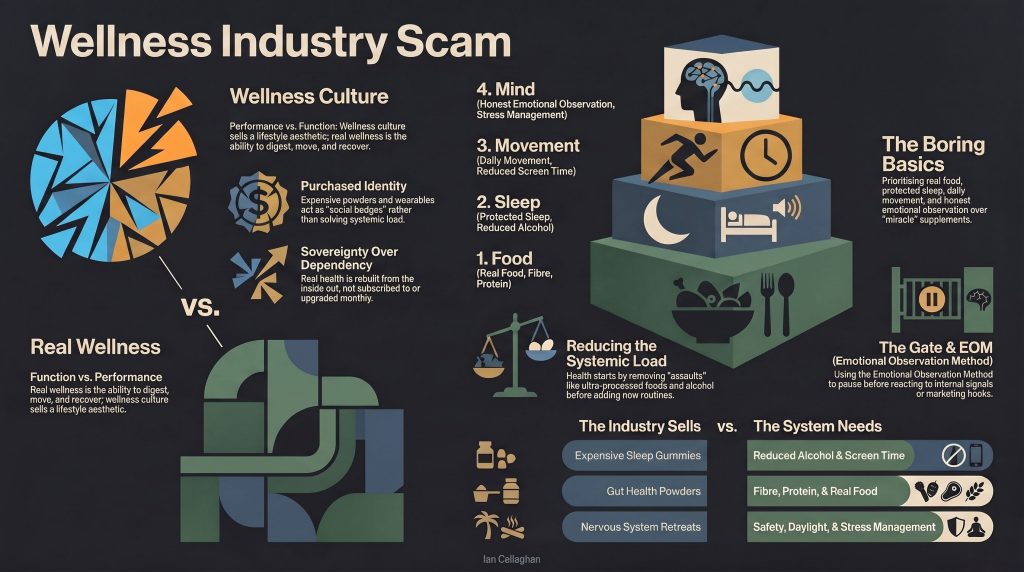
The wellness industry scam is not that health is fake. Health is real. Repair is real. Food, sleep, movement, emotional regulation, nervous system capacity and honest self-awareness all matter. The scam is the way the wellness industry sells expensive products, status, routines, retreats and identity to people who are already exhausted, inflamed, stressed and under load, while often ignoring the boring basics that would actually give the body a chance to recover.
The uncomfortable truth about the wellness industry
The wellness industry has done a brilliant job of convincing ordinary, tired, stressed, overloaded people that health is something they have to keep buying. Not something they rebuild. Not something they protect. Not something they understand from the inside out. Something they purchase, upgrade, subscribe to, photograph and perform.
That is the scam.
Not health itself. Not meditation. Not breathwork. Not cold water. Not real food. Not movement. Not proper nervous system regulation. I use those tools. I teach those tools. I live by a lot of those tools. I would be a hypocrite if I sat here pretending they do not work, because used properly, they absolutely can.
The scam starts when those tools get dragged into the marketing machine, stripped of context, polished into a lifestyle aesthetic and sold back to exhausted people as proof they are not enough without them.
Most people do not need another £47 powder, another miracle supplement, another nervous system reset course, another tracker, another influencer routine or another bloke in linen trousers telling them to align with abundance while flogging a subscription.
Most people need proper food, better sleep, daylight, movement, less alcohol, fewer ultra-processed foods, fewer assaults on the nervous system, more honest connections, and a clearer understanding of what their bodies are actually trying to tell them.
That is not glamorous enough for the wellness industry because it does not create dependency. It does not need a subscription. It does not need a luxury retreat. It does not photograph well next to a ceramic mug and a beige blanket.
But it works. And once you realise that, the whole wellness game starts looking very different.
Why am I writing this
I am not writing this as some bloke sneering from the outside because he saw a few dodgy adverts online.
I am a British Army veteran, a qualified chef, an NLP Master Practitioner, a Reiki Master, a coach, and the creator of the Emotional Observation Method. I drank for 45 years, quit alcohol, rebuilt my own food, sleep, movement and mind from the ground up, lost weight, live with long-term military injury and pain, and now coach people through cravings, stress, emotional regulation, sobriety, compulsive behaviour, food, midlife overload and identity change.
So when I talk about wellness, I am not talking about a lifestyle aesthetic. I am talking about what survives real life.
I am talking about the wet Tuesday version of wellness. The version that still has to work when your back hurts, your sleep is poor, your head is noisy, your finances are stretched, your relationships are under strain, your old coping mechanism is tapping on the window. Bob has turned up with a full legal argument for why you should drink, binge, scroll, spend, eat crap, isolate or blow your life up again.
That is where the truth lives. Not on a retreat. Not in the branding. Not in the influencer kitchen. In the ordinary moment when your system is under load, you still need to make the next decision.
What is the wellness industry actually selling?
The wellness industry does not only sell health products. It sells identity. That is why it works so well.
The powder is not just a powder. It is a signal that you are the kind of person who takes care of yourself. The wearable is not just a wearable. It is a signal that you are optimised. The retreat is not just a retreat. It is a signal that you are healing. The green juice is not just a green juice. It is a little social badge that says you are trying, improving, upgrading, becoming.
That is the hook.
Wellness stopped being about function and became a costume. You can see it everywhere. The right water bottle. The right mat. The right gut health powder. The right supplement stack. The right morning routine. The right wearable. The right breathwork app. The right retreat photo where everyone looks peaceful, thin, expensive and spiritually constipated in a field.
It sells the idea that health has a look. Worse than that, it sells the idea that if your life does not look like that, you are doing something wrong.
If your breakfast is not photogenic, if your house is not calm, if your body is not lean, if your nervous system is not regulated, if your sleep is wrecked, if your cravings are loud, if your anxiety is up, if your digestion is off, if Glucipher is dragging you towards sugar at 9 pm and Bob is telling you that one drink, one binge or one scroll does not count, then apparently you are not aligned enough, disciplined enough or committed enough.
Bollocks.
That is not wellness. That is class signalling with a turmeric latte.
A single parent working shifts does not need to be told they are failing because they have not got time for a two-hour morning routine. A midlife bloke with back pain, poor sleep, debt stress and a liver that spent decades processing lager does not need a cacao ceremony before he is allowed to rebuild. A woman dealing with perimenopause, work pressure, ageing parents, teenage kids and a nervous system that has been running red for years does not need another shiny expert telling her she is out of alignment.
They need the load reduced. That is where real wellness starts.
Why does the wellness industry feel like a scam?
The wellness industry feels like a scam because it often sells solutions without looking at the system that created the problem.
A person is exhausted, so they are sold energy. They are anxious, so they are sold calm. Their digestion is wrecked, so they are sold gut health. Their sleep is poor, so they are sold magnesium sprays, sleep gummies and weighted blankets. Their cravings are out of control, so they are sold willpower hacks. Their life is overloaded, so they are sold another routine to squeeze into it.
Nobody stops and asks the obvious questions. How much alcohol is in a week? How much ultra-processed food is going in? How many hours of proper sleep are happening? How much protein, fat and fibre is the body getting? How much daylight is reaching the eyes? How much movement is built into the day? How much stress is normalised because everyone around them is also running on fumes? How many emotions are being buried under food, booze, shopping, work, porn, scrolling, resentment or people-pleasing? How often is Bob running the meeting while the actual operator sits in the corner, wondering what the hell happened?
These are not glamorous questions, but they are useful questions.
The body does not live in the aesthetic. It lives in the inputs. Your nervous system does not care what colour your yoga mat is. Your gut does not care whether the powder came in a recyclable pouch with a leaf on the label. Glucipher does not give a toss whether the sugar is organic, handmade, small-batch, or blessed under a full moon. Bob does not become less manipulative because you renamed him your inner protector and bought a nicer journal.
Your system responds to what you repeatedly do, consume, tolerate, ignore and justify. That is where the work starts.
Is the wellness industry making people feel broken?
Yes, a lot of wellness marketing makes people feel broken because broken people are easier to sell to.
That does not mean every practitioner is a fraud or every product is useless. It means the machine around wellness often relies on insecurity. The person has to believe something is missing. They have to believe they are not calm enough, clean enough, disciplined enough, feminine enough, masculine enough, healed enough, spiritual enough, lean enough, regulated enough or optimised enough.
Then the offer appears: buy this, and you will feel like the kind of person who has their life together.
That is clever marketing, but it is also dangerous.
People do not buy wellness products because they love powders. They buy them because they are tired of feeling tired. They buy them because their mood is unstable, their appetite is all over the place, their stomach is bloated, their joints hurt, their skin looks dull, their libido has vanished, their patience is gone, their sleep is broken,n and their body feels like a house they no longer understand.
Then the industry steps in with a smile and says, here, buy this.
It rarely says,” Let us look at the whole system. That is the conversation I care about, because I do not see people as broken. I see systems under load.
That is not me being poetic. It is the most useful frame I have found after decades of alcohol, food issues, pain, stress, personal development, coaching and rebuilding. When you stop treating every behaviour as a moral failure and start seeing it as a signal, the shame drops and the work becomes clearer.
Bob is not proof that you are weak. Bob is the old operating system, trying to keep a familiar pattern alive. Glucipher is not proof that you have no discipline. It is the sugar-seeking part of the system looking for fast relief. The PR Firm is not wise. It is internal spin, building a case for the behaviour that keeps you stuck. The Gate is the gap where you notice the signal before you obey it. EOM is the practice of observing emotion without immediately becoming its employee.
That is real power. Not pretending you are healed because you bought another product. Real power is understanding the mechanism.
Are wellness products worth the money?
Some wellness products are worth the money when they solve a specific problem, meet a genuine need and do not distract you from the basics. That is the honest answer.
Supplements can help when there is a real deficiency or a clear reason to use them. Wearables can help if the data changes behaviour rather than creating an obsession. Breathwork apps can be useful if they help you build state control. Cold water can build capacity if it is used intelligently. Therapy, coaching, bodywork, strength training, meditation, nutrition support and good education can all be valuable.
The problem starts when products replace ownership.
A gut powder will not undo a diet built around ultra-processed food. A sleep spray will not cancel out alcohol, late-night scrolling and chronic stress. A nervous system course will not help much if you keep living in a way that tells the body it is never safe. A retreat will not save you if you come home to the same inputs, the same avoidance, the same old operating system, and the same refusal to stand at The Gate.
The useful question is not whether a product is good or bad. The better question is what job you are asking that product to do. If it is supporting a system you are already rebuilding, fair enough. If it is rescuing you from the basics you keep avoiding, that is Bob in a wellness hoodie.
Why do people keep buying wellness products when the basics work?
People keep buying wellness products because buying feels easier than changing. That is not an insult. It is human.
Buying gives immediate relief. It creates a little hit of hope. It feels like action. The parcel arrives. The label looks clean. The routine feels new. The brain gets to say, good, we are doing something.
But doing something is not the same as changing the system.
This is where the PR Firm gets clever. It can make avoidance sound like research. It can make another purchase sound like a commitment. It can make procrastination look like preparation. It can tell you that once you find the right supplement, the right podcast, the right protocol, the right coach, the right plan or the right device, then you will finally start.
Meanwhile, the boring basics sit there untouched. Sleep is still wrecked, food is still chaotic, alcohol is still normalised, movement is still inconsistent, stress is still unmanaged, emotions are still buried, Bob is still negotiating, Glucipher is still driving, and The Gate is still unused.
That is why simple is so powerful and so inconvenient for the industry. Simple does not mean easy. Simple means clear. The body needs better inputs, fewer assaults and repeated signals of safety. That is not a hack. It is a rebuild.
What is real wellness compared with wellness culture?
Real wellness is function. Wellness culture is often performance.
Real wellness asks whether you can sleep, digest, move, recover, think clearly, regulate emotion and make better choices under pressure. Wellness culture often asks whether your life looks like wellness from the outside.
That difference matters.
A person can have the supplements, the mat, the retreats, the morning routine, the water bottle, the expensive leggings, the wearable and the perfect kitchen, while still being metabolically wrecked, emotionally avoidant, secretly drinking too much, sleeping badly, eating processed rubbish and reacting from old patterns all day.
Another person can live a very ordinary life, cook real food, walk daily, protect their sleep, stop poisoning themselves with alcohol, lift a few weights, get outside, breathe properly, observe their emotions, tell Bob to shut up when needed, and slowly become stronger than they have been in years.
One looks like wellness. The other is wellness.
That is why I keep coming back to Food, Sleep, Movement and Mind. Food is the input. Sleep is the repair window. Movement is the signal. Mind is the operator. Get those four wrong for long enough, and the system starts screaming. Get them right consistently enough,h and the system starts coming back online.
Not overnight. Not in some fake thirty-day glow-up where everyone pretends healing is photogenic. But steadily, mechanically and honestly.
Is nervous system regulation being used as wellness marketing?
Yes. Nervous system regulation is real, but wellness marketing has turned it into another thing people feel they have to buy.
Nervous system language is useful when it helps people understand their bodies. It becomes bullshit when it is used as a sales fog. People are now being sold regulation as if it were a new luxury product. Regulate your nervous system with this mat. Reset your nervous system with this retreat. Heal your nervous system with this breathwork bundle. Calm your nervous system with this drink, this course, this candle, this wearable, this app, this £900 weekend in a converted barn with herbal tea and forced vulnerability.
The nervous system is real. Regulation is real. State change is real. The vagal brake is real. Breath, cold water, movement, safety, connection, sleep and emotional awareness can all change state.
But the body is not stupid.
You cannot sprinkle nervous system language over an overloaded life and call it healing. If you are drinking most nights, sleeping badly, eating ultra-processed food, never moving, living on caffeine, scrolling until midnight, suppressing every emotion and letting Bob run the old scripts, your nervous system is not going to be fooled by a candle and a lavender pillow spray.
It wants evidence. Repeated evidence. It wants to know whether the body is fed properly, whether sleep is protected, whether recovery is happening, whether movement exists, whether the threat is being reduced, whether connection is present, and whether emotion is being processed rather than buried under another coping mechanism.
That is why real regulation is built, not bought.
How do you spot wellness marketing bullshit?
You spot wellness marketing bullshit by looking for the move underneath the message.
Is the product helping you understand your body, or making you feel dependent on the seller? Does the claim sound specific, grounded and realistic, or does it promise total transformation with very little effort? Are they talking about food, sleep, movement, stress, alcohol, emotional regulation and daily habits, or jumping straight to a product? Do they explain who the product is not for, or is everyone apparently the perfect customer? Would the advice still be useful if you removed the branding? Does it reduce load, or does it give you another thing to track, buy, manage and feel guilty about? Would you still want it if nobody saw you using it? Is this genuine support, or is Bob and the PR Firm dressing avoidance up as self-improvement?
Those questions matter because modern wellness marketing does not always look like an advert. Sometimes it looks like education. Sometimes it looks like empowerment. Sometimes it looks like trauma awareness. Sometimes it looks like science. Sometimes it looks like spirituality. Sometimes it looks like a personal story that happens to end with a discount code.
That does not automatically make it bad. It means you need to stay awake.
What should you do instead of buying more wellness products?
Start by stripping it back, not forever and not as punishment, but as an audit.
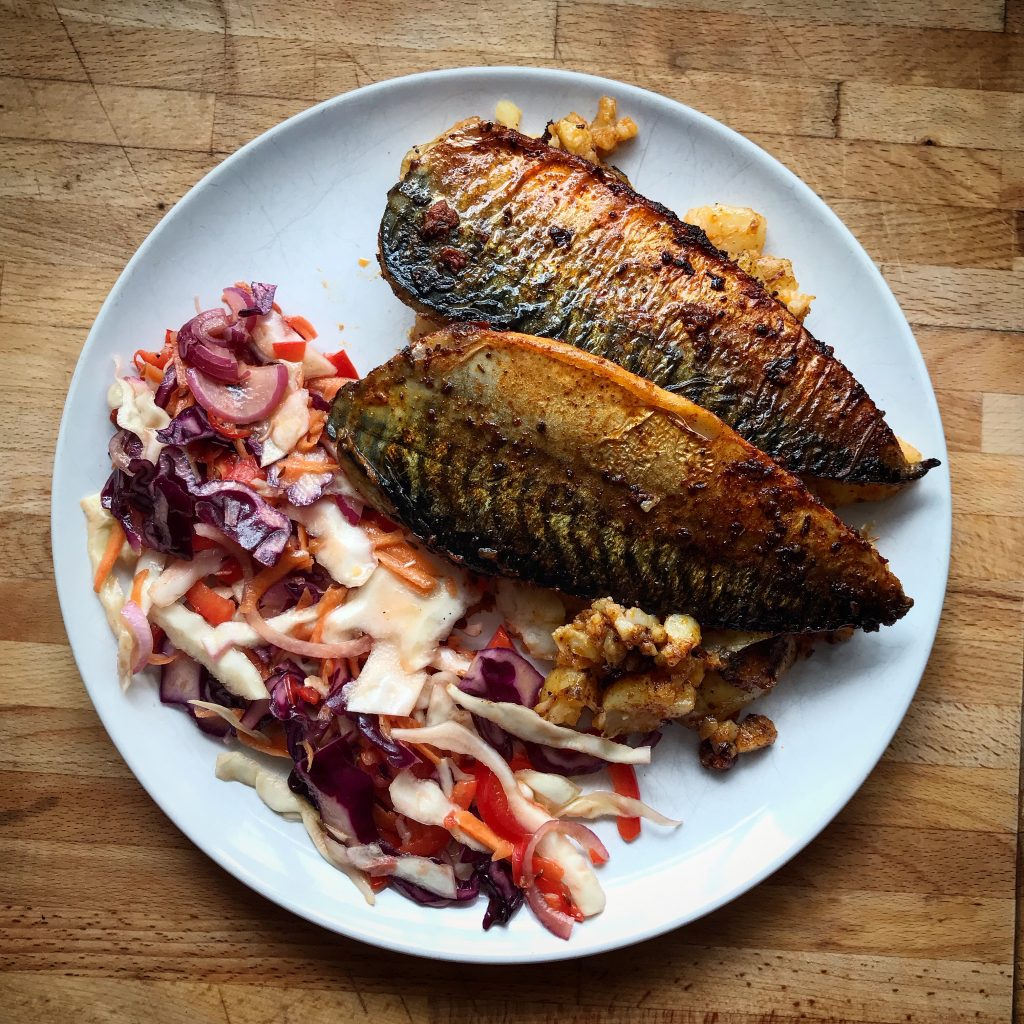
Look at your food without turning it into calorie-counting, guilt or influencer nonsense. Are you giving the body real materials to rebuild with, or are you asking it to run on edible entertainment? Protein, proper fats, fibre, minerals and actual meals are not old-fashioned. They are the foundation.
Look at your sleep as infrastructure, not self-care. Alcohol, late food, stress, screens and blood sugar chaos do not magically stop at bedtime. The body has to process whatever you throw at it. If sleep is wrecked, cravings, mood, appetite, HRV, patience and decision-making all take the hit.
Look at movement without punishing yourself. You do not need to train like a twenty-seven-year-old influencer with no injuries and a ring light. You need to signal life to the system. Walk. Stretch. Lift if you can. Swim if you can. Move within your capacity and build from where you are.
Look at your mind without drowning it in motivational fluff. Catch Bob. Watch the PR Firm. Notice Glucipher. Practise EOM. Stand at The Gate and stop letting every internal signal become an instruction.
That is where real change happens. Not because you bought a new identity, but because you became the operator again.
A simple real wellness audit
Before you buy another product, ask this properly.
Are you sleeping enough to repair? Are you eating enough real food to stabilise energy, mood and cravings? Are you drinking alcohol and pretending it is not affecting your nervous system? Are you moving at your actual capacity daily? Are you getting daylight, fresh air and some rhythm to the day? Are you using food, booze, scrolling, shopping, porn, work or drama to avoid emotion? Are you practising emotional observation, or are you reacting to every signal as if it is an instruction? Are you trying to buy your way out of a pattern you have not been willing to face?
This is where EOM becomes practical. You notice the urge. You observe the emotion. You do not immediately obey it. You do not shame it either. You stop at The Gate and look properly.
You ask what the signal actually is. Is it need, fear, boredom, pain, loneliness, status anxiety, old identity, genuine curiosity or clever marketing landing at the right weak spot?
That pause is everything.
The wellness industry depends on your insecurity outpacing your awareness. It needs you to feel discomfort and click before you question it. It needs you to believe the answer is outside you. It needs you to mistake consumption for change.
When you build the pause, the machine loses grip. You can still buy the powder if you want. You can still use the wearable. You can still go to the retreat. You can still do the breathwork. You can still take the supplement. But now you are the operator, not the mark.
That is the difference.
So is the entire wellness industry a scam?
No. That would be too easy and dishonest.
Good people are doing good work. Breathwork can change state. Meditation can train awareness. Cold water can build capacity when used intelligently. Proper nutrition can transform energy, mood, cravings and metabolic health. Strength work can rebuild confidence. Therapy can be life-changing. Coaching can help people see patterns they have been trapped in for years. Supplements can be useful when there is a genuine need.
But the industry around those tools is full of bollocks. It is full of overpromising. It is full of people selling identity instead of function. It is full of fear-based marketing disguised as empowerment. It is full of complexity where simplicity would do. It is full of luxurious aesthetics that pretend to be healthy. It is full of people who have never been properly under load, telling exhausted humans to raise their vibration.
That is why it needs to be called out. Not because people should reject wellness, but because people deserve better than wellness theatre.
They deserve tools that work in real life. Not just on a retreat. Not just when the lighting is right, not just when the fridge is full, nobody is ill, the bills are paid, and the nervous system is already calm. Real wellness has to work when you are tired, stressed, sore, skint, lonely, triggered, tempted, angry, ashamed, bored or standing in the kitchen at 9 p.m. with Bob and Glucipher both trying to run the evening.
That is where the work has to hold.
The real problem is dependency, not wellne.ss
The wellness industry is not a scam because health is fake. Health is real. Repair is real. Nervous system regulation is real. Food matters. Sleep matters. Movement matters. Emotional awareness matters. Ritual matters. Community matters. Support matters.
The scam is the selling of dependency to people who need sovereignty.
The scam is convincing exhausted people that the answer is always another product, another protocol, another identity, another upgrade, another expert, another retreat, another performance. It is making simple human repair look exclusive, expensive, and complicated, then selling it back to people who already know, deep down, that their lives are asking for something more honest.
You were never meant to spend your whole life chasing wellness. You were meant to build a body, mind and life you do not need to escape from every night.
That is the work. And it starts with taking back the authority they have been selling back to you in instalments.
FAQ
Is the wellness industry a scam?
The wellness industry is not entirely a scam, but much of its marketing is built around selling expensive products, status, and identity to people who need basic system repair. Real wellness starts with food, sleep, movement, stress reduction, emotional regulation, reduced alcohol, intake fewer ultra-processed foods ,and better daily ihabits
Why does the wellness industry feel fake?
The wellness industry can feel fake because it often turns useful health tools into lifestyle performance. Real practices like meditation, breathwork, cold water, nutrition and movement can work. Still, the marketing around them often sells an expensive identity rather than helping people understand what their bodies actually need.
What is the biggest problem with wellness culture?
The biggest problem with wellness culture is that it can make ordinary people feel broken, inferior, or behind because their lives do not look calm, expensive, or perfectly optimised. It often rewards appearance over function and sells products before addressing the system’s real needs.
Are wellness products worth buying?
Some wellness products are worth buying if they solve a specific problem and support a system you are already rebuilding. They become a problem when they distract from the basics: food, sleep, movement, stress, alcohol, emotional regulation, sunlight, connection and daily habits.
Are supplements a waste of money?
Supplements are not automatically a waste of money. They can help when there is a clear reason to use them. They are a poor replacement for proper food, sleep, movement, sunlight, emotional regulation and removing the behaviours that are creating the problem in the first place.
What is real wellness?
Real wellness is function, not aesthetic. It means being able to sleep, digest, move, think clearly, recover from stress, regulate emotion and make better choices under pressure. It is built through repeated daily inputs, not bought through a product identity.
Why do people buy wellness products?
People buy wellness products because they want relief, hope and a sense of control. Buying something can feel like an action, especially when someone is tired, anxious, inflamed, ashamed or desperate for change. The danger is mistaking buying for rebuilding.
How do I spot wellness marketing bullshit?
Look for vague promises, fear-based messaging, expensive identity language, before-and-after fantasy, claims that ignore food, sleep, movement, stress and alcohol, and products that make you feel dependent on the seller. Good wellness support should help you understand your body, not outsource your authority.
What should I focus on instead of wellness trends?
Focus on food, sleep, movement and mind. Eat real food, protect sleep, move daily within your capacity, reduce alcohol and ultra-processed foods, get daylight, manage stress and practise emotional observation. Those basics are not glamorous, but they are the foundation of real change.
How does EOM help with wellness marketing?
EOM, the Emotional Observation Method, helps you notice the emotional signal before you obey it. Instead of buying, drinking, eating, scrolling or reacting automatically, you pause at The Gate and ask what is actually happening. That pause helps you become the operator again.
CTA
If this hit a nerve, that is probably because you already knew half of it before you read it.
You do not need more wellness theatre. You need a working system.
That is what I break down inside my books, my coaching and the Midlife Reset community. Food, sleep, movement, mind, cravings, stress, alcohol, emotional regulation, Bob, Glucipher, The Gate, EOM, and the real work of becoming the operator again.
Heart Rate Variability: The One Number That Tells You Everything About Why You Feel the Way You Do in Midlife
By Ian Callaghan | iancallaghan.co.uk |Heart Rate Variability Midlife
Heart rate variability midlife. You wake up tired. Not the kind of tired that a good night’s sleep fixes. The kind that sits behind your eyes and follows you into the afternoon. Your focus is soft. Your mood is lower than it should be. You’re doing everything vaguely right. You’re not drinking that much, you’re not eating terribly, you’re getting to bed at a reasonable hour, and yet something in the machinery feels off.
You’ve probably blamed it on stress. On age. On the relentlessness of midlife.
Most people do.
But there is a number your body is generating every single morning that tells a different story. A number that most people have never heard of, that their GP has almost certainly never mentioned, and that quietly predicts cardiovascular health, cognitive function, metabolic resilience, emotional regulation, and how fast you are ageing at a biological level.
That number is your Heart Rate Variability. And once you understand what it is, what it measures, and what is suppressing it in your specific life, you cannot unknow it.
This is not a biohacker post. This is not for elite athletes or tech bros with six wearables. This is for the woman in her late forties who is tired of being told she needs to manage her stress better. This is for anyone in midlife who suspects that the way they feel is not inevitable but has not yet found a clear enough explanation of the mechanism to do anything about it.
Here is that explanation.
What Is Heart Rate Variability and Why Does It Matter?
Heart Rate Variability, or HRV, is the variation in time between consecutive heartbeats, measured in milliseconds.
A heart beating at 60 beats per minute does not beat with mechanical precision, beating once every 1,000 milliseconds. The gaps between beats vary. Sometimes 980ms. Sometimes 1,040ms. Sometimes 1,010ms. This variation is not a malfunction. It is a feature. And that variation is the signal.
More variability between heartbeats means your autonomic nervous system is flexible, adaptive, and responsive. It means the parasympathetic branch. Your rest, digest, recover, and repair system. It is functioning well. It means your body can shift between states efficiently. High HRV is broadly associated with resilience across physiological, psychological, and metabolic domains.
Less variability means your nervous system is under strain. The gaps between beats become more uniform, more rigid. Your body is locked in a state of low-grade alert, running on its stress architecture rather than its recovery architecture. Low HRV is independently associated with elevated cardiovascular risk, insulin resistance, faster cognitive decline, anxiety, depression, and burnout.
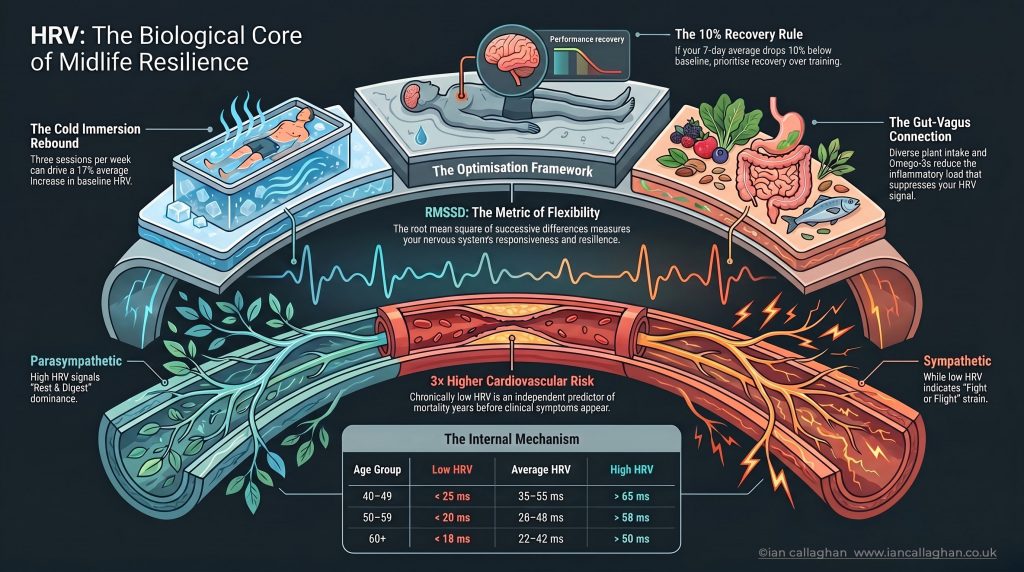
The key measurement is called RMSSD (root mean square of successive differences). This is what your wearable reports when it displays an HRV number. It reflects parasympathetic nervous system activity. The higher it is, the more your body is in recovery mode. The lower it is, the more it is in damage limitation mode.
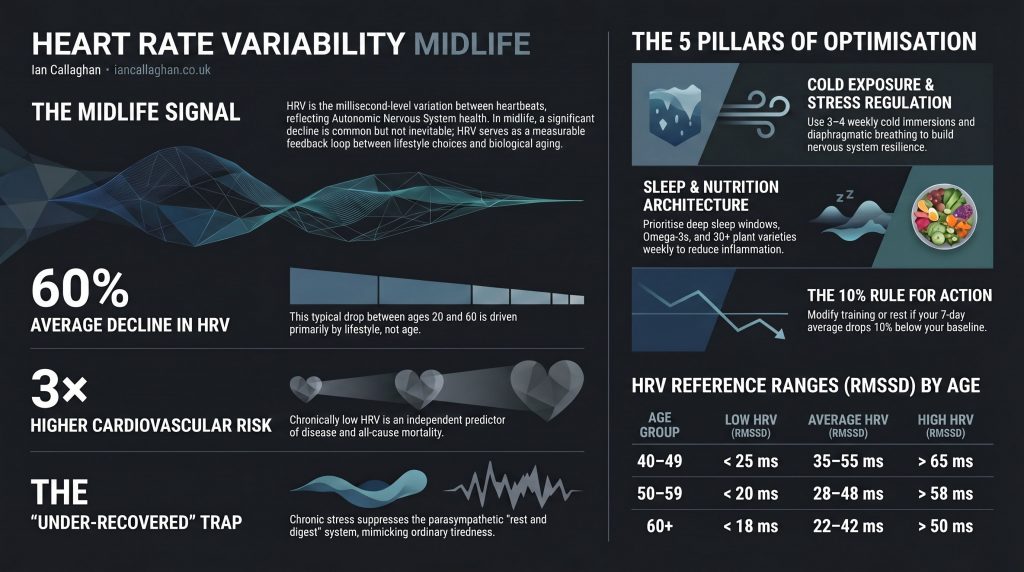
This is why HRV matters specifically in midlife. The average HRV declines by roughly 60% between the ages of 20 and 60. But this is the part the fitness industry consistently fails to communicate clearly: that decline is not inevitable. It is driven overwhelmingly by lifestyle inputs. Aerobically fit 50-year-olds routinely show HRV values that match sedentary 30-year-olds. The gap is in inputs, not age.
The choices being made right now in your 40s and 50s are not just affecting how you feel this week. The choices being made now are setting the trajectory of your autonomic nervous system for the next three decades.
The Autonomic Nervous System: Understanding the Engine
To understand HRV, you need to understand the system it is measuring: your autonomic nervous system. This is the part of your nervous system that runs without your conscious input. It controls heart rate, digestion, immune function, respiratory rate, and the hormone cascade that governs how your body responds to both threat and safety.
It has two primary branches.
The sympathetic nervous system is your fight-or-flight system. It is activated by stress, threat, exertion, or perceived danger. It releases adrenaline and cortisol. It speeds the heart rate, narrows the variability between beats, and prepares the body for action. It is essential and life-saving in acute situations. It is destructive when it runs chronically.
The parasympathetic nervous system is your rest-and-digest system. It is activated during calm, during sleep, and during genuine recovery. It is mediated primarily by the vagus nerve. The longest cranial nerve in the body runs from the brainstem through the heart, lungs, and gut. When parasympathetic tone is high, heart rate slows, beat-to-beat variability increases, digestion functions well, inflammation decreases, and the body performs the repair work it needs.
HRV is, in functional terms, a proxy for parasympathetic nervous system health. A high HRV reading tells you that your vagus nerve is doing its job. A low HRV reading tells you something is suppressing it.
Most people in midlife are living with chronically suppressed parasympathetic activity and have no framework for understanding why they feel the way they feel. They are not burned out in the dramatic clinical sense. They are chronically under-recovered. And the difference between those two diagnoses matters enormously for how you intervene.
What HRV Is Actually Telling You: The Clinical Picture
Low HRV is not just a fitness metric. The research connecting HRV to broader health outcomes is substantial, consistent, and largely ignored outside specialist clinical settings.
Cardiovascular health. HRV is an independent predictor of cardiovascular disease and all-cause mortality. Chronically low HRV appears in the data years before clinical symptoms of cardiovascular disease emerge. People with consistently low HRV face roughly triple the cardiovascular event risk of age-matched peers with healthy HRV.
Metabolic function. HRV is strongly correlated with insulin resistance, metabolic syndrome, and elevated inflammatory markers, including C-reactive protein and interleukin-6. If you are struggling with unexplained weight gain, persistent belly fat that does not respond to diet changes, or energy crashes after meals, your HRV data may be part of the picture your GP is not seeing.
Cognitive function. Higher HRV is associated with better working memory and executive function. Low HRV predicts faster cognitive decline with age. The connection is not incidental. The vagus nerve, which drives parasympathetic tone, also innervates the prefrontal cortex, which governs focus, decision-making, and emotional regulation.
Mental health. Low vagal tone is a documented feature of clinical anxiety, depression, and burnout. The vagus nerve directly feeds into mood regulation circuits. This is not a metaphor about stress management. It is physiology. Your emotional landscape is partly a readout of your autonomic nervous system state.
Physical recovery. Post-exercise HRV suppression lasting more than 48 hours signals overreaching. The body is breaking down rather than adapting. If you are training and not recovering, your HRV will show it before your subjective experience does.
Sleep quality. HRV rises through the night, peaking before natural waking during deep slow-wave sleep. Any disruption, a late meal, alcohol, noise, or temperature. Each one blunts this rise. Your morning HRV reading is effectively a report card on how well your body recovered overnight. When it is consistently low, something in the overnight environment or the preceding day’s inputs is working against you.
The Midlife Trap: Why Your Nervous System Is Under Silent Siege
Here is what happens specifically in midlife that most health content fails to address clearly.
Chronic psychological stress. The kind that accumulates over years of responsibility, invisible labour, career pressure, relationship complexity, and the relentless demands of midlife. All of it keeps cortisol elevated well beyond its normal morning peak. In a healthy cortisol pattern, levels spike at waking and decline steadily through the day. In a chronic stress pattern, cortisol remains elevated throughout the day and fails to drop adequately at night.
This chronically elevated cortisol directly and measurably suppresses parasympathetic activity. It narrows HRV. Over months and years, this creates what looks, from the outside, like ordinary tiredness, and what feels, from the inside, like a slow loss of the version of yourself you used to be.
For women moving through perimenopause and menopause, this picture is compounded by hormonal changes that independently affect HRV. Oestrogen has a protective effect on autonomic function. As oestrogen declines, the nervous system becomes more vulnerable to sympathetic dominance. This is one of the mechanisms behind the sleep disruption, anxiety, brain fog, and emotional volatility that many women in their late 40s and 50s experience, and it is under-discussed in clinical settings and almost absent from mainstream wellness content.
The connection between perimenopause and HRV is a blue ocean of understanding that most healthcare systems have yet to reach. Women are told their symptoms are hormonal, which is partly true, but the nervous system story, and crucially, what you can do about it. That part is rarely part of the conversation.
The good news, and it is really good news, is that HRV responds rapidly and measurably to specific lifestyle inputs. The decline is addressable. The research is consistent. And several of the most powerful interventions cost nothing.
What Is Destroying Your HRV: The Suppressors
Before looking at what raises HRV, it is worth being clear about what tanks it. This section will be uncomfortable for some people. It is meant to be informative, not moralistic.
Alcohol
Alcohol is the most potent dietary suppressor of HRV that has been studied. A single drink the evening before measurably reduces morning HRV by 10-15%. Two drinks produce a 20-25% reduction. The data here is remarkably consistent across multiple studies and wearable datasets.
The mechanism is straightforward. Alcohol disrupts the parasympathetic rebound that should occur during deep sleep. It fragments sleep architecture, suppresses slow-wave sleep, increases overnight cortisol, and elevates resting heart rate. All of this narrows beat-to-beat variability and shows up clearly in your morning reading.
This is not a moral position on alcohol. It is a measurement. Your wearable does not have opinions. It just reports what happened to your autonomic nervous system overnight.
The HRV data on alcohol removal are equally consistent. Removing alcohol produces an average 14% improvement in HRV over four to six weeks. For a woman in her late 40s already navigating perimenopause-related HRV decline and sleep disruption, that is not a small number. That is a meaningful shift in nervous system function that will show in how she thinks, feels, recovers, and ages.
Ultra-Processed Food
Ultra-processed foods disrupt the gut microbiome and increase intestinal permeability. What is commonly called “leaky gut” elevates circulating lipopolysaccharide, a bacterial endotoxin. This LPS triggers systemic inflammation. That inflammation suppresses vagal tone. Suppressed vagal tone lowers HRV.
The gut-vagus connection is underappreciated even within functional health communities. 80% of vagal fibres are afferent. They travel from gut to brain, not the reverse. Your gut is not passively receiving instructions from your nervous system. It is actively sending signals upward continuously, and the quality of those signals is determined by what you feed your microbiome.
A diet high in ultra-processed food sends inflammatory signals up the vagus nerve to the brain, suppressing parasympathetic activity and reducing HRV. A diet rich in diverse whole foods, fermented foods, and anti-inflammatory fats sends the opposite signal.
High-Glycaemic Eating Patterns
Large blood sugar spikes trigger the release of adrenaline and cortisol as the body scrambles to manage glucose levels. This pattern repeats multiple times throughout the day, sustaining sympathetic nervous system dominance and chronically suppressing HRV. It is not dramatic. It does not feel like stress. It just keeps the nervous system running slightly too hot, day after day, year after year.
Poor Sleep and Circadian Disruption
One poor night reduces next-day HRV by 8-12%. Two consecutive poor nights can suppress HRV for three to four days, even with normal sleep afterwards. Irregular sleep and wake times, blue light exposure after 9 pm, late-night eating, and chronic circadian disruption all compound this effect. The overnight HRV curve relies on consistency. Disrupt the conditions,s and you disrupt the recovery.
What Raises HRV: The Protocol That Works
The research here is consistent, and the interventions are accessible. You do not need a £400 supplement stack or a clinic appointment.
Cold Water Immersion
Cold water immersion is the fastest-acting HRV intervention available and the most underutilised outside elite sport. The mechanism works in three phases.
In the first 60 seconds, sympathetic shock occurs. Heart rate spikes, breathing shortens, and cortisol briefly rises. This is the stimulus, and this is the point. That acute stress is what drives the adaptation.
Between 60 and 180 seconds, if you control your breathing and do not fight the cold, the body shifts decisively toward parasympathetic dominance. Norepinephrine surges by up to 300%. Vagal tone increases sharply. This parasympathetic rebound is the mechanism behind HRV gains from cold exposure.
Over days and weeks of repeated exposure, chronic cold immersion recalibrates the autonomic set point. Resting parasympathetic tone increases. Basal heart rate decreases. HRV rises measurably.
The research shows an average RMSSD improvement of 17% after four weeks of cold water immersion, three times per week, at 10 to 15 degrees Celsius for three to five minutes. Resting morning cortisol also drops by approximately 14% after six weeks of regular cold exposure, and lower baseline cortisol directly enables higher baseline HRV.
I swim in the River Usk year-round. In October, the water temperature drops to 10-12 degrees Celsius. I have been doing this for over 50 years. Long before it had a name. I understand it now, through the HRV data, in a way I could not have articulated before. The mechanism explains the experience. Every session is a deliberate recalibration of the autonomic nervous system.
The entry point is not a cold river. It is ending your shower with 30 seconds of cold water. That is week one. The body adapts faster than most people expect.
Anti-Inflammatory Nutrition
Omega-3 fatty acids, from oily fish, specifically EPA and DHA, directly increase cardiac parasympathetic modulation. This is one of the most replicated nutrition-HRV findings in the literature. Two to three portions of oily fish per week is the evidence-based recommendation.
Diversity of plant foods is the single most powerful microbiome intervention available. Thirty different plant varieties per week, including vegetables, fruits, legumes, whole grains, nuts, seeds, and herbs. That diversity drives microbiome diversity, reduces inflammatory signalling, and measurably improves vagal tone over four to six weeks.
Fermented foods (kefir, kimchi, sauerkraut, live yoghurt) deliver live cultures that modulate microbiome composition and reduce the inflammatory markers most directly associated with low HRV.
Magnesium is rate-limiting for parasympathetic neurotransmission. Up to 60% of adults are deficient. Dark leafy greens, pumpkin seeds, and black beans are the food-first approach before considering supplementation.
Sleep Architecture
HRV recovery does not happen during the day. It happens at night, in deep slow-wave sleep, via the parasympathetic nervous system. Protecting the conditions for deep sleep is not optional if you are serious about moving your HRV.
A fixed wake time anchors the circadian rhythm more powerfully than any other single sleep intervention. A room temperature of around 17 degrees Celsius is optimal for deep sleep. No screens for 60 minutes before bed protects melatonin production. No alcohol within three hours of sleep protects sleep architecture. An evening walk helps lower cortisol before the body needs to shift into parasympathetic dominance overnight.
Stress Regulation and Vagal Tone
Breathwork, specifically slow diaphragmatic breathing at around six breaths per minute, directly stimulates the vagus nerve and produces measurable acute increases in HRV. Zone 2 cardiovascular exercise, morning light exposure within 30 minutes of waking, and meditation all build parasympathetic capacity, which cold exposure then amplifies.
These are not lifestyle suggestions. They are inputs to a system that produces measurable outputs. Your wearable will show you the data if you track consistently.
How to Read Your HRV Numbers
The reference ranges for RMSSD by age give useful context, but your personal trend over 14 or more days matters far more than any population benchmark.
For those aged 40 to 49, the average RMSSD ranges from 35 to 55 milliseconds. Below 25 is clinically low. Above 65 is strong. For the 50-59 age group, the average is 28-48 milliseconds. Below 20 is low. Above 58 is strong. For those over 60, the average is 22-42 milliseconds.
The 10% rule is your practical daily guide. If your 7-day HRV average drops 10% or more below your 30-day personal baseline, your body is signalling stress, illness, or overtraining. This is your cue to reduce load and prioritise recovery, not push harder.
Never act on a single data point. Act on trends. Consistency of measurement matters more than the absolute number. Measure at the same time each morning, before coffee, in the same posture.
How to Measure HRV
Consumer wearables (Oura Ring, WHOOP, Apple Watch) provide automated overnight measurement. Convenient and consistent. Sufficient for lifestyle feedback and trend tracking. Accuracy varies by device and skin tone.
For greater precision, a Polar H10 chest strap, used with the free HRV4Training app, provides gold-standard accuracy for a one-minute morning measurement. This is the approach used in most of the research. It removes the confounds of sleep movement that can affect optical sensors.
The protocol is simple: at the same time each morning, before coffee, lying or sitting in a consistent posture. One minute. Every day. Your data becomes meaningful over 14 days and increasingly useful over 30.
Your 30-Day Starting Point
Week one: establish your baseline. Get a wearable or download HRV4Training. Measure every morning. Log your sleep, your alcohol intake, your stress levels, and your food. Do not change anything yet. Just observe. The data at the end of week one will tell you more than any article can.
Week two: add your first interventions. End every shower with 30 seconds of cold water. Set a fixed wake time and stick to it regardless of when you went to bed. Add 10 minutes of outdoor morning light within 30 minutes of waking. If you drink alcohol, remove it for the week and track the HRV response. The data you generate in week two is one of the most instructive things you can do for your own health literacy.
Week three: move to cold bath or open water immersion three to four times per week. Actively track plant variety in your food. Add an omega-3 source daily. Add one fermented food daily. Watch your 7-day average.
Week four: compare your 7-day average to week one. Identify which interventions had the greatest impact on your number. That is your personalised protocol. Not mine. Yours.
The Honest Position on All of This
I am a coach and a chef. I have spent 40 years paying attention to food. I have been going into the River Usk for over 50 years. Long before it had a name. Long before it had a hashtag. Long before anyone called it cold water therapy or gave it a protocol. I have spent 15 years working with people in midlife, men and women both, navigating exactly the territory this post describes.
I am not a clinician. The research I have referenced throughout this post is real and accessible. I am not asking you to take my word for anything. I am asking you to take your own data seriously.
What I can say with complete confidence is this. The way most people in midlife feel is not inevitable. It is not just getting older. It is an input problem. Specific, addressable, and measurable. HRV is the tool that closes the feedback loop between what you are doing and how it affects your body.
The number your heart generates every morning is trying to tell you something. Most people never learn to listen to it.
That is the part that frustrates me most. Not because the information is inaccessible. It is not. But because nobody translated it for the people who need it most, in a language that they understand.
That is what this post is for.
Frequently Asked Questions About Heart Rate Variability
What is a good HRV score for a woman in her 40s or 50s?
There is no single good number because HRV is highly individual. As a general reference, women aged 40 to 49 typically have an RMSSD between 35 and 55 milliseconds on average. For 50 to 59, the average range is 28 to 48 milliseconds. What matters far more than hitting a population benchmark is your personal trend. A consistent upward trend in your own baseline over 14 to 30 days is the signal to pay attention to, not whether you match someone else’s number.
Does alcohol really affect HRV that much?
Yes, and the data is among the most consistent in this field. A single drink the evening before measurably suppresses morning HRV by 10-15%. Two drinks push that to 20-25%. The mechanism is straightforward: alcohol disrupts the parasympathetic rebound that occurs during deep sleep, fragments sleep architecture, and elevates overnight cortisol. Your wearable will show this the morning after a drink, even if you feel fine. It does not have opinions. It just reports what happened.
Can you improve HRV after 50?
Yes. This is one of the most important things the research shows clearly. The decline in HRV between your 20s and 60s is driven primarily by lifestyle inputs, not by age itself. Aerobically fit 50-year-olds routinely show HRV values that match sedentary 30-year-olds. Alcohol removal alone produces an average 14% HRV improvement over four to six weeks. Cold water immersion three times per week yields an average improvement of 17% over four weeks. The decline is not a sentence. It is a feedback loop you can change.
Does perimenopause affect HRV?
Yes, significantly and in ways that are rarely discussed in clinical settings. Oestrogen has a protective effect on the autonomic nervous system function. As oestrogen declines during perimenopause, the nervous system becomes more vulnerable to sympathetic dominance. This is part of the physiological mechanism behind the sleep disruption, anxiety, brain fog, and mood volatility that many women in their late 40s and 50s experience. It also means that lifestyle interventions that raise HRV, specifically cold exposure, anti-inflammatory nutrition, alcohol removal, and sleep consistency, are particularly valuable during this transition.
What is the best device to track HRV?
For everyday trend tracking, the Oura Ring, WHOOP, and Apple Watch all provide usable HRV data. None is clinical-grade, but all are sufficiently consistent for lifestyle feedback. For greater precision, the Polar H10 chest strap, used with the free HRV4Training app, provides gold-standard accuracy and is the basis for most peer-reviewed research. Whichever device you choose, consistency matters more than the device itself. Measure at the same time every morning, in the same posture, before coffee.
How quickly can you improve your HRV?
Faster than most people expect. Removing alcohol for a week will show measurable improvement in your 7-day average within days for most people. A single cold water immersion session produces an acute HRV boost in the hours following exposure. Sustained improvement in your 30-day baseline takes four to six weeks of consistent intervention. The interventions are not slow. Most people never start them because nobody explained the mechanism clearly enough to make it worth the effort.
Is low HRV dangerous?
Chronically low HRV is an independent predictor of cardiovascular disease, appearing in the data years before clinical symptoms emerge. It is also strongly correlated with insulin resistance, faster cognitive decline, clinical anxiety, and burnout. This does not mean a single low reading is cause for alarm. One poor night of sleep will drop your HRV. What matters is persistent, chronic suppression over weeks and months. If your 7-day average has been sitting 10% or more below your 30-day baseline for an extended period, that is a signal worth taking seriously and worth discussing with your GP.
What is the vagus nerve, and why does it matter for HRV?
The vagus nerve is the longest cranial nerve in the body, running from the brainstem through the heart, lungs, and gut. It is the primary mediator of parasympathetic nervous system activity, the branch of the autonomic nervous system responsible for rest, digestion, recovery, and repair. When vagal tone is high, HRV is high. When something suppresses vagal tone, including alcohol, ultra-processed food, chronic stress, and poor sleep, HRV drops. Practices that directly stimulate the vagus nerve, including cold water immersion, slow diaphragmatic breathing, and certain forms of meditation, raise HRV measurably. The vagus nerve is the hardware. HRV is the readout.
About Ian Callaghan
Ian Callaghan is a British Army veteran, qualified chef, NLP Master Practitioner, Reiki Master, and multi-disciplinary coach based in Monmouthshire, Wales. He has been swimming in the River Usk year-round for over 50 years, long before cold water immersion had a name or a hashtag. He works with midlife adults on the Total Systems Reset framework: food, sleep, movement, and mind, not as lifestyle aspirations but as engineering problems with measurable solutions.
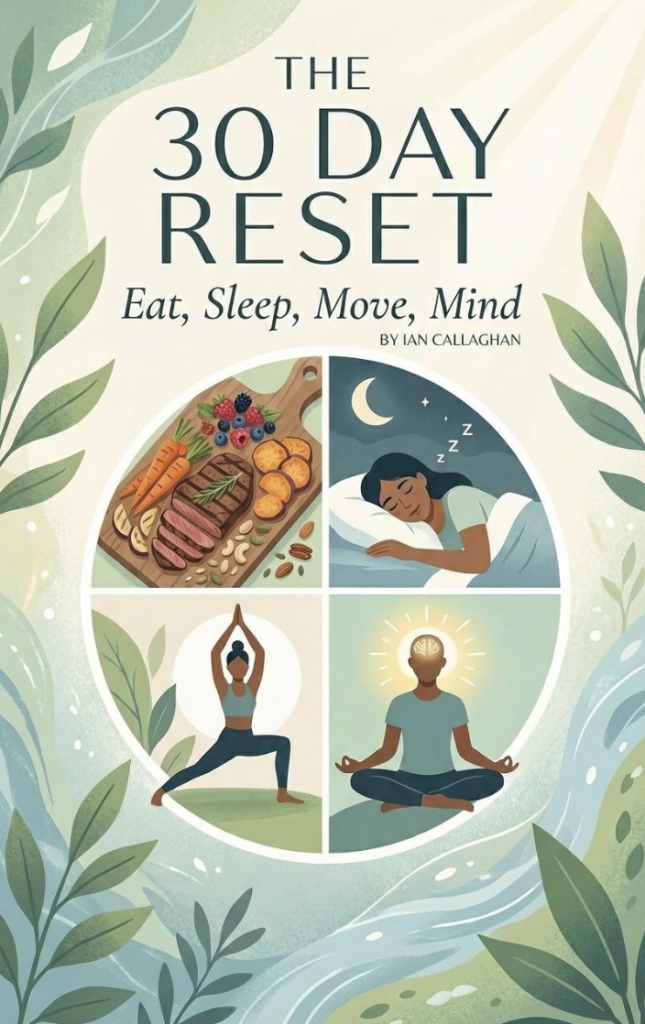
The 30 Day Reset is not a diet. It is a complete biological overhaul for anyone who is wired, tired, and done with feeling like shite. The 30-Day Reset is a 160+ page military-grade systems reboot for the over-35s. Four pillars. Eat, sleep, move, mind. One month to strip out the industrial poison, reset your dopamine pathways, silence Bob, and rebuild the machine that’s been running on the wrong fuel for decades. Not a diet. Not a programme. A complete…
I’m 58, I Quit Drinking After 45 Years, Lost 5 Stone, Reversed Pre-Diabetes, and My HRV Says I’m Built Different. Here’s the Data.
Midlife Rebuild. This isn’t a feel-good story about finding yourself at a yoga retreat. This is a systems rebuild. And I’ve got the receipts.
I spent 25 years as an IT Technical Architect designing complex infrastructure. I know what happens when you run 2026 demands on legacy hardware. Crashes. Failures. System degradation. And for most of my adult life, that’s exactly what I was doing to my own body and drinking for 45 years, eating badly, ignoring the signals, masking the symptoms—the human equivalent of a server held together with gaffer tape and unquestioning optimism.
Seventeen months ago, I shut the whole thing down and rebuilt it from the ground up. No rehab. No 12-step programme. No label. Just a bloke from Monmouthshire who looked at the data and made a decision.
What followed has been the most significant physiological and psychological transformation of my life. And I can prove it.
The Numbers First. Because Numbers Don’t Lie.
Before I tell you how, let me show you what.
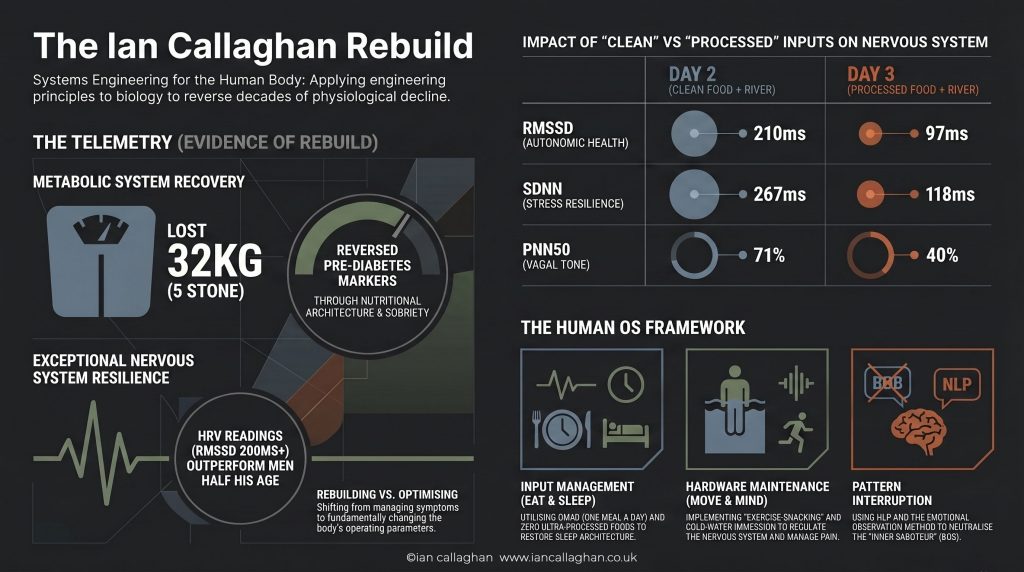
Five stone gone. Pre-diabetes reversed. HRV readings that would embarrass men half my age. Chronic inflammation markers are down. Sleep architecture rebuilt from scratch. A nervous system that was running on cortisol and ethanol is now operating on something closer to its original design spec.
And then there’s the experiment I accidentally ran this week.
Three mornings. Same man. Same river. Different variables. The results tell you everything you need to know about what food actually does to your biology overnight.
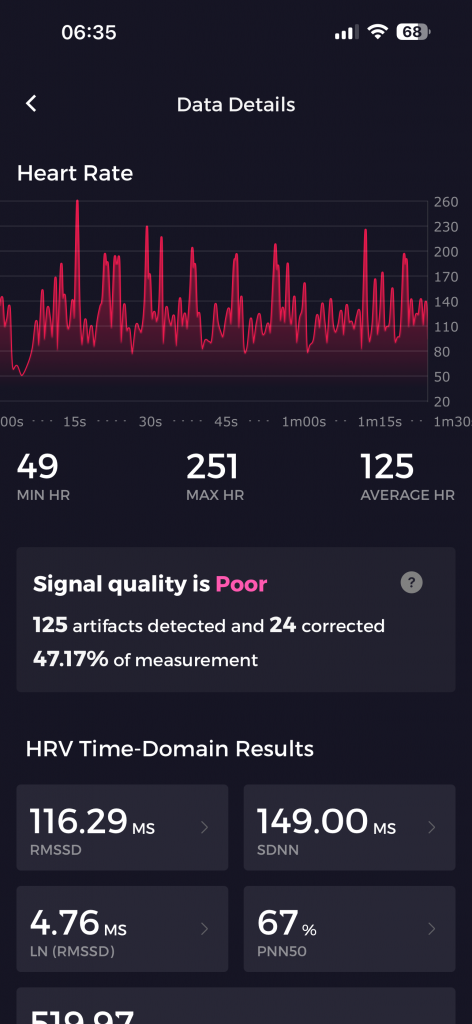
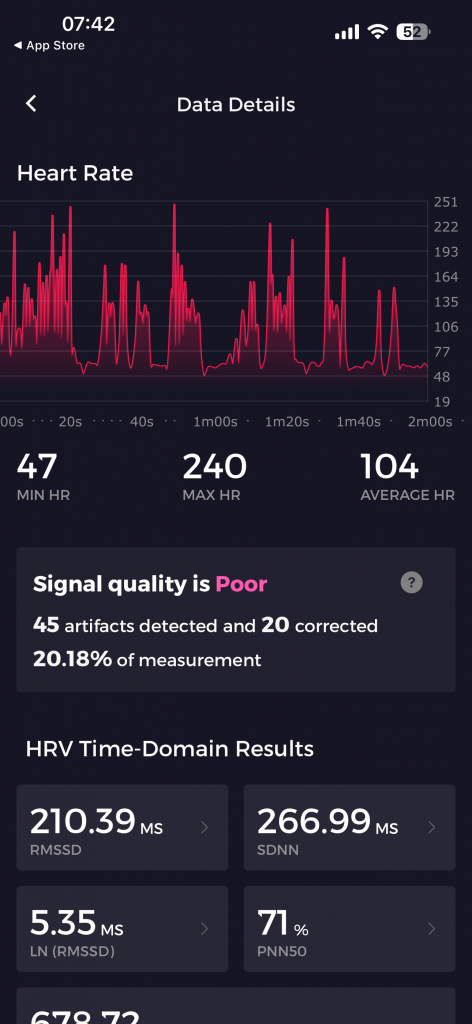
Day one was a noisy reading, poor signal quality on my HRV monitor, which is about 15 years old and struggling. Take it with a pinch of salt.
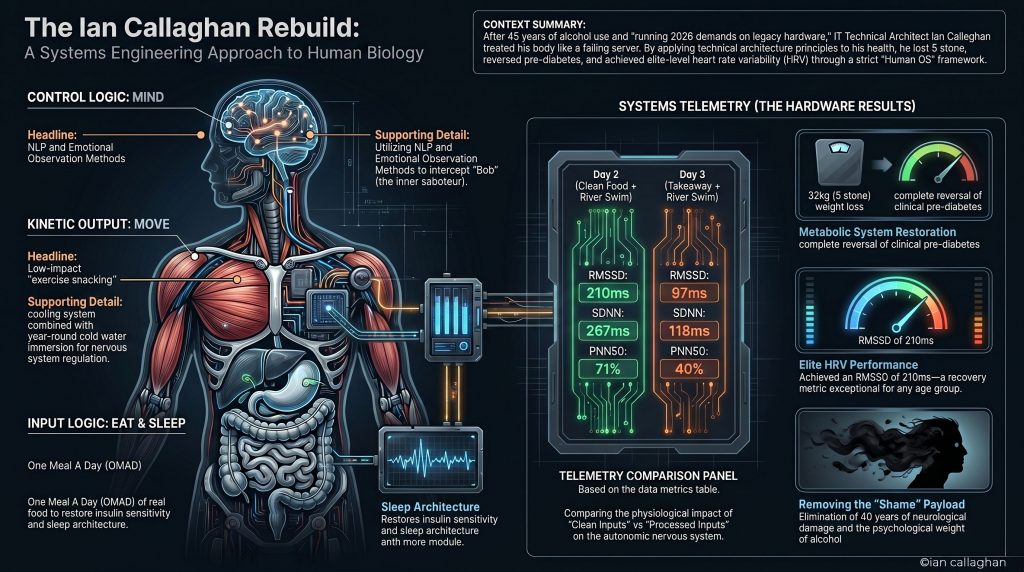
Day two: the night before, I’d been in the River Usk for around 20 minutes. Clean food all day. Woke up at 7:42 am to an RMSSD of 210ms, SDNN of 267ms, PNN50 at 71%, and an average resting heart rate of 104 during the measurement. For context, an RMSSD above 100ms is exceptional at any age. Above 200ms at 58 years old, after 45 years of drinking, is something a cardiologist would want to look at twice.
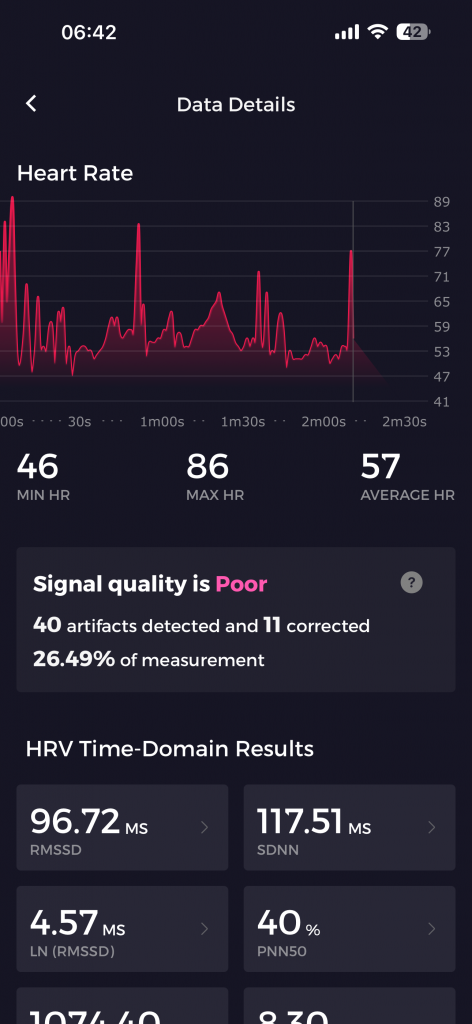
Day three: the night before, I’d been in the river again—same cold water exposure. But I’d also eaten a takeaway. Mixed gyro, salad, tzatziki, some pitta and fries. Not a 2 am kebab from a van. By most people’s standards, it was a reasonably decent meal. But by morning, my RMSSD had dropped to 97ms, SDNN to 118ms, and PNN50 down to 40%. Heart rate is sitting at 57.
Same cold water. Different food. The HRV told the story my body couldn’t hide.
The fries were cooked in seed oils. The pitta was made from processed wheat. Even the gyro meat in most takeaways is blended with fillers and stabilisers. None of it was catastrophic. But my autonomic nervous system registered every bit of it and showed up the next morning with the evidence.
That’s not theory. That’s telemetry.
Who the Hell Am I and Why Does Any of This Matter?
Fair question.
I’m Ian Callaghan. 58 years old. British Army veteran, 1st The Queen’s Dragoon Guards, 12 years served. Qualified chef. NLP Master Practitioner. Reiki Master. Technical Architect with CCNA and MCSE certifications. Multi-discipline coach based on the edge of the Brecon Beacons in Monmouthshire, Wales.
I also drank for over 40 years. Heavily. Consistently. In the way that becomes so normal, you stop seeing it as a problem and start calling it personality.
I didn’t go to rehab. I didn’t join AA. I don’t carry a chair count, day, or introduce myself with a label. I’m just a bloke who doesn’t drink. He looked at what alcohol was doing to his hardware and decided enough was enough.
Seventeen months ago, I made that decision. And the rebuild started immediately.
The Four Pillars. Not a Wellness Framework. An Operating System. Midlife Rebuild
Everything I do sits on four pillars. Eat. Sleep. Move. Mind. Not because I read it in a book, but because after decades of dismantling and reassembling my own biology, these are the four systems that either run clean or cause cascading failure everywhere else.
Eat
I eat one meal a day. OMAD. Not because it’s trendy —it isn’t —but because it’s what my body does best—one window. Real food. Animal fats, fermented foods, bone broth, organ meat when I can get it, resistant starch, and seasonal vegetables. Zero seed oils. Zero ultra-processed food. Nothing with more ingredients than my grandmother would recognise.
I’m a trained chef. I know what’s in food. I know what seed oils do at high heat. I know why the vegetable oil lobby has spent 50 years convincing people that butter is the enemy. I know what industrial food production looks like from the inside. And I refuse to put any of it in my body.
The weight loss was almost a side effect. Five stone gone. Pre-diabetes reversed. Not through calorie counting, points systems, or meal replacement shakes, but through eating food that is actually food.
I recently invested in a Wrekin water filter. Not a plastic Brita jug. Because if I’m this deliberate about what I eat, why would I drink tap water full of chlorine, fluoride, and microplastics? The inputs matter. All of them.
Sleep
Alcohol destroys sleep architecture. Not just quantity, quality. It sedates you rather than letting you sleep. You miss the deep restorative stages. You wake at 33 amwith your nervous system in low-grade panic. You call it insomnia. It isn’t. It’s ethanol metabolism.
Within weeks of stopping drinking, the sleep changed completely. I’d forgotten what it felt like to wake up actually rested—not less drunk. Not just functional. Genuinely rested. That alone would have been worth it.
Sleep is where your body does its maintenance. Skip it or corrupt it, and nothing else works properly—your HRV tanks. Your insulin sensitivity degrades. Your cortisol stays elevated. Your decisions get worse. Everything downstream of bad sleep is a mess.
Fix the sleep, and half your problems fix themselves.
Move
I don’t go to the gym. I’m not built for it, literally, three herniated discs at L3, L4 and L5 from my army service means conventional lifting can put me horizontal for days. So I adapted.
And before anyone romanticises the army injury as a badge of honour,r the institution handed out and walked away from, let me be clear. I’m currently fighting an active court case against the MOD for tinnitus and hearing loss caused during service. At the same time,e I’m battling PIP, the government’s disability benefit system, which has its own unique talent for making people feel like they’re lying about the body that was broken in service to the country. Two institutional fights are running simultaneously, on top of chronic pain, on top of rebuilding everything else.
I’m telling you this not for sympathy. I’m telling you this because the people in my audience are not rebuilding from a position of comfort. They’re rebuilding under fire. And if the transformation is possible while navigating all of that, it’s possible for anyone.
Exercise snacking throughout the day. Bird dog. Cat cow. Glute bridges. Planks. Tai chi squat arm swings. Resistance bands. Hand grips. Dead hangs. Assisted pull-ups. Yoga poses worked into the day rather than carved out of it.
I walk every day. The Brecon Beacons are on my doorstep, and I use them. I’m getting back into climbing, carefully, with a back that has its opinions about things.
And then there’s the river.
I’ve been swimming in the River Usk year-round my entire life. Not since Wim Hof made it fashionable. Not since some podcast told me cold water was good for inflammation, since before any of that had a name or a hashtag or a warrior attached to it. The river is 50 metres from where I grew up. It’s been part of my daily practice for as long as I can remember.
Cold water immersion does things to your nervous system that nothing else replicates. Vagal tone. Norepinephrine release. Dopamine baseline reset. Brown adipose tissue activation. The data backs all of it. But I didn’t need the data. I knew it from the inside out before the science caught up.
The HRV readings on the mornings after river swims tell the same story every time.
Mind
I’m an NLP Master Practitioner. I’ve spent decades studying how the mind processes experience, encodes belief, and either propels or sabotages everything you try to do. I use that knowledge daily. On myself first.
Meditation. Visualisation. Breathwork. Reiki. EOM, my own Emotional Observation Method, which is about learning to watch your emotional states rather than be consumed by them. These aren’t wellness add-ons. They’re functional tools for nervous system regulation.
I call my inner saboteur Bob. Bob is the part of your mind that tells you one drink won’t hurt, that you’ve earned it, that everyone else is doing it, that you’ll start Monday again. Bob has a very sophisticated PR operation, and he’s been running it for decades. The work is learning to recognise Bob’s voice and not act on it.
The meditation and breathwork are how I keep Bob in his box.
The Sobriety Part. Let’s Be Honest About This.
I drank for over 40 years. That’s not a background detail. That’s four decades of consistent neurological damage, liver stress, disrupted sleep, elevated cortisol, impaired gut function, suppressed immune response, and a running dialogue of shame that I got very good at drowning out with more alcohol.
I didn’t quit because I hit rock bottom. I quit because I looked at the data, and it was undeniable. Alcohol is a WHO Group 1 carcinogen. Not a grey area. Not “fine in moderation.” A carcinogen. The same category as asbestos and tobacco. The only reason we don’t talk about it that way is that the alcohol industry has spent billions making sure we don’t.
Seventeen months into my Midlife Rebuild, the physical changes have been extraordinary. But the psychological shift has been more significant. I described it once as having 40kg of invisible shame removed. The lies. The guilt. The performance is fine. All of it is gone.
I walk differently now. I make eye contact differently. I speak differently. Not because I found God or joined a movement, but because there’s nothing to hide anymore. Sobriety sharpened everything, including my voice.
The Reach. Because This Is Also a Media Story.
In December 2025, I had 400 Facebook followers.
By May 2026, under four months later, I had 58,000. A group of 10,000 members. 58 million views. An audience that is 82.2% aged 35 to 64. The demographic that every health brand struggles to reach authentically,y because most of their ambassadors are 28 years old and have never had a problem in their life.
On YouTube, in the last 90 days alone: 68,843 views. 2,000 hours of watch time. 1,075 subscribers. A 99.4% like ratio. 62.91% audience retention. A single video, “What Really Happens When You Quit Drinking,” pulled 16,557 views and 350 subscribers on its own.
LADbible picked me up. Ran my story. My quotes. My data. Because it’s a real story with real numbers and a real human behind it.
None of this came from paid ads. No social media agency. No growth hacking tools. Just showing up with the truth every single day and refusing to sanitise it.
Before Facebook, there was TikTok. I’d built 25,000 followers there before a video hit 400,000 views, and the subsequent surge in comments triggered TikTok’s Layer 7 Application Filter, which misclassified normal human engagement velocity as network automation. They banned the account. I appealed twice through their standard process, got nowhere, so I sent their Trust and Safety team a formal technical letter as a CCNA and MCSE certified Technical Architect, diagnosing the exact mechanism that caused the false positive, citing Engagement Velocity spikes, device telemetry correlation, and the specific comment rate-limiting behaviour that their filter misread. I requested a manual audit of the server logs.
Their response was complete silence.
So I moved to Facebook with 400 followers and grew to 58,000 in under four months.
I’m not telling that story to complain about TikTok. I’m telling it because it proves two things. First, I can build audiences from scratch across platforms without a budget, a team, or tools. Second, I’m not someone who wears technology for show. I understand how these systems work at an architectural level. When a brand partners with me on a health tech product, I’m not going to read the marketing copy. I’m going to understand the data, interrogate the methodology, and explain it to an audience that trusts me precisely because I never bullshit them.
That’s a different proposition entirely from a lifestyle influencer with a ring light and a discount code.
Why the Wellness Industry Gets This Age Group Wrong
Every supplement brand, every fitness app, every recovery programme targets the same demographic. Young, aspirational, already relatively healthy, looking to optimise.
The men and women in my audience aren’t optimising. They’re rebuilding, they are deep in Midlife Rebuild.
There’s a significant difference, and most brands completely miss it.
Optimising means taking something that works reasonably well and making it slightly better. Rebuilding means taking a system that has been running on the wrong inputs for decades, that has accumulated damage, inflammation, metabolic dysfunction, and psychological weight, and fundamentally changing its operating parameters.
The people who need Whoop aren’t the CrossFit athletes who already know their HRV. They’re the 52-year-old who hasn’t had a proper night’s sleep in a decade and doesn’t understand why. They’re the 47-year-old who quit drinking three months ago and wants to understand what’s actually happening in their nervous system. They’re the 58-year-old swimming in a Welsh river every morning and tracking his autonomic recovery with a 15-year-old chest strap because nobody has offered him anything better.
That’s my audience. And that audience is enormous, underserved, and desperate for tools that treat them like adults.
The HRV Monitor Situation. And What Comes Next.
My current HRV monitor is approximately 15 years old. The app, Elite HRV, struggles with the signal. As you’ve seen from my three morning readings, the artefact rate is high, and the data is messy.
But even through the noise, the signal is clear. The food experiment proved it. Cold water plus clean eating equals a nervous system operating at a level that surprises people who see the numbers.
I’m actively looking for a new monitor. Something that gives me clean data I can share with my audience in real time. Because the content writes itself, every morning reading is a data point. Every food choice, every river swim, every meditation session shows up in the numbers. That’s not a blog post. That’s a longitudinal case study with 58,000 people watching in real time.
If you’re a health tech brand reading this, that’s your pitch. Not an influencer posting a discount code. A genuine proof of concept, documented in public, by the kind of human your product was actually built for.
What I’ve Published. The Proof of Work.
Seven books. All available exclusively at iancallaghan.co.uk/the-shop/
Under Load. The 30 Day Reset. Emotional Mastery. Fix Your Metabolism. Nobody Taught You This. Beyond 12 Steps. And others.
A coaching practice. A Facebook community of 10,000 members. A subscriber hub. A Skool community. A YouTube channel. A blog with over 350 posts.
All of it was built as a single operator with no team, no agency, no budget. At the same time, fighting the MOD in court. While battling PIP. At the same time, I am managing chronic pain from three herniated discs at L3, L4 and L5. All of it was built on the evidence of my own life.
The Bottom Line
I’m not selling a shortcut. There isn’t one.
What I’m telling you is that at 58, after 45 years of drinking, after decades of running on the wrong inputs, the human body has a remarkable capacity to rebuild when you give it what it actually needs.
The data backs it. The HRV backs it. The five stone backs it. The reversed pre-diabetes backs it. The 58 million views from people who recognise their own story back it.
This isn’t wellness content. This is systems engineering applied to human biology. And the case study is me.
Pick up the wrench. The rebuild starts the moment you decide it does.
Frequently Asked Questions
Can you reverse pre-diabetes by quitting alcohol?
Yes, and the mechanism is straightforward once you understand it. Alcohol drives insulin resistance through multiple pathways — it disrupts liver glucose regulation, elevates cortisol, damages the gut lining, and chronically raises blood sugar. Remove the alcohol, add real food, sort the sleep, and insulin sensitivity often improves significantly within months. My own pre-diabetes markers reversed within the first year alongside OMAD and ancestral eating. It’s not a guarantee for everyone, but it’s far more common than the medical establishment acknowledges.
The evidence points strongly in that direction, and my own data backs it up. Cold water immersion activates the vagus nerve, drives norepinephrine release, and triggers a parasympathetic rebound after the initial cold shock response. Over time, regular cold exposure appears to improve vagal tone, which is the primary driver of HRV. My best readings consistently follow river swims, and the differential between cold water plus clean eating versus cold water plus processed food is stark enough to be visible in the numbers the very next morning.
What is exercise snacking, and does it actually work?
Exercise snacking is the practice of distributing short bouts of movement throughout the day rather than concentrating all activity into one gym session. Bird dogs, glute bridges, dead hangs, resistance band work, tai chi movements, planks — done in two- to five-minute windows across the day. The research suggests it produces comparable and in some cases superior metabolic and cardiovascular outcomes to a single daily session, particularly for people who can’t sustain conventional training due to injury or pain. For me, with three herniated discs at L3, L4 and L5, it isn’t a preference. It’s the only option. And the HRV data suggests it’s working.
How long after quitting alcohol does sleep improve?
Most people notice a change within the first two weeks, though the first few days can actually feel worse as the nervous system recalibrates without alcohol’s sedative effect. The deep restorative sleep stages — slow-wave sleep and REM — begin to return within the first month for most people. By three months, the architecture is usually significantly rebuilt. What took me by surprise was just how profound the difference was. I hadn’t slept properly in decades and had completely normalised the exhaustion. Waking up genuinely rested rather than just functional was one of the most disorienting early experiences of stopping.
OMAD stands for One Meal A Day. It’s an intermittent fasting approach where all daily calories are consumed in a single eating window, typically one to two hours. It’s not a fad for me — it’s how I’ve eaten for years because it aligns with my natural hunger patterns and produces stable energy, mental clarity, and metabolic efficiency. Whether it’s appropriate for anyone else depends on their individual health status, history, and goals. If you’re on medications that require food, diabetic, pregnant, or have a history of disordered eating, it needs careful consideration and medical input. For a 58-year-old man following a whole-food diet, it works exceptionally well.
What does HRV actually measure and why does it matter?
Heart Rate Variability measures the variation in time between consecutive heartbeats. Counterintuitively, more variation is better — it indicates a nervous system that is responsive and adaptable, with good balance between the sympathetic (fight or flight) and parasympathetic (rest and digest) branches. Low HRV is associated with chronic stress, poor recovery, cardiovascular risk, and accelerated ageing. High HRV correlates with resilience, good sleep quality, metabolic health, and longevity. It’s one of the most useful single metrics for understanding how well your system is actually functioning, which is why I track it every morning. The numbers don’t lie, and they don’t care how you feel about them.
What is the midlife rebuild,d and who is it for?
The midlife rebuild is what happens when you stop managing symptoms and start fixing the system. It’s for anyone in their 40s, 50s, or beyond who is running on the wrong inputs—too much alcohol, ultra-processed food, disrupted sleep, a sedentary lifestyle, and a mind full of patterns written decades ago and never updated. It’s not a programme you buy. It’s a decision you make. The tools are simple: real food, proper sleep, daily movement, nervous system regulation, and the willingness to be honest about what isn’t working. Everything else follows from that.
Is it possible to quit drinking without AA or rehab?
Yes. I did it. Millions of people have. AA and rehab serve an important function for many people, particularly those with severe physical dependency who need medically supervised withdrawal. But they are not the only path, and for a significant proportion of people, they are not the right path. What I used was a combination of understanding the neuroscience of addiction, NLP techniques for pattern interruption, cold water therapy for nervous system regulation, nutritional rebuilding, meditation and breathwork, and a refusal to use labels that build identity around the problem rather than the solution. None of that required a programme, a sponsor, or a chip. It required honesty, structure, and a decision not to go back.
Ian Callaghan is a British Army veteran, qualified chef, NLP Master Practitioner, and multi-disciplinary coach based in Goytre, Monmouthshire. He has been featured by LADbible and built a Facebook audience of 58,000 followers and 58 million views in under four months. His books are available exclusively at iancallaghan.co.uk/the-shop/
Used to monitor number of Google Analytics server requests when using Google Tag Manager
1 minute
_gid
ID used to identify users for 24 hours after last activity
24 hours
_ga_
ID used to identify users
2 years
_gali
Used by Google Analytics to determine which links on a page are being clicked
30 seconds
_ga
ID used to identify users
2 years
__utmx
Used to determine whether a user is included in an A / B or Multivariate test.
18 months
__utmv
Contains custom information set by the web developer via the _setCustomVar method in Google Analytics. This cookie is updated every time new data is sent to the Google Analytics server.
2 years after last activity
__utmz
Contains information about the traffic source or campaign that directed user to the website. The cookie is set when the GA.js javascript is loaded and updated when data is sent to the Google Anaytics server
6 months after last activity
__utmc
Used only with old Urchin versions of Google Analytics and not with GA.js. Was used to distinguish between new sessions and visits at the end of a session.
End of session (browser)
__utmb
Used to distinguish new sessions and visits. This cookie is set when the GA.js javascript library is loaded and there is no existing __utmb cookie. The cookie is updated every time data is sent to the Google Analytics server.
30 minutes after last activity
__utmt
Used to monitor number of Google Analytics server requests
10 minutes
__utma
ID used to identify users and sessions
2 years after last activity
_gac_
Contains information related to marketing campaigns of the user. These are shared with Google AdWords / Google Ads when the Google Ads and Google Analytics accounts are linked together.