By Ian Callaghan | Nutritional Strategist | Author of Fix Your Metabolism & The 30-Day Reset | Gut Brain Neurodegeneration
“The day I understood that neurodegeneration begins in the gut — not the brain — was the day everything changed. Not just what I ate. How I thought about ageing, about disease, about the decades I had ahead of me.”
What Nobody Is Telling You About Brain Disease and Gut Brain Neurodegeneration
Gut Brain Neurodegeneration. Here is a question your GP has almost certainly never asked you.
How’s your gut?
Not because they don’t care. But because in five-plus years of medical training, the average UK GP receives less than one week of total education on nutrition and gut health. One week. It covers the system that produces 90% of your serotonin, 50% of your dopamine, and houses more neurons than your entire spinal cord.
That blind spot is costing people their minds. Literally.
Because the science — published in leading neuroscience journals, studied at Stanford, and presented at the highest levels of academic research in 2025 — is telling us something that changes everything we thought we knew about brain disease.
Parkinson’s doesn’t start in the brain. It starts in your gut.
Alzheimer’s isn’t a memory disease. It’s a metabolic one.
Neurodegeneration isn’t inevitably bad luck. It’s a downstream consequence of a gut environment that’s been quietly failing for decades.
This is the definitive guide to understanding the gut-brain highway, how it works, and how it breaks. And what you can do, starting today, to protect your neurological future.
The Architecture of the Gut-Brain Axis: What You Were Never Taught
Your gut and your brain are in constant conversation. Not metaphorically. Physically. Through a sophisticated bidirectional communication network called the Gut-Brain Axis (GBA).
This network operates through three primary channels:
Neural — Direct physical connection via the vagus nerve, the longest nerve in your autonomic nervous system
Humoral — Chemical signals sent through the bloodstream, including hormones and metabolites
Immune — The systemic movement of inflammatory cytokines and immune cells
The gut contains its own nervous system — the Enteric Nervous System (ENS) — embedded within the lining of the gastrointestinal tract. It has more than 500 million neurons. It operates with remarkable autonomy. Scientists call it the Second Brain.
And here is the architectural detail that most people miss entirely.
The vagus nerve — the physical highway connecting your gut to your brainstem — is composed of 80% afferent (sensory) fibres. That means the overwhelming majority of traffic along this nerve flows upward. Bottom-up. From your gut to your brain.
Your brain is not commanding your gut. Your gut is reporting to your brain. Constantly. Every hour of every day. Based on what you feed it.
When the report is good — a diverse microbiome, a strong gut lining, and healthy SCFA production — your brain receives signals of safety, repair, and neurological protection.
When the report is bad — dysbiosis, leaky gut, bacterial endotoxins — your brain receives alarm signals that trigger inflammation, accelerate protein misfolding, and set the conditions for the slow-motion catastrophe we call neurodegeneration.
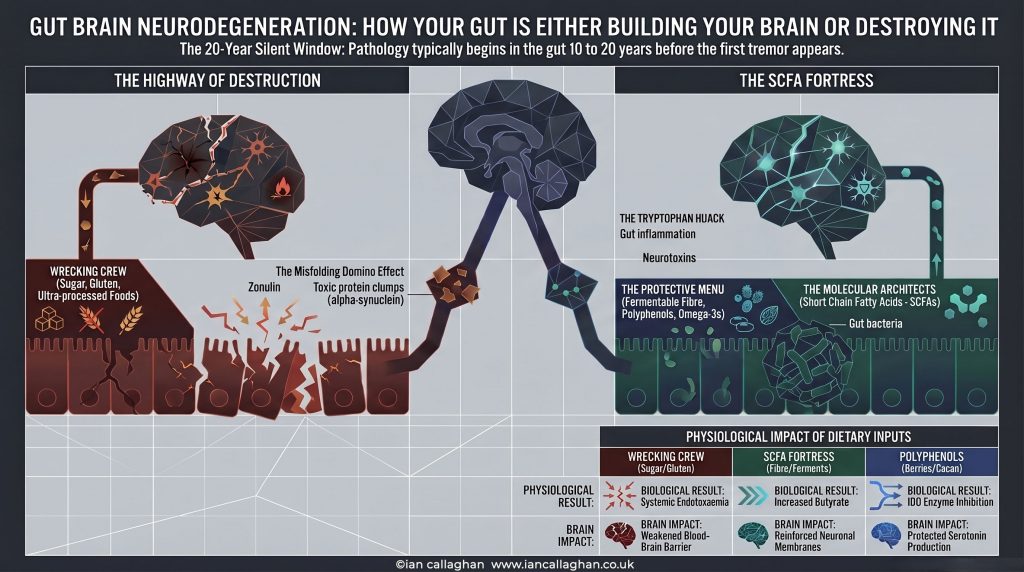
The 20-Year Silent Window: When Disease Begins Long Before Symptoms Appear
This is the part that should stop you in your tracks.
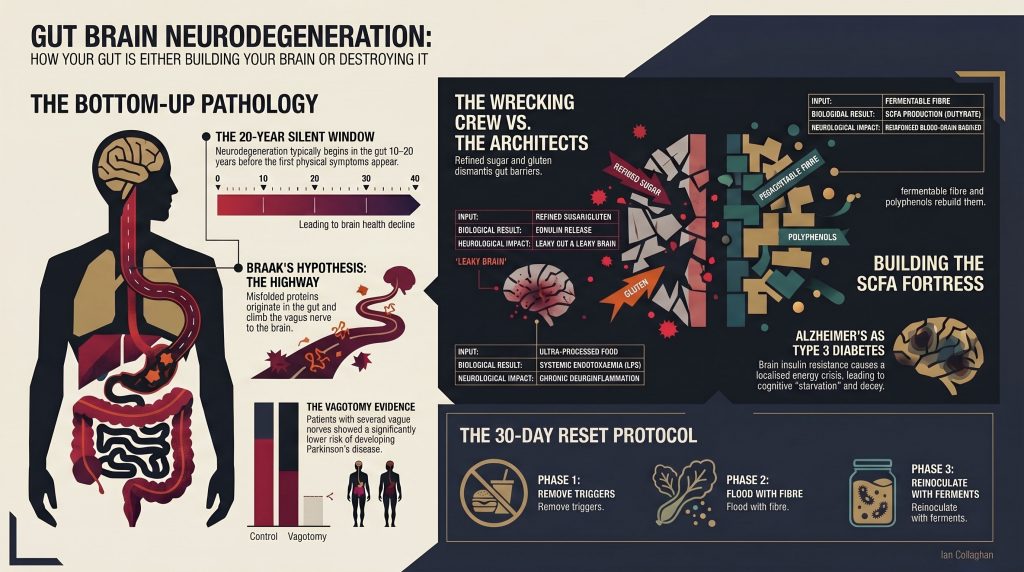
By the time a Parkinson’s patient experiences their first tremor — the shaking hand, the shuffling gait, the rigidity that changes a life overnight — the pathological process that caused it has typically been running for 10 to 20 years.
Two decades. Silent. Invisible. Building in the gut wall before the first symptom ever reaches the brain.
This is what Braak’s Hypothesis tells us. And the evidence behind it is compelling enough to have fundamentally shifted how the world’s leading neuroscientists think about disease prevention.
The implication is enormous.
If the disease starts in the gut, and the disease starts 10 to 20 years before diagnosis, then the intervention window — the period during which you can actually change the trajectory — isn’t at diagnosis. It’s right now. Decades before any neurologist ever entered the picture.
What you eat today is either building the conditions for future neurological health or quietly laying the groundwork for disease. Not as a metaphor. As a biological mechanism.
Braak’s Hypothesis: The Science That Changes Everything
In 2003, German neuroanatomist Heiko Braak proposed something that the medical establishment largely ignored for years. He suggested that Parkinson’s disease doesn’t originate in the substantia nigra — the brain region whose dopamine-producing neurons are destroyed in the disease — but in the gut’s enteric nervous system.
The mechanism he proposed goes like this.
Step 1 — The Trigger in the Gut
Environmental triggers — pesticides, bacterial toxins called lipopolysaccharides (LPS), heavy metals — breach a compromised gut lining and enter the enteric nervous system. Here, they cause a protein called alpha-synuclein to misfold. In its healthy state, alpha-synuclein is soluble and harmless. Under inflammatory stress, it changes shape. It becomes sticky. It aggregates into toxic clumps.
Step 2 — The Prion-Like Spread
These misfolded protein clumps don’t stay put. They behave almost like prions — corrupting healthy proteins around them in a domino effect. Cell by cell, the misfolding spreads through the enteric nervous system.
Step 3 — The Highway
Then the clamps find the vagus nerve. And they climb. Via a process of retrograde transport, misfolded alpha-synuclein seeds travel upward along the vagal fibres — from the gut, through the brainstem, into the midbrain, and eventually to the cortex.
The first port of call is the dorsal motor nucleus of the brainstem. This correlates precisely with the earliest non-motor symptoms of Parkinson’s — sleep disturbances, depression, constipation, loss of smell — symptoms that often appear years before the tremor.
Eventually, the seeds reach the substantia nigra. Dopamine-producing neurons die. The motor symptoms begin.
By the time you see the tremor, you’re looking at the end of a very long story that started in the gut.
The Vagotomy Evidence: The Accidental Human Trial
Here is where the science becomes genuinely jaw-dropping.
In the mid-20th century, a common treatment for stomach ulcers was a procedure called a truncal vagotomy — surgically severing the vagus nerve to reduce stomach acid production. It was performed on hundreds of thousands of patients across multiple countries over several decades.
Epidemiological data later revealed something nobody was looking for.
Patients who had undergone a full truncal vagotomy showed a significantly reduced risk of developing Parkinson’s disease later in life.
Cut the highway between the gut and the brain. Parkinson’s risk drops.
This wasn’t a small study. This was large-scale population data. And what it tells us is that the vagus nerve isn’t just a communication channel between gut and brain. In a diseased gut environment, it becomes the anatomical bridge that allows pathology to travel from one to the other.
The medical establishment had accidentally run a massive human trial. And the result pointed directly at the gut as the origin of the disease.
This evidence is now considered among the strongest support for Braak’s Hypothesis. And it has profound implications for how we think about prevention.
Alzheimer’s: The Type 3 Diabetes Nobody Told You About
Parkinson’s isn’t the only neurodegenerative condition being reframed through the lens of metabolic and gut health.
Alzheimer’s disease — which affects over 900,000 people in the UK and is projected to rise to 1.6 million by 2040 — is increasingly understood through a framework called Type 3 Diabetes.
This isn’t fringe science. It’s the emerging consensus of nutritional neuroscience. And it changes everything about how we think about cognitive decline.
Here’s the mechanism.
Brain Insulin Resistance
Insulin isn’t just for managing blood sugar. In the brain, insulin is required to activate glucose transporters — specifically GLUT4 — in memory-critical regions like the hippocampus. When those regions become insulin resistant, they enter a state of localised energy crisis. ATP production drops. Mitochondria fail. Synaptic connections degrade.
The brain is starving. Not of calories. Of the ability to use the energy that’s already there.
The Sugar Rust — AGEs
Chronic hyperglycaemia produces a compound called methylglyoxal, the precursor to Advanced Glycation End-products (AGEs). These compounds cross-link with brain proteins, rendering them dysfunctional and triggering a destructive cycle of chronic neuroinflammation mediated by the brain’s immune cells — microglia.
Think of it as rust. Forming slowly. Inside your brain. Over years of elevated blood sugar.
The Overwhelmed Cleanup Crew
The Insulin-Degrading Enzyme (IDE) has two jobs. It clears excess insulin. And it clears amyloid-beta — the protein associated with Alzheimer’s plaques.
In a state of chronic hyperinsulinaemia, IDE is monopolised by excess insulin. It can’t do both jobs. Amyloid-beta accumulates freely.
The brain’s cleanup crew has been overwhelmed. Not by genetics. By metabolic dysfunction driven by decades of the wrong dietary inputs.
The Methionine-Acetylcholine Connection
There’s another mechanism connecting gut health to Alzheimer’s that rarely gets discussed. Your gut microbiome modulates the metabolism of methionine, an essential amino acid. Methionine is a precursor to SAM (S-adenosylmethionine), which is required for the synthesis of choline. And choline is the precursor for acetylcholine — the neurotransmitter most associated with memory and cognitive function.
Reduced acetylcholine is a primary hallmark of Alzheimer’s disease.
Gut dysbiosis disrupts this entire pathway. It doesn’t just affect your mood or your digestion. It starves your brain of the raw materials it needs for memory.
The Molecular Architecture of Brain Protection: The SCFA Fortress
So what stands between your gut and neurodegeneration?
Short-Chain Fatty Acids. SCFAs.
Specifically, the trinity of butyrate, propionate, and acetate — metabolites produced by your gut bacteria when they ferment dietary fibre. These aren’t just digestive byproducts. They are your brain’s primary architects of defence.
Here’s what they actually do.
Sealing the Gut Lining
SCFAs upregulate tight junction proteins — specifically occludin — in the gut epithelium. These proteins act as molecular bouncers, sealing the gaps between intestinal cells and preventing bacterial endotoxins from leaking into the bloodstream.
No leak. No LPS. No systemic endotoxaemia. No compromised blood-brain barrier.
Reinforcing the Blood-Brain Barrier
SCFAs don’t stop at the gut wall. They enter the systemic circulation and travel to the blood-brain barrier, where they bind to G protein-coupled receptors (GPR41/GPR43) on endothelial cells, signalling them to maintain structural integrity. They upregulate occludin here, too — specifically in the frontal cortex and hippocampus.
The fortress has two walls. SCFAs build and maintain both.
Activating the Master Antioxidant Defence
Propionate specifically activates the Nrf2 pathway — the body’s master antioxidant defence system. This armours the blood-brain barrier against oxidative erosion and reduces the expression of inflammatory receptors (CD14) that would otherwise trigger neuroinflammatory cascades.
Quenching Neuroinflammation
Once in the central nervous system, SCFAs block master inflammatory pathways — specifically NF-κB and MAPK. This calms microglial activation. In animal models, it has been shown to halt the degeneration of dopaminergic neurons and preserve motor function.
The SCFA fortress is not a nice-to-have. It is the primary molecular mechanism standing between your gut environment and your neurological future.
When SCFA production collapses — as it does on a modern Western diet low in fermentable fibre — both walls come down simultaneously.
The Tryptophan Hijack: When Your Gut Turns Against Your Brain
There’s another mechanism connecting gut inflammation to neurological damage that almost nobody is talking about.
Your gut microbiome controls the fate of tryptophan — the essential amino acid required for serotonin synthesis.
Under healthy conditions, dietary tryptophan is converted to serotonin (90-95% of which is produced in the gut) or 5-HTP, which crosses the blood-brain barrier for central nervous system serotonin production.
This is your mood, your sleep, your emotional resilience. All starting in your gut.
But when the gut is inflamed, a catastrophic diversion occurs.
Pro-inflammatory cytokines — TNF-α, IL-6, IFN-γ — activate an enzyme called IDO (indoleamine 2,3-dioxygenase). This enzyme hijacks tryptophan away from the serotonin pathway and diverts it into the kynurenine pathway instead.
The end products of this diversion are neurotoxic.
Quinolinic Acid (QUIN) — an excitotoxin that overstimulates NMDA receptors, triggering a calcium influx that destroys neuronal membranes
Your inflamed gut isn’t just failing to produce serotonin. It’s actively producing brain-damaging toxins from the same raw material that should have become your primary mood neurotransmitter.
This is the tryptophan hijack. And it runs silently in millions of people with chronic gut inflammation — most of whom have been told their depression, anxiety, or brain fog is a mental health issue, not a gut issue.
The Leaky Gut Pipeline: How Dysbiosis Becomes Neurodegeneration
Everything described above depends on one critical vulnerability: intestinal permeability—the leaky gut.
In a healthy gut, the epithelial lining is a masterwork of biological engineering. A single layer of cells secured by tight junction proteins — occludin and claudin — that act as molecular bouncers. Nutrients in. Pathogens out.
When the microbiome shifts into dysbiosis — an imbalance caused by processed foods, refined sugar, antibiotics, alcohol, and chronic stress — several things happen simultaneously.
Beneficial bacteria that produce mucins (the protective mucus layer) decline. The gut lining becomes more permeable. Gram-negative bacteria produce lipopolysaccharides (LPS) — bacterial endotoxins that can now breach the gut wall and enter the bloodstream.
This is systemic endotoxaemia. And it creates a vicious cycle.
LPS in the bloodstream triggers systemic inflammation. That inflammation weakens the blood-brain barrier. LPS enters the brain and activates microglia via the TLR4/MyD88/NF-κB pathway, thereby driving a self-sustaining cycle of neuroinflammation. The NLRP3 inflammasome — a multi-protein complex that initiates inflammatory cell death — is activated. Dopaminergic neurons die.
The leaky gut pipeline doesn’t just connect your gut to your brain. It is the mechanism by which a damaged microbiome becomes a damaged nervous system over time.
The gut is the source. The vagus nerve is the highway. The brain is the destination.
The Wrecking Crew vs The Fortress: What You’re Feeding Every Day
Your daily dietary choices are either to build the SCFA fortress or to send in the wrecking crew.
Here’s what each side looks like.
🔴 The Wrecking Crew
Refined Sugar and Processed Carbohydrates Drive hyperglycaemia and hyperinsulinaemia. Monopolise IDE. Allow amyloid-beta to accumulate—fuel pro-inflammatory bacterial species. Collapse SCFA production.
Gluten triggers the release of zonulin — a protein that physically disassembles the tight junction proteins of the gut lining. Leaky gut by design. This is the mechanism. It is not a wellness industry myth.
Ultra-Processed Food Strips the diet of fermentable fibre — the substrate your gut bacteria need to produce SCFAs. Without fibre, the architects have no materials. The fortress crumbles.
Alcohol directly damages the gut lining, disrupts the microbiome, drives LPS translocation, and compromises the blood-brain barrier. The gut-brain connection in alcohol recovery is a subject I’ve written about extensively — because it’s personal, and because the science is unambiguous.
Fermentable Fibre Vegetables, legumes, oats, resistant starch. This is the raw material for butyrate-producing bacteria — Faecalibacterium prausnitzii, Roseburia intestinalis. No fibre, no SCFAs. No SCFAs, no fortress.
Polyphenols: berries, dark chocolate, green tea, olive oil, herbs and spices. Polyphenols enhance SCFA production AND inhibit the IDO enzyme — shutting down the tryptophan hijack before it starts. They are simultaneously prebiotic fuel and neurological protection.
Omega-3 Fatty Acids: Oily fish, flaxseed, walnuts. Suppress intestinal inflammation, support SCFA-producing bacteria, and protect the serotonin pathway by keeping IDO dormant.
Fermented Foods: Sauerkraut, kimchi, kefir, live yoghurt. Increase microbiome diversity — your neurological insurance policy. Specific strains like Lactobacillus rhamnosus (JB-1 and HN001) and Bifidobacterium longum have been shown to directly activate the vagus nerve and alter GABA receptor expression in the brain.
Nutrient-Dense Proteins Provide choline (for acetylcholine and the methionine pathway) and tryptophan (for serotonin, when the IDO enzyme is kept dormant by the rest of the protocol).
Top-Down Toning: The Conscious Override
Diet — the bottom-up approach — is the foundation. But the gut-brain axis is bidirectional. And there are top-down practices that directly activate the parasympathetic nervous system and improve vagal tone, creating a feedback loop that protects both gut and brain simultaneously.
Cold Water Exposure Physically triggers the vagal dive reflex — an immediate systemic shift to parasympathetic dominance. Lower heart rate. Reduced cortisol. Calmer microglia. I use this daily. The science behind it is not optional reading for anyone serious about neurological longevity.
Breathwork Acts as a manual override for the autonomic nervous system. Controlled breathing through extended exhalation directly activates vagal efferent fibres — signalling safety to the enteric nervous system, improving insulin sensitivity, and reducing the inflammatory load that drives the tryptophan hijack.
Meditation operates at a systems level to calm microglial activation. Daily meditation practice reduces the neuroinflammatory baseline that, left unchecked, would progressively damage synaptic integrity.
HRV Tracking Heart Rate Variability — specifically the RMSSD metric (Root Mean Square of Successive Differences) — gives you a direct, objective measurement of vagal tone and parasympathetic activity. It is concrete proof that your interventions are working. Track it daily. Watch it improve. Your gut-brain highway is getting stronger in real time.
FAQ: The Questions I Know You’re Already Asking
Can diet actually prevent Parkinson’s disease?
There is no randomised controlled trial proving that specific dietary interventions prevent Parkinson’s in humans. What we have is a rapidly growing body of mechanistic evidence showing that gut health directly determines the biological conditions that precede neurodegeneration — often by 10 to 20 years. The mechanism is established. The intervention window is real. The vagotomy data are real. What you choose to do with that information is your call.
My GP has never mentioned any of this. Is it fringe?
It is being studied at Stanford, King’s College London, and the Mayo Clinic. It is published in Nature Neuroscience, Gut, and the Journal of Parkinson’s Disease. It is the subject of the MAMS EJS ACT-PD trials — the most sophisticated multi-arm clinical trials in neuroscience in 2025. It is not fringe. Your GP’s curriculum hasn’t caught up. That gap is what I’m here to close.
Is it too late if I’m already in my 40s or 50s?
The gut lining regenerates completely every few days. Microbiome composition shifts measurably within weeks of dietary change. The brain has extraordinary neuroplasticity. It is never too late to start. But the earlier you start, the longer the protective period you’re creating. The 20-year silent window cuts both ways — which means the next 20 years of what you eat matter more than most people will ever be told.
What about genetics?
Genetics loads the gun. Lifestyle pulls the trigger. For the vast majority of neurodegenerative disease risk, the gut environment determines whether a genetic predisposition becomes a clinical reality. The NLRP3 inflammasome, the TLR4 pathway, the IDO enzyme — these are not genetic inevitabilities. They are biological switches that your daily choices either activate or suppress
What’s the most important thing I can do right now?
Remove the wrecking crew first—Gluten, refined sugar, ultra-processed food. The gut lining cannot begin to heal while zonulin is continuously disassembling it. Week one of the 30-Day Reset is always about clearing the field before building the fortress.
The 30-Day Reset: Building Your Neurological Fortress
The protocol is simple. The discipline is the hard part.
📅 Week 1 — Remove the Wrecking Crew gluten and refined sugar. Ultra-processed food is out. Alcohol out. Watch what happens to your gut, your sleep, your mental clarity, and your brain fog within seven days. You’ll have your first data point.
📅 Week 2 — Flood with Fibre and Polyphenols. Every meal contains plants. Colour, variety, volume. Aim for 30 different plant species across the week — research shows this level of diversity dramatically shifts microbiome composition toward SCFA-producing species. Your gut bacteria are rebuilding the fortress.
📅 Week 3 — Reinoculate with Ferments Daily sauerkraut, kimchi, or kefir. This is where microbiome diversity begins to compound. Introduce the vagal-stimulating strains. Watch your RMSSD score start to climb.
📅 Week 4 — Repair and Audit: How’s the gut? The mood? The brain fog? The energy? The clarity? You have four weeks of biological data. You don’t need me or anyone else to tell you it’s working. Your body will be telling you loud and clear.
What’s Coming Next: The Bottom-Up Thesis
I’m going to be straight with you.
Everything in this article represents the tip of a very deep research process I’m currently embedded in.
The gut-brain-neurodegeneration connection — the bottom-up thesis that your gut is either building your brain or destroying it — is the subject of a book I’m developing. It goes deeper than anything currently on the market. Into the molecular origami of protein misfolding. Into the NLRP3 inflammasome and the toxic cascade. Into the 2025 clinical landscape of disease-modifying therapies. What Braak’s Hypothesis means not just for Parkinson’s but for the full spectrum of neurodegenerative conditions.
The research is ongoing. The book is coming.
If you want to be the first to know when it lands — and to get access to the research, protocols, and thinking as it develops — make sure you’re on the list.
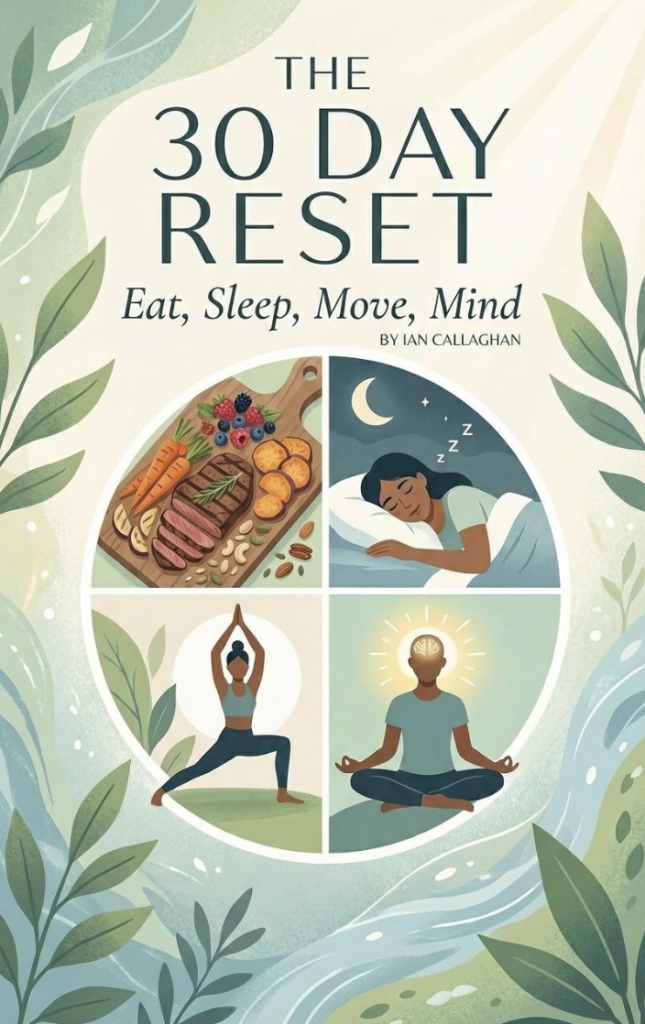
The 30 Day Reset is not a diet. It is a complete biological overhaul for anyone who is wired, tired, and done with feeling like shite. The 30-Day Reset is a 160+ page military-grade systems reboot for the over-35s. Four pillars. Eat, sleep, move, mind. One month to strip out the industrial poison, reset your dopamine pathways, silence Bob, and rebuild the machine that’s been running on the wrong fuel for decades. Not a diet. Not a programme. A complete…
Your GP has had less than a week of training on gut and nutritional health. The system they were trained in has a blind spot the size of a motorway.
But you’ve just read the science. The vagotomy data. The Braak Hypothesis. The SCFA fortress. The tryptophan hijack. The Type 3 Diabetes framework. The 20-year silent window.
You now know more about the gut-brain connection and its role in neurodegeneration than most people will ever be told by anyone in a clinical setting.
The question is never what you know. It’s what you do with it.
Your gut is either building your brain or dismantling it. Every single day. Based on what you eat.
That’s not a scare tactic. That’s the machine. And now you know how it works.
👇 Drop a comment below. Has this changed how you think about gut health and brain disease? Has anyone in your family been affected by Parkinson’s or Alzheimer’s? I want to hear from you.
Ian Callaghan is a nutritional strategist, mindset coach, and author based in the UK. His work sits at the intersection of metabolic health, gut biology, and neurological longevity. He is the author of Fix Your Metabolism and The 30-Day Reset, and is currently deep in research for a groundbreaking new book on the bottom-up thesis of neurodegeneration.
Why can’t I stop drinking even though I want to? There is a particular kind of hell in wanting to stop drinking and still finding yourself doing it again.
Not the dramatic Hollywood version of addiction where everything is on fire, and everyone can see it. I mean the quieter version. The one where you wake up in the morning with that dry mouth, that thick head, that low-level dread in your chest and the same tired sentence running through your mind.
I am not doing this again tonight.
And you mean it. That is the part that people who have never been caught in this loop struggle to understand. You are not always lying in that moment. You are not always making some half-arsed promise you know you will break. In the morning, with the regret still fresh and your body still paying the bill, you often do mean it. You know the drink is costing you. You know your sleep is wrecked. You know your mood is flatter than it should be. You know your patience is thinner. You know your confidence is taking a kicking. You know your relationships, your work, your energy and your self-respect are all being taxed by something that was supposed to help you relax.
Then the day happens.
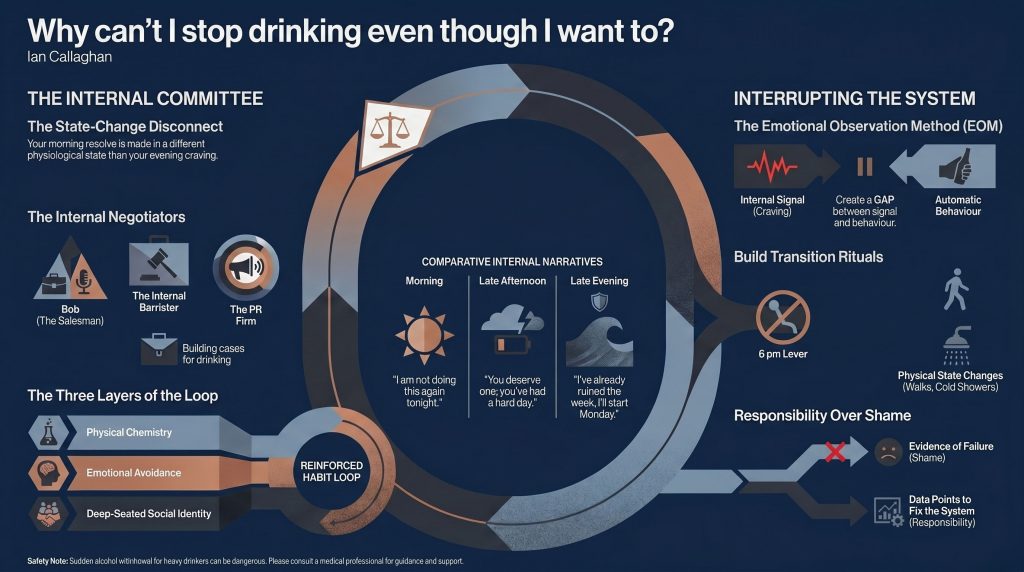
Work happens. Stress happens. Boredom happens. Loneliness happens. Family pressure happens. Pain happens. Hunger happens. Fatigue happens. Your nervous system gets overloaded all day, and by late afternoon, the version of you who made that clear, sober morning decision is no longer the one in charge. That is when the internal negotiation starts.
You deserve one.
You have had a hard day.
Just tonight.
You can stop tomorrow.
You are not as bad as other people.
You have already ruined the week; may as well start fresh on Monday.
That voice does not usually sound like an enemy. That is why it works. It sounds like you. It borrows your memories, your stress, your excuses, your tiredness and your pain, then uses all of it to build a case for the very thing you swore off only a few hours earlier.
That is why the question “Why can’t I stop drinking even though I want to?” is so important. It is not a stupid question. It is not a weak question. It is not a question asked by someone who needs another motivational quote or a lecture on units.
It is the question asked by someone who is starting to realise that information is not enough.
Because you already know enough.
You know alcohol is not doing you any favours. You know it damages sleep, mood, health, motivation, hormones, digestion, relationships and self-trust. You know alcohol is linked to serious health risks, including cancer. You know it can worsen anxiety and low mood. You know it can become physically and psychologically dependent. You do not need another patronising leaflet telling you to drink water between drinks.
The real question is not whether alcohol is harmful.
The real question is why the part of you that knows that keeps getting overruled by the part of you that wants relief now.
That is where the real work starts.
Before anything else, a serious safety note
If you are drinking heavily every day, if you shake when you do not drink, if you sweat, vomit, hallucinate, feel severely agitated, have seizures, or need alcohol to feel normal, do not suddenly stop without medical advice.
Alcohol withdrawal can be dangerous and, in some cases, life-threatening. Speak to your GP, NHS 111, a local alcohol service or emergency medical support if you are worried about withdrawal.
This article is not a detox plan. It is not medical advice. It is not telling anyone to white-knuckle a dangerous withdrawal at home. It is about understanding the loop that keeps so many people drinking after they have already decided they want to stop.
Because for a lot of people, the terrifying part is not only the alcohol. It is the feeling that they can no longer trust themselves around it.
You are not fighting a drink; you are fighting a system
One of the biggest mistakes people make is treating drinking as if it were only a single decision.
Do I drink or do I not drink?
That sounds simple, but for many people it is nowhere near that simple. By the time you reach for the bottle, open the can, walk into the pub or stop at the shop, the decision has often been prepared long before the drink appears.
Alcohol may have become part of your internal operating system. It may be how you mark the end of the day. It may be how you avoid silence. It may be how you soften stress, numb resentment, quiet anxiety, dodge boredom, delay grief, reduce social discomfort or create a fake sense of reward in a life that has become all pressure and no real recovery.
That does not make alcohol a solution. It makes it a lever.
And once the brain and body learn that pulling that lever changes state quickly, the system starts defending it.
Bad day? Pull the lever.
Argument? Pull the lever.
Lonely evening? Pull the lever.
Work pressure? Pull the lever.
Kids in bed? Pull the lever.
Partner opens wine? Pull the lever.
Friday night? Pull the lever.
Sunny afternoon? Pull the lever.
Tuesday for no obvious reason? Pull the lever anyway.
After a while, you are not making a single clear decision about a drink. You are up against habit, memory, chemistry, identity, emotional avoidance, social conditioning, routine and a nervous system that has learned to associate alcohol with relief.
This is why willpower often collapses. Not because you are weak, but because willpower is a conscious tool, and the drinking loop often starts before conscious reasoning has even got its boots on.
In my own language, this is where Bob walks in.
Bob is the voice in the system that argues for the old behaviour. Bob is not some cartoon devil on your shoulder. Bob is much slicker than that. Bob is the polished internal salesman who knows exactly where the pressure points are. He knows when you are tired. He knows when you are hungry. He knows when you feel rejected, trapped, bored, lonely, ashamed or resentful. He knows how to turn discomfort into permission.
Bob rarely starts with, “Let’s wreck your life.”
Bob starts with, “You deserve one.”
That is why he is dangerous.
Then the Internal Barrister gets involved. This is the part of the mind that starts building a legal case for the behaviour after another part of you has already decided against it. It gathers evidence. It calls stress to the witness stand. It brings fatigue as an expert. It reminds you of other people who drink more than you. It notes that you went three days last week, so you are clearly fine. It argues that this is not the right time to stop. It cross-examines your morning promise until it sounds naive.
By the time the drink is in your hand, it feels like you made a decision.
But often, the case was built before you even noticed the courtroom had opened.
Why knowing better does not automatically make you do better
There is a lazy idea that people keep drinking because they do not understand the consequences.
Sometimes that is true. Some people are genuinely misinformed. The alcohol industry has done a brilliant job of wrapping a toxic, dependence-producing drug in friendship, reward, sophistication, stress relief and celebration. Plenty of people still have no idea how badly alcohol can affect sleep, anxiety, heart health, cancer risk, metabolic health and the nervous system.
But a lot of people do know.
They know too much, if anything. They have read the articles. They have watched the videos. They have tracked their sleep. They have noticed the anxiety. They have seen the weight creep on. They have felt the shame. They have made the promises. They have had awful mornings.
The problem is that information does not automatically override the state.
You can know alcohol is harming you and still crave it when your nervous system is screaming for relief. You can know one drink becomes ten and still believe the little internal lie that this time will be different. You can know tomorrow will be worse and still choose tonight because tonight feels urgent and tomorrow feels theoretical.
That is not a lack of intelligence. That is a state problem.
When the body is overloaded, the brain does not always ask, “What is best for my long-term health?” It asks, “What gets me out of this feeling quickest?”
Alcohol answers quickly.
Badly, expensively and destructively, but quickly.
That speed is part of the trap.
The drink is often the final output, not the first cause
If you only look at the drinking, you miss the machinery underneath it.
The drink is usually the visible behaviour. It is the thing other people notice. It is the thing you count, hide, justify, regret or promise to control. But the drink often arrives at the end of a chain that started hours, days or years earlier.
There is usually a physical layer, an emotional layer and an identity layer.
The physical layer is the body adapting to alcohol. Repeated alcohol use affects reward pathways, stress chemistry, sleep architecture, blood sugar, mood regulation and the autonomic nervous system. Your system can begin to expect alcohol at certain times or in certain states. That is when a craving stops feeling like a casual thought and starts feeling like a bodily demand. It is no longer “I quite fancy a drink.” It is “Something is wrong, and I need to fix it now.”
The emotional layer is what alcohol is being used to avoid, soften or escape. This is not always some dramatic hidden trauma, although for some people it is. Sometimes it is the ordinary grind of being alive with no real release valve. Stress. Resentment. Exhaustion. Grief. Loneliness. Anger. Shame. Social discomfort. Feeling trapped and feeling invisible. Feeling like the whole day belongs to everyone else, and the drink at the end is the only thing that feels like yours.
The identity layer is the part people often miss. Alcohol becomes who you are in certain rooms. The wine person. The pub bloke. The fun one. The one who can handle it. The one who drinks after work. The one who relaxes with a few. The one who says, “I am not into all that sober stuff.”
When you stop drinking, you are not only removing a substance. You may also be threatening a version of yourself that has existed for years. That version may be unhealthy, exhausted and quietly miserable, but it is familiar. And the familiar can feel safer than freedom.
This is why part of you wants to stop and part of you fights like hell to keep drinking. You are not one clean, unified decision-making machine. You are a whole internal committee, and some parts of you still believe alcohol is protection.
Wanting to stop is real, but it is not the whole job
Wanting to stop matters. I would never dismiss that. That first honest moment where you say, “I do not want to live like this anymore,” can be powerful.
But wanting to stop is not the same as being equipped to stop.
This is where people drown themselves in shame. They think, “If I really wanted to stop, I would stop.” It sounds logical, but it is often bollocks.
People want to stop all sorts of destructive patterns and still struggle. Smoking. Gambling. Cocaine. Doom scrolling. Porn. Overeating. Rage reactions. People-pleasing. Avoidance. Self-sabotage. The pattern is not always a lack of desire. The pattern is that the behaviour has been linked to relief, reward, escape, control, identity or emotional survival.
So the better question is not only, “Do I want to stop drinking?”
The better question is, “What is alcohol currently doing for me that I have not learned how to do another way?”
That question changes the whole conversation.
Does alcohol permit you to stop?
Does it quieten anxiety?
Does it help you avoid conflict?
Does it give you a fake sense of connection?
Does it create a boundary where you have none?
Does it replace proper rest?
Does it numb grief?
Does it turn down the noise in your head?
Does it make an unbearable life feel temporarily bearable?
If the answer is yes, then the drink is not the only issue. The drink is the tool your system is using because the real need is not being met cleanly.
That does not make alcohol harmless. It makes the pattern understandable. And once something is understandable, it becomes workable.
The 6 pm switch-off trap
A lot of people are certain in the morning.
They wake up feeling rough and disgusted with themselves. They pour away what is left. They search online. They read posts like this. They feel the fear, and they mean the promise.
Then the day gets its hands on them.
By late afternoon,n they are running on poor sleep, caffeine, stress, low food quality, unresolved emotion and a nervous system that has had no real recovery. Then they get home and expect one morning decision to overpower the full weight of the day.
That is a bad plan.
The evening craving is often not random. It is predictable. It turns up when the system has been running all day and is looking for an off switch.
This is why so many people drink after work. Not because they are weak, but because the drink has become the ritual that tells the body the day is over. The problem is that alcohol does not really switch you off. It sedates you, disrupts recovery, fragments sleep, increases next-day load, and often leaves the nervous system more unstable.
So the next morning starts lower.
More tired. More anxious. More inflamed. More ashamed. More depleted.
Then the next evening, there are demands for relief again.
That is the loop.
It is not just a drinking problem. It is a load problem, a state problem and a system problem.
If your danger window is 5 pm to 8 pm, that window needs a plan in place before you arrive. Not a vague hope. A plan.
Food ready. Alcohol out of the house. No detour past the shop. A different routine when you get in. A walk. A shower. Breathwork. Cold water, if it is safe and appropriate for you. A proper meal. A call. A meeting,g if that is your thing. A community check-in. Something that tells your body, “The day is over,” without pouring ethanol into the system.
A craving is often an unfulfilled transition.
Build the transition, and you take power away from the drink.
Morning and evening, you are not in the same state
This is one of the simplest but most important things to understand.
The version of you who makes the promise in the morning is not always the same version of you who has to keep it in the evening.
Morning, you may be ashamed, but clearer. Evening. You may be hungry, tired, overstimulated, resentful, and desperate for relief.
Morning, you make the promise. Evening, you inherit the stress.
Then, when evening comes, you drink, and in the morning, you call the whole person a liar.
But what often happened is not that you lacked morals. Your state change,d and your strategy did not.
That distinction matters.
If you rely on morning motivation to survive evening collapse, you will keep losing the same fight. You have to design your life around the point where the old pattern normally wins. That does not mean wrapping yourself in bubble wrap or pretending you will never have stress. It means becoming honest about the danger point and preparing for it like an operator, not hoping your way through it like a passenger.
Why moderation feels so seductive
Moderation sounds grown-up. It sounds balanced, sensible and socially acceptable. And for some people, moderation may genuinely work.
For a lot of people caught in the drinking loop, though, moderation is not freedom. It is a full-time negotiation department.
How many drinks? Which days? Only weekends? Only beer? No spirits? Only with food? Not before 6 p.m.? Not alone? Not in the house? Only on holiday? Only special occasions?
Then Bob starts redefining special.
A hard Tuesday becomes special. A sunny evening becomes special. A stressful meeting becomes special. A family barbecue becomes special. A bad mood becomes special. A good mood becomes special. Being alive apparently becomes special.
This is where the PR Firm gets involved.
The PR Firm is the part of you that rebrands a bad idea until it sounds reasonable. It turns “I am repeating the same destructive pattern” into “I am practising balance.” It turns “I am scared to face the evening sober” into “I do not want to be extreme.” It turns “I cannot moderate” into “I just need better rules.”
For some people, stopping completely is not extreme. It is quiet. It is the end of the admin. It is the end of the courtroom. It is no longer necessary to negotiate with a substance that keeps winning.
That does not mean everyone has to use the same language, join the same groups or adopt the same identity. It simply means being honest about your own data.
If moderation has failed you fifty times, maybe the problem is not that you have not found the perfect rule yet. Maybe the problem is that alcohol has a seat at the table it no longer deserves.
Shame keeps the loop alive.
Shame feels like it should help because it feels severe.
You think that if you hate yourself enough, you will finally change. You think one more brutal morning of calling yourself weak, pathetic, stupid or broken will somehow scare you straight.
But shame usually does the opposite.
Shame creates threat. Threat increases the need for relief. Relief has been linked to alcohol. So shame drives you back towards the very thing you are ashamed of.
This is why the morning beating rarely works.
You idiot. You weak bastard. You have done it again. What is wrong with you? You are pathetic.
That language does not create safety or clarity. It creates more internal load. And when the load gets too high, the old escape hatch starts looking attractive again.
This does not mean letting yourself off the hook. I am not interested in fluffy self-compassion that becomes another excuse to avoid responsibility. There is a difference between responsibility and self-attack.
Responsibility says, “This is mine to change.”
Shame says, “I am broken.”
Responsibility gives you something to work with. Shame turns you into the enemy.
If you want to stop drinking, you have to stop using self-hatred as your main management tool. It has not worked. It has probably made the loop worse.
My own lived experience with this
I drank for 45 years before I stopped.
That is not a line I use for drama. It is context. It means I am not writing this as someone who has read a few books and decided to build a neat little content niche. I know what it is to keep doing something after part of you already knows it is costing you. I know what it is to be fully informed and still not fully honest. I know what it is to have the internal negotiation running like a corrupt legal system in the background.
For me, stopping was not a glamorous rock-bottom story. It was a wake-up call. It was the point where I stopped dressing the truth up in softer language. I could either lose one thing or keep risking everything else.
Alcohol was not just a drink in my life. It was a state changer. It was part of how I switched off, avoided, rewarded myself and performed being fine. It was part of how I kept delaying a truth I already knew.
When I stopped, I did not do it by pretending the craving voice did not exist. I learned to observe it. That is a massive difference.
I did not need to become powerless. I needed to become conscious of the machinery.
That is what my Emotional Observation Method is built around. It is not about fighting every thought, believing every thought or turning recovery into theatre. It is about creating space between signal and action.
A craving can appear without you obeying it. A thought can appear without being true. A feeling can rise without needing to be drowned. Bob can speak without being put in charge. The Internal Barrister can present a case without you accepting the verdict. The PR Firm can spin the story without you having to buy the campaign.
That space is where power comes back.
Not in a slogan. Not in a perfect morning routine. In the tiny moment where the old pattern starts, and you finally see it as a pattern rather than an instruction.
What a craving really is
A craving is not just wanting a drink.
It is a signal package.
It can include bodily sensations, emotions, memories, predictions, language, images, smells, routines, and the environment. You might feel it in your chest, gut, jaw, hands or legs. You might suddenly become irritable. You might imagine the sound of the can opening or the glass being poured. You might feel pulled towards the shop before you have consciously decided to go. You might get a thought that feels urgent and reasonable at the same time.
Most people respond too late. They wait until the craving has become a command.
The work is learning to spot the earlier signal.
Before “I need a drink,” there may be something else.
I am overloaded. I am hungry. I am angry. I am lonely. I feel trapped. I need the day to end. I do not know how to sit with this feeling. I want to disappear for a bit. I want someone to take the weight off me. I want relief, and I want it now.
That earlier signal is the useful information.
The drink is the final demand. The earlier the signal, the more leverage you get
The Emotional Observation Method, or EOM, is my framework for creating a gap between emotional signal and automatic behaviour.
In plain English, it means you stop treating every internal event like an order.
You observe the signal before you exhibit the behaviour.
That matters because most destructive patterns do not start with the action. They start with the interpretation. Something happens in the body; the mind builds a story around it; Bob adds a sales pitch; the Internal Barrister argues the case; the PR Firm sanitises the consequences; and suddenly the old behaviour feels inevitable.
EOM interrupts that sequence.
It asks what is happening in the system before the system drags you into another round of the same old crap.
What is the signal? Where is it in the body? What story arrived with it? What is Bob trying to sell me? What relief is being promised? What will this cost me tomorrow? What do I actually need right now? What action would support the version of me I say I want to become?
That is not soft. That is not spiritual wallpaper. That is operator behaviour.
The operator does not smash the machine because a warning light comes on. The operator reads the signal and responds properly.
What to do when you want to drink tonight
When the craving hits, do not turn it into a debate. Debate is Bob’s courtroom. If you let the Internal Barrister drag you in there, you can lose an hour arguing with yourself and still end up at the shop.
Start by naming the process.
Say, “This is the loop starting.”
Not “I am failing.” Not “I am weak.” Not “Here we go again.”
This is the loop starting.
That one sentence separates you from the urge. You are observing the process instead of becoming it.
Then change state before you make a decision. Do not decide from the peak of the craving. Move your body. Get outside. Eat proper food. Have a shower. Phone someone. Use breathwork. Put your shoes on and walk away from the environment where the old pattern normally wins. Your job is not to win a philosophical argument with alcohol. Your job is to get through the first wave without obeying it.
Cravings rise, peak and fall. They feel permanent when you are inside them, but they are not permanent. What makes them dangerous is the belief that they must be solved immediately.
After you have changed state, ask the honest question.
What do I actually need?
Not what do I want? Not what Bob is selling. What do I actually need?
Food. Rest. Space. Connection. A boundary. Sleep. Pain management. Emotional release. A different routine. A proper conversation. A plan for tomorrow. A life that does not require sedation every evening.
That question is where the deeper work begins.
What not to do
Do not build your whole plan around willpower. Willpower is useful, but it is not a full operating system. It gets tired. It weakens under stress. It collapses when sleep, food, mood and environment are all working against you.
Do not keep alcohol in the house and call it a test. That is not a strength. That is setting Bob up with a home office.
Do not romanticise the drink you keep regretting. Your brain will edit the advert and delete the consequences. You have to remember the whole film, not just the first scene.
Do not make promises from a state you cannot access later. Morning certainty is not enough. Build evening protection.
Do not confuse privacy with isolation. You do not have to announce your life to everyone, but if nobody knows you are struggling, you are carrying a heavy burden with no external support.
Do not use one slip as evidence that you cannot change. That is Bob turning data into a death sentence. A slip is information. It tells you where the system failed. Use it.
Why “I am not that bad” is such a dangerous sentence
One of the most common ways people stay stuck is comparison.
I am not drinking in the morning. I still work. I still pay bills. I am not on a park bench. I only drink at night. I only drink wine. I only drink beer. I know people worse than me.
That may all be true.
It may also be irrelevant.
The question is not whether someone else is worse. The question is whether alcohol is costing you more than you are willing to admit.
Is it stealing your sleep? Is it raising your anxiety? Is it making you unreliable to yourself? Is it flattening your mood? Is it affecting your body? Is it damaging your relationships? Is it keeping you stuck in a version of life you say you do not want?
If the answer is yes, then “not that bad” is not freedom. It is the PR Firm trying to keep the account.
You do not need to wait until life is completely wrecked before you change direction.
You are allowed to get off the road because you can see where it leads.
The first goal is not a perfect life; it is one clean interruption
People often make quitting alcohol too big a deal in the first moment.
They imagine forever. They imagine every holiday, wedding, birthday, barbecue, grief, celebration and lonely evening for the rest of their life. No wonder the brain panics.
The first job is smaller and more practical.
Interrupt the loop once.
Notice the signal. Name the process. Change state. Do not obey Bob for the next ten minutes. Then the next ten. Then the next hour. Then get to bed sober.
That might not sound glamorous, but it is how self-trust begins to be rebuilt.
Not through grand declarations. Through kept promises.
Every time you do not obey the old loop, you give the system new evidence.
I can feel this and not drink.
I can have a hard evening and not drink.
I can be bored and not drink.
I can be angry and not drink.
I can want relief and choose something that does not destroy tomorrow.
That evidence matters. Your brain has years of evidence for the old pattern. You need to start collecting evidence for the new one.
What recovery can look like without shame, labels or theatre
Some people need medical support. Some people need meetings. Some people need therapy. Some people need community. Some people need medication. Some people need structured programmes. I am not here to tell everyone there is only one way.
What I will say is this. You do not have to turn your entire identity into a wound to change your life. You do not have to perform brokenness for other people. You do not have to adopt language that makes you feel smaller. You do not have to wait for rock bottom. You do not have to call yourself powerless if that does not help you.
But you do have to become honest.
Honest about the cost. Honest about the pattern. Honest about the excuses. Honest about the role alcohol is playing. Honest about the times of day you are most vulnerable. Honest about the people, places, emotions and routines that keep pulling you back. Honest about whether moderation is genuinely working or just keeping the negotiation alive.
That honesty is not punishment.
It is the beginning of freedom.
A practical starting point for the next seven days
If you are reading this because you want to stop drinking, do not finish the article and then drift back into the same routine. Do something concrete.
For the next seven days, track the loop without dressing it up.
Write down what time the craving starts. What happened before it? What you ate. How did you sleep? What emotion was present? What Bob said. What excuse appeared? What your body felt like. What you did next. What helped. What made it worse?
Do not do this as a punishment exercise. Do it as a mechanic looking at a fault.
You are looking for patterns.
Maybe the craving always follows hunger. Maybe it follows conflict. Maybe it follows loneliness. Maybe it follows boredom. Maybe it follows overwork. Maybe it follows pain. Maybe it follows the moment you sit in the same chair, put the telly on and enter the old routine.
Once you see the pattern, you can stop acting surprised by it.
And when you stop acting surprised, you can start designing around it.
That is how change becomes practical.
Frequently asked questions
Why can’t I stop drinking even though I really want to?
Because wanting to stop is only one part of the system. Alcohol may have become linked to relief, stress reduction, identity, routine, social connection or emotional avoidance. When your nervous system is overloaded, the part of you that wants long-term freedom can be overruled by the part of you that wants immediate relief. That does not mean you are weak. It means the loop needs to be understood and interrupted earlier.
Does struggling to stop drinking mean I am an alcoholic?
Not everyone finds that label useful. The more important question is whether alcohol is costing you more than you are willing to keep paying. If you repeatedly promise yourself you will not drink and then drink anyway, if you struggle to control the amount, if alcohol is affecting your sleep, mood, health, relationships or self-respect, then the pattern deserves serious attention regardless of the label.
Can I stop drinking without AA?
Some people find AA helpful. Others do not connect with it. Stopping without AA is possible for some people, but the support structure still matters. That might include medical advice, therapy, coaching, community, peer support, education, nervous system regulation, habit redesign and practical lifestyle changes. The key is not whether you follow one specific route. The key is whether you build a route that actually interrupts your pattern.
Can I stop drinking without rehab?
Some people stop without rehab. Others need residential treatment or medical detox, especially if they are physically dependent or at risk from withdrawal. If you drink heavily every day or experience withdrawal symptoms, get medical advice before stopping. Rehab is not the only path, but safety comes first.
Why do I keep drinking after promising myself I won’t?
Because the promise is usually made in one state and tested in another, one morning you may be clear and regretful. In the evening, you may be stressed, tired, hungry, lonely, or emotionally overloaded. If you do not plan for the state in which the old pattern wins, the old pattern will continue to have the advantage.
Why does alcohol feel like the only thing that helps me relax?
Because your system has learned to associate alcohol with a fast state change, it may feel like relaxation. Still, alcohol often disrupts sleep, recovery and nervous system regulation, which can leave you more anxious and depleted later. The work is building real transition rituals and recovery tools, so alcohol is no longer the only off-switch your body recognises.
Is moderation worth trying?
That depends on your own evidence. If moderation genuinely works for you and does not lead to constant negotiation, consequences, or obsession, that is your data. If moderation repeatedly fails, keeps you mentally trapped, or always turns into more than you intended, then it may be time to stop pretending the next rule will magically fix the pattern.
What should I do first if I want to stop drinking?
Start with safety, honesty and pattern recognition. If withdrawal may be a risk, speak to a medical professional. If it is safe for you to stop, remove alcohol from the house, identify your danger window, build a plan for that time of day, eat properly, change your evening routine, and track the craving loop so you can see what is actually driving it.
Why do I feel anxious after drinking?
Alcohol can disrupt sleep, affect stress chemistry, alter blood sugar, increase next-day nervous system load and intensify anxiety in many people. Some people call this “hangxiety.” It is not just guilt. It can be a physical and neurological rebound after alcohol.
What if I slip?
A slip is not proof that you cannot change. It is data. Look at what happened before it, what state you were in, what excuse appeared, what environment you were in, and what support or structure was missing. Then adjust the system. Do not let Bob turn one slip into a full relapse by selling you the lie that you have ruined everything.
Final word
If you cannot stop drinking even though you want to, you are not dealing with a simple information problem. You are dealing with a loop that has probably been built over the years. A physical loop, an emotional loop, an identity loop, a nervous system loop, a negotiation loop and a shame loop, all feeding each other while you stand in the middle, wondering why one honest morning promise keeps collapsing by the evening.
That is why another round of self-hatred will not fix it. Neither will pretending alcohol is harmless, waiting until life gets bad enough to justify change, or letting Bob, the Internal Barrister and the PR Firm keep dressing the same old pattern up as stress relief, moderation, reward or “just tonight.”
The way out starts when you stop staring only at the drink and start observing the machinery that comes before it. The signal before the urge. The story before the excuse. The state before the collapse. The need underneath the craving. That is where the gate is, and that is where the work has to happen.
You do not need to win your whole future in one heroic moment. You need to catch the loop earlier than you caught it yesterday. You need to see the internal sales pitch before you buy it. You need to notice the body state before Bob turns it into a command. You need to protect tomorrow before tonight starts pretending it does not matter.
That is not a weakness. That is not recovery theatre. That is you taking the operator’s seat back, one honest interruption at a time.
Why willpower fails. You set a goal on a Sunday night: new diet, no booze, gym four times a week, the whole reset. Monday, you nail it. Tuesday,y you nail it. Wednesday, you nail it. By Friday evening, the plan is a corpse on the kitchen floor, and you are eating something out of a foil tray with a glass of red in your hand, wondering what the hell happened to the version of you who made the plan.
The standard explanation: you weren’t motivated enough. You didn’t want it badly enough. You lacked discipline. You need to find your why.
All wrong. The reason why willpower fails.
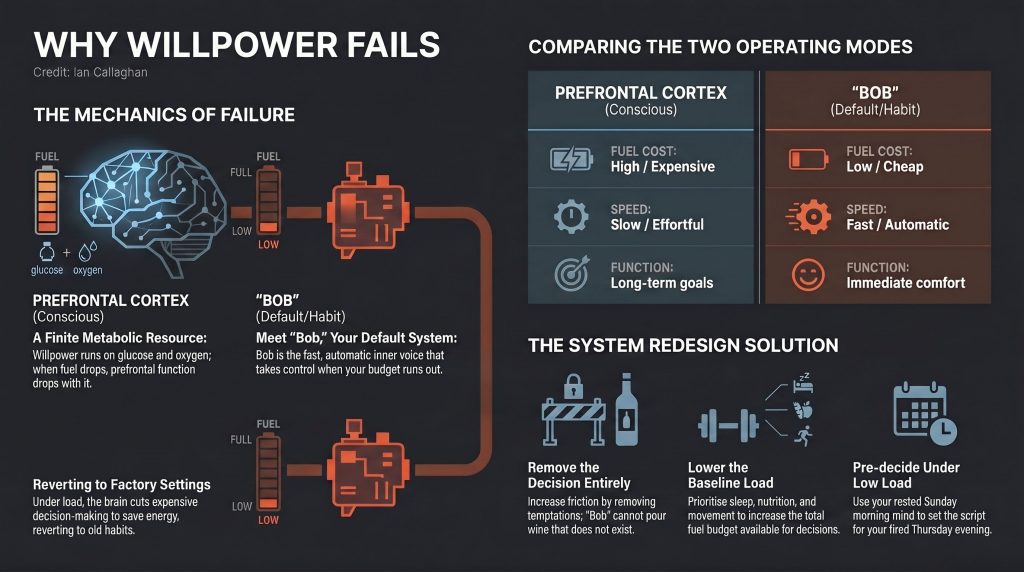
Willpower is real. But it is a finite, depleting resource that runs on the same fuel as everything else your nervous system is trying to do. When the fuel runs out, the system reverts to its default state. That reversion is not a moral failure. It is mechanical. It is the system doing exactly what it was built to do.
This post explains why willpower-based approaches to behaviour change fail predictably, what is actually happening under the hood, and what works instead. Not motivation. Not affirmations. Not finding your why. System redesign.
What willpower actually is and why willpower fails.
Willpower is a metabolic process. The prefrontal cortex, the part of your brain that handles effortful decisions, planning, impulse control, and overriding short-term comfort for long-term outcomes, runs on glucose, oxygen, and a regulated nervous system. When any of those three drops, prefrontal function drops with it.
This is not theoretical. Research on ego depletion and decision fatigue has been around for decades. Roy Baumeister’s lab at Florida State has repeatedly demonstrated that exerting self-control on one task reduces the capacity for self-control on the next task. The original experiments used radishes and cookies. The mechanism applies to every effortful decision you make in a day.
Here is the IT systems analogy that actually maps to what is happening. Willpower is the equivalent of running every process in foreground mode. It works in the short term, but it consumes all the other bandwidth. The longer you run it that way, the closer the whole system gets to thrashing. Eventually, it crashes back to a low-power state.
The body has an obvious fail-safe for this. When fuel drops, when stress is high, when sleep is poor, when blood sugar is dysregulated, the system starts cutting things to stay alive. The first thing it cuts is effortful decision-making, because that is the most expensive process running. It hands the controls back to the older, faster, cheaper pathways. Habit. Default. Whatever you have always done in this situation before.
That is not a bug. It is a survival design. Your nervous system would rather you make a slightly suboptimal choice than burn through your last reserves trying to make the perfect one. The problem is that, in modern life, the slightly suboptimal choice is the second drink. Or the takeaway. Or the doomscroll. Or the missed gym session. Or the argument with your partner that you knew you could have walked away from.
You did not lose willpower because you are weak. You lost it because the budget ran out, and the system rebooted to factory settings.
The Emotional Observation Method, briefly
The framework that explains all of this properly is the Emotional Observation Method. EOM for short. EOM treats every destructive behaviour as the predictable output of a system under load. Not as a moral failing. Not as a personality flaw. Not as evidence that you are broken. As a mechanical consequence.
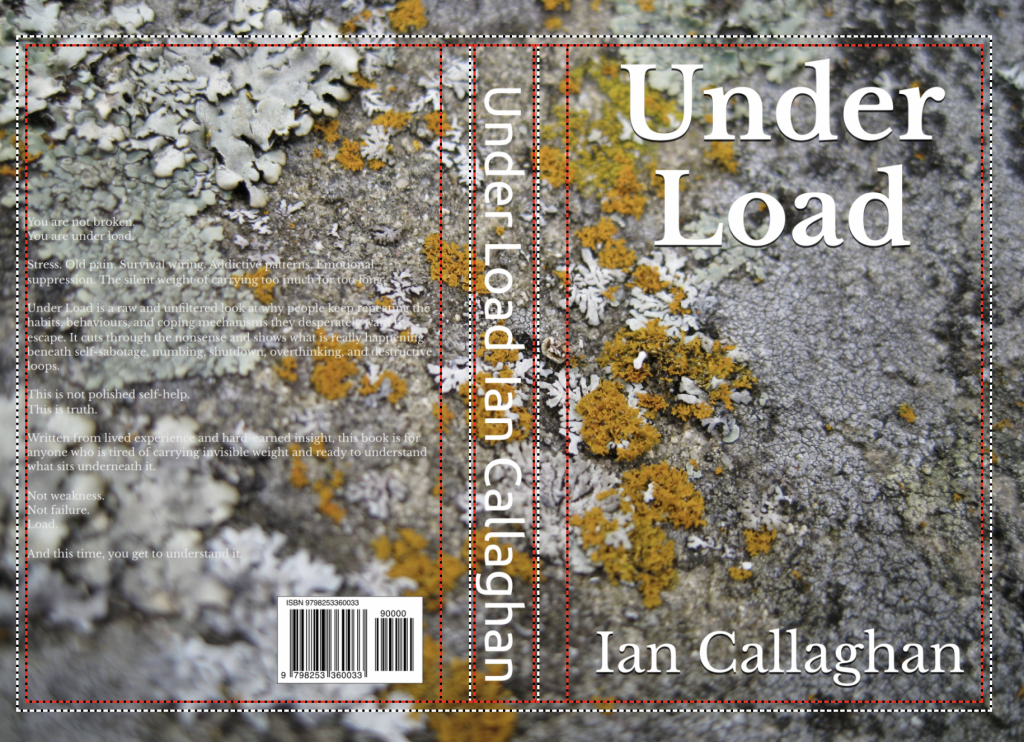
Under Load is the book that lays out EOM in full across seven parts and thirty-four chapters. The summary version follows here, focused on the willpower question.
EOM starts from a basic premise. A human being is a system. Like any system, it has a baseline state, a capacity, and a load. The baseline is what happens when nothing is asking anything of you. Capacity is how much load it can carry before something gives way. The load is everything currently drawing on your fuel reserves: stress, poor sleep, blood sugar dysregulation, emotional pressure, low-grade chronic fear, unresolved relationship friction, work demands, financial worry, the hundred small decisions you make each day that you do not even register.
Willpower draws from the same fuel reserve as all of those.
When the load exceeds capacity, the system starts cutting things. The expensive, effortful, prefrontal-cortex-driven processes go first. The cheap, automatic, limbic-system-driven processes take over. That is when the second drink happens. That is when the new habit collapses. That is when you do the thing you swore you would not do at 9 am.
The wanting is intact. You still want the change. The fuel is gone.
Meet Bob
EOM identifies several recurring constructs that govern how the system behaves under load. The most important one is Bob.
Bob is the inner voice. The part of you that runs default behaviours when the rest of you is offline. Not a trauma response. Not a wounded child. Not anything mystical. Just the cheap, fast, automatic version of you that takes the controls when the expensive, effortful, prefrontal version runs out of fuel.
Bob has a job. The job is to keep the system running on autopilot when conscious control is unavailable. He does this by reaching for whatever has worked before. Whatever delivered relief, dopamine, calm, distraction, comfort. He does not care whether the thing is good for you in the long term. He cares about now. About getting through the next ten minutes without expending fuel the system does not have to spare.
Bob is excellent at his job. The wine pours itself. The takeaway gets ordered. The phone is in your hand, and you are scrolling before you decide to do any of it. That is Bob. He is fast and efficient, operating below the threshold of conscious awareness. By the time you “decide” to do the thing, the decision has already been made. You are watching yourself execute it.
When your prefrontal cortex is fully fuelled and online, you can override Bob. You can notice the urge, pause, and choose differently. You can have the conversation. You can skip the wine. You can cook the proper meal.
When the fuel runs out and prefrontal function drops, Bob takes the controls without asking. Bob is not bad at his job. He is brilliant at it. The job just isn’t what adult life actually requires most of the time.
The fix is not silencing Bob. You cannot silence the inner voice. He is older than your conscious mind, and he has root access to the operating system. The fix is keeping the rest of the system fuelled enough that Bob does not get unsupervised access to the controls. That is most of what behaviour change actually is.
Why most advice fails
Now you can see why most behaviour-change advice predictably fails.
Most programmes assume willpower is renewable on demand. They assume you can “just decide” to do the difficult thing every day for the rest of your life. They assume motivation is a stable feature of your psychology rather than a metabolic state that varies with sleep, food, stress, and load. They are asking you to spend a finite resource forever and treating you as a failure when the resource runs out.
12-step programmes work for some people partly because the community substitutes for the depleted internal regulation. When you cannot self-regulate, the meeting regulates you. The sponsor regulates you. The fellowship regulates you. That is a partial fix that depends on attendance. Stop attending, and the regulation goes with it. This is why people relapse after years of sobriety, the moment life pulls them away from the rooms.
“More motivation” advice is even worse. It assumes the problem is upstream of willpower. It is not. Motivation, the felt sense of wanting to do the thing, is itself a metabolic state. You have plenty of it on a well-rested Tuesday morning. You have none of it on a stressed-out Thursday evening. Trying to manufacture motivation in a depleted system is asking the empty tank to refill itself.
The honest version is uncomfortable. Any sustainable change requires either reducing the load on the system so willpower lasts longer, or removing the need for willpower in the relevant decisions, or both. Trying to power through with willpower alone will fail. Not because you are weak. Because the maths do not work.
What works instead
System redesign over willpower expenditure. Five mechanisms that work without burning fuel:
1. Removing the decision entirely
If the wine is in the house, you have to use willpower not to drink it every time you walk past the kitchen. If the wine is not in the house, the decision is made once at the supermarket, and that’s it. The same logic applies to ultra-processed food, scrolling apps, and anything you reach for under load. Friction up. Defaults down. Bob cannot pour wine that does not exist.
2. Reducing the system load
Better sleep, regulated blood sugar, less chronic stress, fewer micro-decisions. Every reduction in baseline load increases the budget available for the decisions that genuinely require willpower. Most people are running on a depleted system, permanently, and then wonder why they have nothing left for the moments that matter. Sleep first. Food second. Movement third. Mind fourth. The four pillars of any reset that actually hold.
3. Pre-deciding under low load
The decision to skip the work drinks should be made on Sunday morning when you are rested and clear, not on Thursday evening when you are tired and your colleague is offering you a pint. By the time you are standing at the bar, the willpower budget is too low to make a good call. Under low load, future-you decides for tired-you. Tired, you execute the script.
4. Building automaticity
Repetition until the new behaviour becomes the default. Once a behaviour is automatic, it leaves the willpower budget entirely. Brushing your teeth at night does not draw on willpower. Going for a run on autopilot at 7 am does not draw on willpower. The investment is in the build phase. Six to twelve weeks of conscious effort, and then the system runs it for free. This is why people who have been sober for years stop white-knuckling it at some point. The new behaviour is now the default.
5. Working with the nervous system, not against it
Breath, cold exposure, movement, rest. These are not optional wellness extras. They are system maintenance. A regulated nervous system has more fuel available for everything else. A dysregulated nervous system runs on cortisol fumes and burns through willpower in hours.
This is what EOM is built around. Not “try harder.” Not “want it more.” System redesign that removes the load and reduces the need for willpower in the first place.
The honest limit
Willpower still has a place. It is the bridge across the worst moments. It is the override switch when the system is failing, and you need a few hours of conscious control to get to the other side. It is the thing that gets you to the meeting, makes the phone call, and gets you to walk past the off-licence on the worst day. It matters.
The mistake is treating it as the primary engine instead of the emergency lever.
An adult life run mostly on willpower is exhausting and unstable. You spend every day depleting yourself trying to override defaults that should not be running in the first place. Eventually, the system breaks down, and Bob takes the controls for a week, and you are back where you started, wondering what is wrong with you.
An adult life run on system design, with willpower as a backup, is sustainable. The defaults are correct. The load is managed. Bob still runs the things he is good at, like keeping you alive and breathing, but he does not get to make the decisions that require a fully fuelled prefrontal cortex.
That is what the work is. Not stronger willpower. Better system design.
Where to go next
The full framework is under load. Seven parts, thirty-four chapters. Why do human beings keep doing the things that are destroying them, and how can they take back control? The eBook includes AI Ian, a trained companion built on the full EOM framework. Read the full Under Load page →
If you want to apply EOM directly to your own situation in real time, book a 1:1 session →. Sessions are where the framework gets applied to your actual nervous system, your actual defaults, your actual load.
If you want a structured starting point before going deep, The 30 Day Reset is built around the four pillars (Eat, Sleep, Move, Mind) that reduce system load enough for behaviour change actually to stick. Browse the catalogue →
Frequently asked questions
Is willpower a real thing or a myth?
Willpower is real. The myth is that it is unlimited. It is a finite, depleting resource that runs on the same fuel as the rest of your nervous system. When you exert self-control on one decision, you have less available for the next one. This is not a personality trait. It is a metabolic process. The strongest-willed person on the planet runs out of willpower if you deplete their sleep, food, and regulated nervous system enough.
How much willpower do I have per day?
There is no fixed number. Willpower capacity varies day to day depending on sleep quality, blood sugar, stress levels, emotional load, and how well your nervous system is regulated. A well-rested person with stable blood sugar and a calm baseline has significantly more available willpower than the same person after a stressful week, poor sleep, and processed food. The question is not how to maximise willpower. The question is how to need less of it in the first place.
Why do I always slip up in the evenings?
Because that is when the willpower budget is lowest, you have spent the day making decisions, managing emotions, dealing with people, and navigating work pressure. By 7 pm, the prefrontal cortex is depleted, and Bob is running the show. Bob has the same 7 pm defaults he’s had your entire life: the wine, the takeaway, the scroll, the avoided conversation. Evenings are not your weakness. Evenings are when the system runs out of fuel and reverts to default. Fix the upstream load, and the evenings get easier almost automatically.
Does motivation help if willpower runs out?
Motivation is itself a metabolic state. It runs on the same fuel as willpower. You cannot manufacture motivation in a depleted system any more than you can manufacture willpower. This is why “find your why” advice fails so consistently. The why is intact. The fuel to act on the why is gone. What helps is reducing the load on the system so that motivation is available when you need it, rather than trying to grit your teeth through a depleted state and pretend you are inspired.
What is the Emotional Observation Method?
The Emotional Observation Method, EOM for short, is a framework that treats every destructive behaviour as the predictable output of a system under load. Not as a moral failing. Not as a personality flaw. As a mechanical consequence. EOM identifies the constructs that govern how the system behaves under load, including Bob (the part of you that runs default behaviours when the rest of you is offline), and provides a system redesign approach to behaviour change that does not depend on willpower as the primary engine. The full framework is in the book Under Load.
How do I stop relying on willpower for sobriety?
By redesigning the system so that willpower is not required for the daily decisions. Remove the alcohol from the house. Reduce the chronic stress that drives the craving. Improve sleep and blood sugar regulation. Build the new habits to automaticity over six to twelve weeks. Work with your nervous system through breath, movement, and cold exposure rather than fighting against it. Pre-decide on low-load days for high-load moments. Willpower remains the emergency lever for the worst nights, but it is no longer the engine driving every decision. Sustainable sobriety is a system design problem, not a willpower problem.
Ian Callaghan is a British Army veteran, NLP Master Practitioner, Reiki Master, and creator of the Emotional Observation Method. He spent 45 years drinking before stopping on the Winter Solstice 2024. Author of Under Load and the Uncovering Truths series. He works globally via video call and writes from Goytre, Monmouthshire.
Used to monitor number of Google Analytics server requests when using Google Tag Manager
1 minute
_gid
ID used to identify users for 24 hours after last activity
24 hours
_ga_
ID used to identify users
2 years
_gali
Used by Google Analytics to determine which links on a page are being clicked
30 seconds
_ga
ID used to identify users
2 years
__utmx
Used to determine whether a user is included in an A / B or Multivariate test.
18 months
__utmv
Contains custom information set by the web developer via the _setCustomVar method in Google Analytics. This cookie is updated every time new data is sent to the Google Analytics server.
2 years after last activity
__utmz
Contains information about the traffic source or campaign that directed user to the website. The cookie is set when the GA.js javascript is loaded and updated when data is sent to the Google Anaytics server
6 months after last activity
__utmc
Used only with old Urchin versions of Google Analytics and not with GA.js. Was used to distinguish between new sessions and visits at the end of a session.
End of session (browser)
__utmb
Used to distinguish new sessions and visits. This cookie is set when the GA.js javascript library is loaded and there is no existing __utmb cookie. The cookie is updated every time data is sent to the Google Analytics server.
30 minutes after last activity
__utmt
Used to monitor number of Google Analytics server requests
10 minutes
__utma
ID used to identify users and sessions
2 years after last activity
_gac_
Contains information related to marketing campaigns of the user. These are shared with Google AdWords / Google Ads when the Google Ads and Google Analytics accounts are linked together.